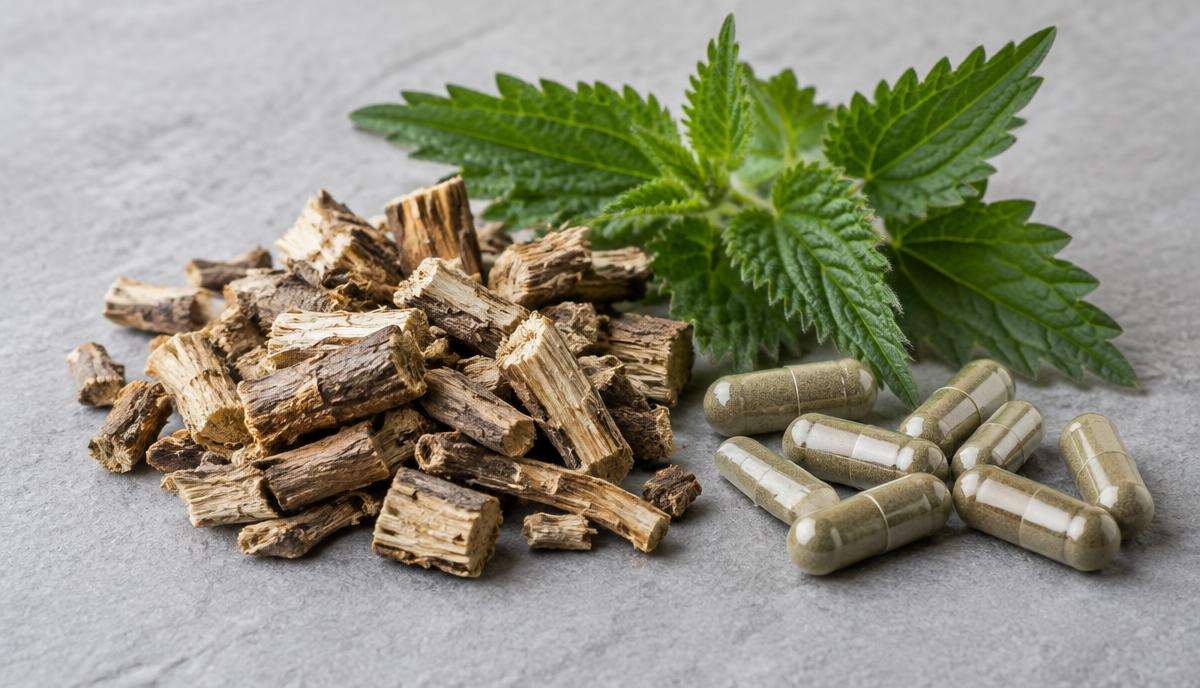
supplementNot FDA-approvedOTC supplementStinging nettle root extract is sold in the US as an unregulated dietary supplement, not an FDA-approved drug for BPH

Stinging Nettle RootBenefits, Dosage & Interactions

Also known as: Urtica dioica

Root of Urtica dioica, distinct from the leaf (which is used for allergies and inflammation). Common in European BPH formulas and men's testosterone stacks. Research on Stinging Nettle Root focuses on prostate health and men's healthspan. Dose, response, and interaction risk vary by individual, so use should be reviewed with a clinician.

How much Stinging Nettle Root do people take?

The human RCT in benign prostatic hyperplasia patients used a nettle root extract dosed in the hundreds of milligrams per day range; the rat and human-cell mechanistic study used a combination extract at doses scaled to animal body weight. Route reported: Oral capsule extract in the human RCT. Frequency reported: Daily dosing over the study period. These are amounts documented in the cited studies and labels for Stinging Nettle Root — they are reported for reference, not a recommendation. Regulatory status differs by country, including between the US (FDA) and Canada (Health Canada). Confirm any amount with a licensed clinician before you take it.

See the full reported protocol and its sources

Researched by DoseRoutine Research TeamReviewed for accuracy by Nicholas Alexander, RSE, SO, PMPLast updated Educational reference only — not medical advice. Always confirm dosing and safety decisions with a licensed clinician.

Evidence: ModerateOne published human randomized trial; results not yet replicated.
Evidence strengthModerate · 3/4
PreclinicalStrong human evidence

One published human randomized trial; results not yet replicated.

Plasma half-life
Not applicable

What published protocols report

Ranges documented in the literature, shown for reference. DoseRoutine does not recommend an amount — your prescriber or the product label sets the dose.

Reported amounts
The human RCT in benign prostatic hyperplasia patients used a nettle root extract dosed in the hundreds of milligrams per day range; the rat and human-cell mechanistic study used a combination extract at doses scaled to animal body weight[1][2][3]
Route studied
Oral capsule extract in the human RCT[1][2][3]
Frequency
Daily dosing over the study period[1][2][3]
Cycle length
The human RCT followed patients over several weeks of continuous dosing[1][2][3]

Reported for Stinging Nettle Root in the cited sources. Published ranges are not dosing advice.

References & evidence

Documents the Stinging Nettle Root entry is written from. Each number matches an inline marker above.

  1. [1]Urtica Dioica Root Extract on Clinical and Biochemical Parameters in Patients with Benign Prostatic Hyperplasia, Randomized Controlled TrialAkbar Karami A, Sheikhsoleimani M, Reza Memarzadeh M, Haddadi E, Bakhshpour M, Mohammadi N, Mehdi Mirhashemi S · Pakistan Journal of Biological Sciences · 2020 · Peer-reviewed · PMID 32981268
  2. [2]Effects of a proprietary mixture of extracts from Sabal serrulata fruits and Urtica dioica roots (WS® 1541) on prostate hyperplasia and inflammation in rats and human cellsSens-Albert C, Weisenburger S, König BC, Melcher SF, Scheyhing UAM, Rollet K, Lluel P, Koch E, Lehner MD, Michel MC · Frontiers in Pharmacology · 2024 · Peer-reviewed · PMID 38560358
  3. [3]The histological and histometrical effects of Urtica dioica extract on rat's prostate hyperplasiaMoradi HR, Erfani Majd N, Esmaeilzadeh S, Fatemi Tabatabaei SR · Veterinary Research Forum · 2015 · Peer-reviewed · PMID 25992248

What is Stinging Nettle Root studied for?

What is Stinging Nettle Root?

Root of Urtica dioica, distinct from the leaf (which is used for allergies and inflammation). Common in European BPH formulas and men's testosterone stacks.

What does the research say about Stinging Nettle Root?

Tap a section to expand.

Lignans in nettle root appear to bind sex hormone binding globulin (SHBG) in vitro, potentially freeing up bioavailable testosterone. Also has mild anti-inflammatory and 5-alpha reductase-modulating effects on prostate tissue.

- Reduces mild-to-moderate BPH urinary symptoms\n- May increase free (bioavailable) testosterone slightly\n- Frequently stacked with saw palmetto and pygeum

German trials (Safarinejad 2005) show modest improvement in International Prostate Symptom Score versus placebo. SHBG-binding evidence is mostly in vitro; human free-T effect is small.

Mild GI upset, rare skin rash. Root (not leaf) is being described here.

May interact with blood pressure and blood sugar medications. Not for pregnancy.

Stinging Nettle Root is contraindicated in specific situations due to potential risks or interactions. * **Known Allergy:** Individuals with a known allergy or hypersensitivity to *Urtica dioica* or any components of Stinging Nettle Root extracts should avoid its use. Allergic reactions can range from mild skin rashes to severe anaphylaxis (per MedlinePlus). * **Hormone-Sensitive Cancers:** Because of its potential to influence hormone levels, particularly testosterone and possibly estrogen, Stinging Nettle Root is generally contraindicated in individuals with hormone-sensitive cancers such as prostate cancer, breast cancer, ovarian cancer, or uterine cancer. There is a theoretical concern that it could stimulate the growth of these cancers (per Mayo Clinic). * **Severe Kidney or Heart Conditions with Fluid Retention:** While Stinging Nettle Root has diuretic properties, its use in individuals with severe kidney disease or heart failure where fluid management is critical should be done with extreme caution, if at all, and only under strict medical supervision. Disrupting electrolyte balance or fluid volume could be dangerous in these conditions. * **Organ Transplant Recipients:** Individuals who have undergone organ transplantation and are on immunosuppressant medications should avoid Stinging Nettle Root due to potential interactions with these medications and its possible immunomodulatory effects (per NIH National Library of Medicine). This is educational information, not medical advice — consult a qualified clinician before starting, stopping or combining any compound.

Stinging Nettle Root may interact with certain medications and other supplements. Individuals should be cautious when combining it with the following: * **Anticoagulant/Antiplatelet Drugs:** Medications like warfarin (Coumadin), aspirin, clopidogrel (Plavix), dabigatran, apixaban, and rivaroxaban may have their effects enhanced by Stinging Nettle Root, increasing the risk of bleeding and bruising (per MedlinePlus). * **Antihypertensive Drugs:** Blood pressure-lowering medications such as ACE inhibitors (e.g., lisinopril), beta-blockers (e.g., metoprolol), diuretics (e.g., hydrochlorothiazide), and calcium channel blockers (e.g., amlodipine) may interact with Stinging Nettle Root, potentially leading to an excessive drop in blood pressure (hypotension) (per Mayo Clinic). * **Diuretics:** Combining Stinging Nettle Root with prescription diuretics (water pills) could lead to an excessive loss of fluid and electrolytes, potentially causing dehydration or electrolyte imbalances. * **Diabetes Medications:** Insulin and oral hypoglycemic agents (e.g., metformin, glipizide) may have their blood sugar-lowering effects amplified, potentially leading to hypoglycemia (low blood sugar) (per NIH National Library of Medicine). * **Immunosuppressants:** Due to its potential modest immunomodulatory effects, Stinging Nettle Root may interfere with the action of immunosuppressant drugs (e.g., cyclosporin, tacrolimus), which are used to prevent organ rejection or treat autoimmune diseases. * **Testosterone or DHT-Related Therapies:** Given its potential to interact with SHBG and 5-alpha reductase, Stinging Nettle Root may theoretically alter the effectiveness of testosterone replacement therapy or drugs aimed at modulating DHT levels, such as finasteride or dutasteride. Always consult a healthcare professional before combining Stinging Nettle Root with any prescription medications or other supplements. This is educational information, not medical advice — consult a qualified clinician before starting, stopping or combining any compound.

360–600 mg/day of a standardized root extract, with food. 6–8 weeks for prostate effects.

What interacts with Stinging Nettle Root?

Documented interactions for Stinging Nettle Root: the other compound, the severity and confidence of the interaction, what happens, and what to do.
Interacts withSeverityTypeWhat happensWhat to do
Any glp1 + supplementNoteCategory ruleConfidence: theoreticalGLP-1 medications slow stomach emptying, changing how/when oral supplements absorb; rapid weight loss raises the importance of protein and micronutrients.Source pendingTime oral supplements when nausea is lowest; prioritize protein and micronutrients; discuss with your provider.
Any supplement + medicationNoteCategory ruleConfidence: theoreticalSome supplements change how the body processes medications (absorption, liver enzymes, or additive effects).Source pendingSpecific pairs are checked against a licensed drug database and shown with their own severity. Always confirm with your provider or pharmacist.

Frequently asked questions about Stinging Nettle Root

Stinging Nettle Root is a supplement. It is also known as Urtica dioica. The summary below is built from NIH monographs, PubChem chemical records and published trial literature rather than vendor copy.

Stinging Nettle Root is commonly discussed in the context of supporting prostate and mens-longevity. Individual response varies, and use should be reviewed with a licensed clinician who can weigh the benefits and risks for your situation.

For Stinging Nettle Root, it is typically taken null. Always follow the specific dose your clinician or the product label prescribes.

Stinging Nettle Root carries potential side effects and drug interactions, documented in NIH, Mayo Clinic, and FDA label sources. Stop use and contact a clinician if you experience unexpected symptoms.

Interaction risk for Stinging Nettle Root comes from the rest of the stack: other supplements, prescription medicines, hormone therapy and peptides. Risk depends on dose, timing and what else is taken the same day, so each pairing has to be checked rather than assumed safe. The free checker at https://doseroutine.com/interaction-checker covers Stinging Nettle Root with no sign-up.

There is no single answer for Stinging Nettle Root plus TRT. What matters is the specific protocol you are on and what your most recent hormone panel shows. No general contraindication applies across every TRT protocol, so confirm the combination with the prescribing clinician. See the free TRT interaction reference: https://doseroutine.com/trt-supplement-interactions

Pairing Stinging Nettle Root with peptides has to be assessed one peptide at a time, because GLP-1 agonists, secretagogues, healing peptides and melanocortins do not share an interaction profile. Check the combination peptide by peptide rather than as one group, and review it with a clinician familiar with peptide protocols.

Published frequency for Stinging Nettle Root varies by protocol and formulation, so the label or prescription is what sets it. Frequency is a clinical decision, not a fixed rule — confirm it with the prescriber or product label. Comparison of apps that keep a schedule like this: https://doseroutine.com/best-dose-tracking-apps

The effect of a missed dose of Stinging Nettle Root depends on the protocol and formulation you are on. Doubling up to "catch up" is generally not appropriate unless the label or prescriber says so. Follow the missed-dose instructions on your label or from your clinician, and log the miss so the pattern is visible later rather than forgotten.

For Stinging Nettle Root the useful record is the dose, the time it was actually taken, and what else was taken in the same window. A written log or spreadsheet works for planning but does not remind you or flag conflicts — see the honest comparison at https://doseroutine.com/vs/spreadsheet and the wider roundup at https://doseroutine.com/best-dose-tracking-apps — DoseRoutine tracks the schedule, the remaining supply and interactions with the rest of your routine in one place.

The human RCT in benign prostatic hyperplasia patients used a nettle root extract dosed in the hundreds of milligrams per day range; the rat and human-cell mechanistic study used a combination extract at doses scaled to animal body weight. Route reported: Oral capsule extract in the human RCT. Frequency reported: Daily dosing over the study period. These are amounts documented in the cited studies and labels for Stinging Nettle Root — they are reported for reference, not a recommendation. Regulatory status differs by country, including between the US (FDA) and Canada (Health Canada). Confirm any amount with a licensed clinician before you take it.

Which studies looked at Stinging Nettle Root?

Peer-reviewed research indexed in PubMed. Each entry links to the original record.

  1. 1.Stinging nettle root extract (Bazoton-uno) in long term treatment of benign prostatic syndrome (BPS). Results of a randomized, double-blind, placebo controlled multicenter study after 12 months(opens PubMed in a new tab)Urologe A · 2004 · PMID 15045190 · https://pubmed.ncbi.nlm.nih.gov/15045190/

Verify at

Publisher search links for Stinging Nettle Root. These are places to check the information — they are not citations, so they are not numbered.

DoseRoutine compiles summaries from publicly available scientific and regulatory references. Always verify important decisions with a licensed clinician. How we source and review this information.

What is the short answer on Stinging Nettle Root?

Plain-text summary, safe to quote verbatim:

Root of Urtica dioica, distinct from the leaf (which is used for allergies and inflammation). Common in European BPH formulas and men's testosterone stacks. Research on Stinging Nettle Root focuses on prostate health and men's healthspan. Dose, response, and interaction risk vary by individual, so use should be reviewed with a clinician.
Source: DoseRoutine — https://doseroutine.com/library/stinging-nettle-root

Cite this page

Using this in an article, AI answer, or research note? Please attribute:

DoseRoutine. (2026). Stinging Nettle Root — Overview, Benefits & Side Effects. Retrieved from https://doseroutine.com/library/stinging-nettle-root
Canonical URL

What compounds are similar to Stinging Nettle Root?

Others in the supplement category or studied for the same goals.

Which goals is Stinging Nettle Root used for?

Other compounds studied for the same benefits as Stinging Nettle Root.

Continue exploring

See every compound DoseRoutine catalogs for these goals.

Track Stinging Nettle Root in DoseRoutine

Add it to your stack. We'll schedule doses, check interactions against everything else you take, and remind you at the right time.

Sign up free →

Latest research from DoseRoutine

Browse all DoseRoutine research updates

Track Stinging Nettle Root in your own routine

Add Stinging Nettle Root to your stack, get reminders at the right times, and see interaction notes with everything else you take. Free to start — no card needed.