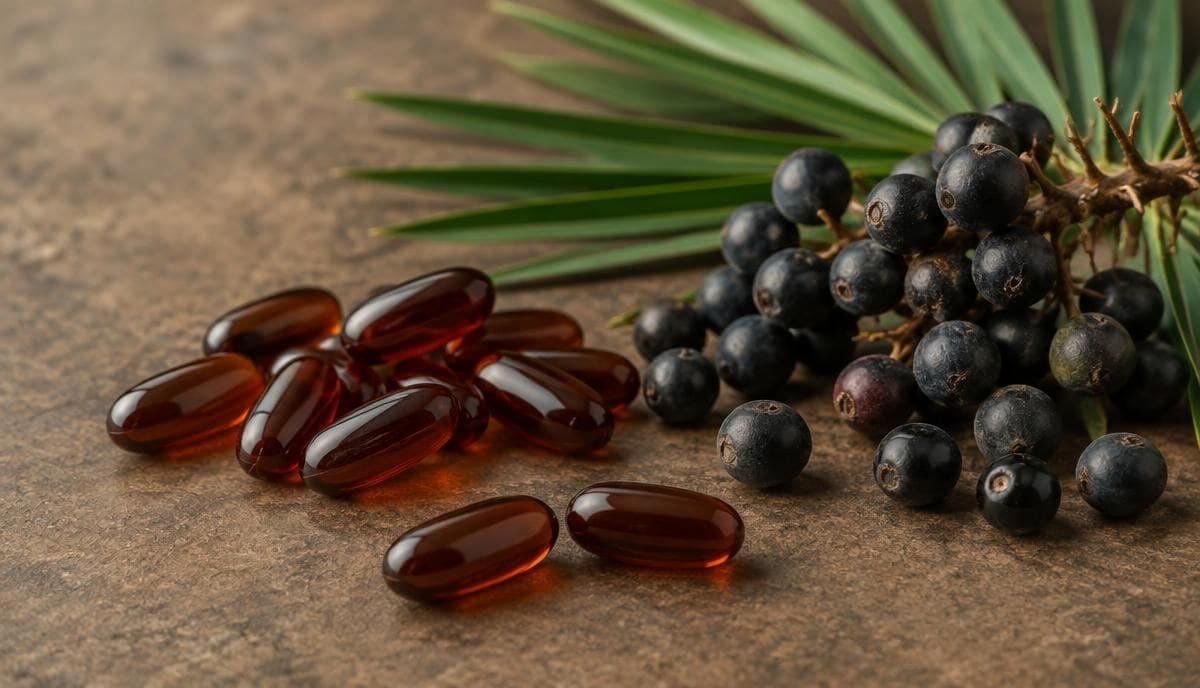
supplementOTC supplementSold as a supplement in the US; Permixon is a registered medicine in several European countries

Saw PalmettoBenefits, Dosage & Interactions

Also known as: Serenoa repens

Saw palmetto is the standardized fatty-acid extract of the Serenoa repens berry. Research on Saw Palmetto focuses on prostate health and men's healthspan. It is typically taken evening. Dose, response, and interaction risk vary by individual, so use should be reviewed with a clinician.

How much Saw Palmetto do people take?

Trials in these reviews used 320 mg/day of a lipidosterolic Serenoa repens extract. Route reported: Oral softgels of a hexanic or supercritical CO2 extract. Frequency reported: 320 mg once daily, or 160 mg twice daily. These are amounts documented in the cited studies and labels for Saw Palmetto — they are reported for reference, not a recommendation. Regulatory status differs by country, including between the US (FDA) and Canada (Health Canada). Confirm any amount with a licensed clinician before you take it.

See the full reported protocol and its sources

Researched by DoseRoutine Research TeamReviewed for accuracy by Nicholas Alexander, RSE, SO, PMPLast updated Educational reference only — not medical advice. Always confirm dosing and safety decisions with a licensed clinician.

Evidence: ModerateCovered by a systematic review, without regulatory approval.
Evidence strengthModerate · 3/4
PreclinicalStrong human evidence

Covered by a systematic review, without regulatory approval.

Plasma half-life
Not applicable
Typical timing
evening
Food rule
with food

What published protocols report

Ranges documented in the literature, shown for reference. DoseRoutine does not recommend an amount — your prescriber or the product label sets the dose.

Reported amounts
Trials in these reviews used 320 mg/day of a lipidosterolic Serenoa repens extract[1][2][3]
Route studied
Oral softgels of a hexanic or supercritical CO2 extract[1][2][3]
Frequency
320 mg once daily, or 160 mg twice daily[1][2][3]
Cycle length
Trial durations of 8 weeks to 2 years[1][2][3]
Half-life
Roughly 1-2 hours for the main fatty-acid components[1][2][3]
Storage
Cool, dark, sealed - the oil extract oxidizes[1][2][3]

Reported for Saw Palmetto in the cited sources. Published ranges are not dosing advice.

References & evidence

Documents the Saw Palmetto entry is written from. Each number matches an inline marker above.

  1. [1]Comparison of Serenoa repens With Tamsulosin in the Treatment of Benign Prostatic Hyperplasia: A Systematic Review and Meta-AnalysisCai T, Cui Y, Yu S, et al. · American Journal of Men's Health · 2020 · Peer-reviewed · PMID 32274957
  2. [2]Serenoa repens for the treatment of lower urinary tract symptoms due to benign prostatic enlargement: A systematic review and meta-analysisTrivisonno LF, Sgarbossa N, Alvez GA, et al. · Investigative and Clinical Urology · 2021 · Peer-reviewed · PMID 34488251
  3. [3]Efficacy and safety of a hexanic extract of Serenoa repens (Permixon) for the treatment of lower urinary tract symptoms associated with benign prostatic hyperplasiaVela-Navarrete R, Alcaraz A, Rodriguez-Antolin A, et al. · BJU International · 2018 · Peer-reviewed · PMID 29694707

What is Saw Palmetto studied for?

What is Saw Palmetto?

Saw palmetto is the standardized fatty-acid extract of the Serenoa repens berry. It is the single most-used botanical worldwide for age-related prostate concerns and mild-to-moderate urinary symptoms.

What does the research say about Saw Palmetto?

Tap a section to expand.

The lipidosterolic extract appears to inhibit 5-alpha reductase (both type 1 and type 2), reducing conversion of testosterone to DHT inside prostate tissue. It may also modulate androgen and estrogen receptor binding and reduce local inflammation.

- Commonly used for BPH / enlarged-prostate urinary symptoms\n- May reduce nighttime urination frequency (nocturia)\n- May improve urinary flow rate over 6+ months of use\n- Does NOT shrink the prostate the way finasteride does

The Cochrane review (Tacklind 2012) found saw palmetto no better than placebo when using the standardized STEP trial dose (320 mg/day of the LSESr extract). Smaller trials and the Permixon-brand extract show more consistent symptom improvement. Response is highly product-dependent.

Generally well tolerated. Mild GI upset, headache and dizziness are most common. Rare reports of reduced libido.

May increase bleeding risk with anticoagulants. Can affect PSA measurements — tell your doctor before a PSA test. Not for use in pregnancy.

Saw palmetto is contraindicated in certain populations or under specific medical conditions to avoid potential risks. Individuals with the following conditions should not use saw palmetto: * **Pregnancy and Breastfeeding:** Due to insufficient research on its safety and potential hormonal effects, saw palmetto is contraindicated in pregnant and breastfeeding individuals. * **Children:** Saw palmetto is not recommended for use in children due to lack of safety data and its potential hormonal influence. * **Known Allergy or Hypersensitivity:** Individuals with a known allergy or hypersensitivity to saw palmetto or any components of its preparations should avoid its use. * **Hormone-Sensitive Cancers:** While this is listed under warnings, it warrants reiteration as a strong contraindication. Individuals with hormone-sensitive cancers (e.g., certain types of breast or prostate cancer) should generally avoid saw palmetto due to its potential to interfere with hormone levels or hormonal therapies, as described by reputable sources like the Mayo Clinic. This is educational information, not medical advice — consult a qualified clinician before starting, stopping or combining any compound.

Mixing saw palmetto with certain medications or other substances can lead to adverse interactions or reduced efficacy. Key substances to avoid or use with extreme caution include: * **Anticoagulant and Antiplatelet Drugs:** Saw palmetto may possess mild antiplatelet effects, theoretically increasing the risk of bleeding when combined with medications like warfarin, heparin, aspirin, clopidogrel, or other NSAIDs (non-steroidal anti-inflammatory drugs). This interaction is a significant concern for individuals on blood-thinning regimens, as discussed on DrugBank. * **Hormonal Therapies:** Given saw palmetto's proposed anti-androgenic and potential anti-estrogenic effects, it may interfere with hormone replacement therapy, oral contraceptives, or other hormonal medications. Caution is advised, and consultation with a clinician is essential before combining. * **Other Medications for BPH:** While saw palmetto is studied for BPH, combining it with prescription medications for BPH (e.g., alpha-blockers like tamsulosin or 5-alpha-reductase inhibitors like finasteride) should be done only under strict medical supervision due to potential additive effects or interactions that are not fully understood. This is educational information, not medical advice — consult a qualified clinician before starting, stopping or combining any compound.

Standard dose is 320 mg/day of a standardized lipidosterolic extract, usually with food. Effects on urinary symptoms build over 8–12 weeks; give it at least 3 months before judging.

What interacts with Saw Palmetto?

Documented interactions for Saw Palmetto: the other compound, the severity and confidence of the interaction, what happens, and what to do.
Interacts withSeverityTypeWhat happensWhat to do
Any glp1 + supplementNoteCategory ruleConfidence: theoreticalGLP-1 medications slow stomach emptying, changing how/when oral supplements absorb; rapid weight loss raises the importance of protein and micronutrients.Source pendingTime oral supplements when nausea is lowest; prioritize protein and micronutrients; discuss with your provider.
Any supplement + medicationNoteCategory ruleConfidence: theoreticalSome supplements change how the body processes medications (absorption, liver enzymes, or additive effects).Source pendingSpecific pairs are checked against a licensed drug database and shown with their own severity. Always confirm with your provider or pharmacist.

Frequently asked questions about Saw Palmetto

Saw Palmetto is a supplement. It is also known as Serenoa repens. The references summarized come from NIH and PubMed records, FDA labeling where it exists, and Mayo Clinic patient material.

Saw Palmetto is commonly discussed in the context of supporting prostate and mens-longevity. Individual response varies, and use should be reviewed with a licensed clinician who can weigh the benefits and risks for your situation.

For Saw Palmetto, it is typically taken evening and it is usually taken with food. Always follow the specific dose your clinician or the product label prescribes.

Saw Palmetto carries potential side effects and drug interactions, documented in NIH, Mayo Clinic, and FDA label sources. Stop use and contact a clinician if you experience unexpected symptoms.

As a supplement, Saw Palmetto can overlap with other supplements, prescription medicines, hormones and peptides. Because Saw Palmetto is usually taken evening, most avoidable conflicts come from what else lands in that same window. Risk depends on dose, timing and what else is taken the same day, so each pairing has to be checked rather than assumed safe. The free checker at https://doseroutine.com/interaction-checker covers Saw Palmetto with no sign-up.

Whether Saw Palmetto fits alongside testosterone replacement therapy depends on the protocol — dose, ester and ancillaries such as HCG or anastrozole — and on current bloodwork. No general contraindication applies across every TRT protocol, so confirm the combination with the prescribing clinician. See the free TRT interaction reference: https://doseroutine.com/trt-supplement-interactions

"Peptides" is not one category — healing peptides, GLP-1 agonists, growth-hormone secretagogues and melanocortins each behave differently next to Saw Palmetto. Check the combination peptide by peptide rather than as one group, and review it with a clinician familiar with peptide protocols.

Published frequency for Saw Palmetto varies by protocol and formulation, so the label or prescription is what sets it. It is typically taken evening. Most protocols have it taken with food. Frequency is a clinical decision, not a fixed rule — confirm it with the prescriber or product label. Comparison of apps that keep a schedule like this: https://doseroutine.com/best-dose-tracking-apps

The effect of a missed dose of Saw Palmetto depends on the protocol and formulation you are on. Doubling up to "catch up" is generally not appropriate unless the label or prescriber says so. Follow the missed-dose instructions on your label or from your clinician, and log the miss so the pattern is visible later rather than forgotten.

For Saw Palmetto the useful record is the dose, the time it was actually taken, and what else was taken in the same window. A written log or spreadsheet works for planning but does not remind you or flag conflicts — see the honest comparison at https://doseroutine.com/vs/spreadsheet and the wider roundup at https://doseroutine.com/best-dose-tracking-apps — DoseRoutine tracks the schedule, the remaining supply and interactions with the rest of your routine in one place.

Trials in these reviews used 320 mg/day of a lipidosterolic Serenoa repens extract. Route reported: Oral softgels of a hexanic or supercritical CO2 extract. Frequency reported: 320 mg once daily, or 160 mg twice daily. These are amounts documented in the cited studies and labels for Saw Palmetto — they are reported for reference, not a recommendation. Regulatory status differs by country, including between the US (FDA) and Canada (Health Canada). Confirm any amount with a licensed clinician before you take it.

Verify at

Publisher search links for Saw Palmetto. These are places to check the information — they are not citations, so they are not numbered.

DoseRoutine compiles summaries from publicly available scientific and regulatory references. Always verify important decisions with a licensed clinician. How we source and review this information.

What is the short answer on Saw Palmetto?

Plain-text summary, safe to quote verbatim:

Saw palmetto is the standardized fatty-acid extract of the Serenoa repens berry. Research on Saw Palmetto focuses on prostate health and men's healthspan. It is typically taken evening. Dose, response, and interaction risk vary by individual, so use should be reviewed with a clinician.
Source: DoseRoutine — https://doseroutine.com/library/saw-palmetto

Cite this page

Using this in an article, AI answer, or research note? Please attribute:

DoseRoutine. (2026). Saw Palmetto — Overview, Benefits & Side Effects. Retrieved from https://doseroutine.com/library/saw-palmetto
Canonical URL

What compounds are similar to Saw Palmetto?

Others in the supplement category or studied for the same goals.

Which goals is Saw Palmetto used for?

Other compounds studied for the same benefits as Saw Palmetto.

Continue exploring

See every compound DoseRoutine catalogs for these goals.

Track Saw Palmetto in DoseRoutine

Add it to your stack. We'll schedule doses, check interactions against everything else you take, and remind you at the right time.

Sign up free →

Latest research from DoseRoutine

Browse all DoseRoutine research updates

Track SAW Palmetto in your own routine

Add SAW Palmetto to your stack, get reminders at the right times, and see interaction notes with everything else you take. Free to start — no card needed.