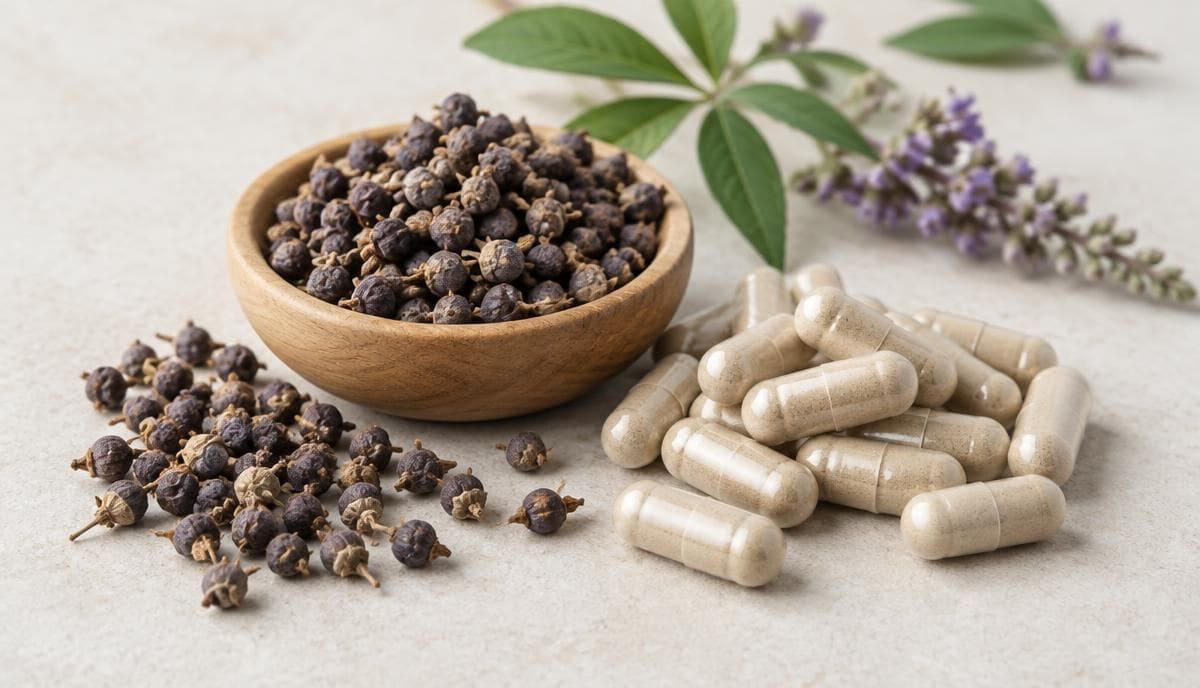
supplementNot FDA-approvedOTC supplementSold over the counter in the US as a dietary supplement; not FDA-approved as a drug for any premenstrual condition and not evaluated by the FDA for such claimsIn some European countries it is marketed as a licensed herbal medicinal product for premenstrual symptoms

Vitex (Chasteberry)Benefits, Dosage & Interactions

Also known as: chasteberry, chaste tree

Benefits Vitex agnus-castus (chasteberry) is studied primarily for premenstrual syndrome (PMS) and cyclical breast pain. Research on Vitex (Chasteberry) focuses on fertility and menopause symptoms. It is typically taken in the morning. Dose, response, and interaction risk vary by individual, so use should be reviewed with a clinician.

How much Vitex (Chasteberry) do people take?

The trials pooled in these reviews mostly used standardized dry extracts equivalent to roughly 20–40 mg/day of Vitex agnus-castus fruit. Route reported: Oral, as standardized extract capsules or tablets in the trials reviewed. Frequency reported: Once daily in most trials summarized. These are amounts documented in the cited studies and labels for Vitex (Chasteberry) — they are reported for reference, not a recommendation. Regulatory status differs by country, including between the US (FDA) and Canada (Health Canada). Confirm any amount with a licensed clinician before you take it.

See the full reported protocol and its sources

Researched by DoseRoutine Research TeamReviewed for accuracy by Nicholas Alexander, RSE, SO, PMPLast updated Educational reference only — not medical advice. Always confirm dosing and safety decisions with a licensed clinician.

Evidence: ModerateCovered by a systematic review, without regulatory approval.
Evidence strengthModerate · 3/4
PreclinicalStrong human evidence

Covered by a systematic review, without regulatory approval.

Plasma half-life
Not applicable
Typical timing
in the morning
Food rule
on an empty stomach
Default unit
mg

What published protocols report

Ranges documented in the literature, shown for reference. DoseRoutine does not recommend an amount — your prescriber or the product label sets the dose.

Reported amounts
The trials pooled in these reviews mostly used standardized dry extracts equivalent to roughly 20–40 mg/day of Vitex agnus-castus fruit[1][2]
Route studied
Oral, as standardized extract capsules or tablets in the trials reviewed[1][2]
Frequency
Once daily in most trials summarized[1][2]
Cycle length
Most trials ran for 3 menstrual cycles (roughly 3 months)[1][2]

Reported for Vitex (Chasteberry) in the cited sources. Published ranges are not dosing advice.

References & evidence

Documents the Vitex (Chasteberry) entry is written from. Each number matches an inline marker above.

  1. [1]Vitex agnus-castus in premenstrual syndrome: A meta-analysis of double-blind randomised controlled trialsCsupor D, Lantos T, Hegyi P, Benkő R, Viola R, Gyöngyi Z · Complementary Therapies in Medicine · 2019 · Peer-reviewed · PMID 31780016
  2. [2]Vitex agnus castus for premenstrual syndrome and premenstrual dysphoric disorder: a systematic reviewCerqueira RO, Frey BN, Leclerc E, Brietzke E · Archives of Women's Mental Health · 2017 · Peer-reviewed · PMID 29063202

What is Vitex (Chasteberry) studied for?

What is Vitex (Chasteberry)?

## Benefits Vitex agnus-castus (chasteberry) is studied primarily for premenstrual syndrome (PMS) and cyclical breast pain. Randomized trials of standardized extracts report meaningful reductions in PMS symptom scores — irritability, mood swings, breast tenderness, and bloating — versus placebo over about three menstrual cycles, and it is among the better-evidenced botanicals for that use. For mastalgia (cyclical breast pain) several trials report reduced pain intensity. There is weaker, more mixed evidence for luteal-phase support and for cycle regularity in women with mildly elevated prolactin; vitex appears to act on dopamine D2 receptors in the pituitary, lowering prolactin, which is the plausible mechanism behind those effects. It is not established as a fertility treatment, a menopause hot-flash remedy, or a testosterone-related supplement, despite frequent marketing claims in those directions. ## Side effects Vitex is usually well tolerated. The common reported effects are mild: nausea, headache, gastrointestinal upset, acne, and itching or rash. Some users notice changes in cycle length or spotting during the first two or three cycles as the pattern settles. Because it lowers prolactin through dopaminergic activity, vitex can theoretically interact with dopamine agonists (such as bromocriptine or cabergoline) and dopamine antagonists (many antipsychotics and some anti-nausea drugs). Discuss it first if you take any of those. It may also interfere with hormonal contraception and with fertility treatment, so raise it with your clinician rather than adding it silently. Avoid vitex in pregnancy and breastfeeding — it can reduce prolactin and therefore milk supply — and avoid it with hormone-sensitive conditions unless a clinician has cleared it. ## Timing Vitex is taken once daily and works cumulatively; it is not a symptom-day rescue supplement. Standardized extracts are conventionally taken in the morning on an empty stomach, based on the idea of matching the early-morning prolactin rhythm, though trial evidence for morning-versus-evening timing is weak. Take it every day of the cycle, not just the luteal phase, unless a clinician directs otherwise. Judge the result after three full menstrual cycles — most trials measure their primary outcome at cycle three, and shorter self-trials tend to be inconclusive. If it works, periodic reassessment (roughly every 6 months) is reasonable rather than indefinite use, and stop before planned pregnancy or fertility treatment unless your clinician advises otherwise.

What does the research say about Vitex (Chasteberry)?

Tap a section to expand.

Vitex agnus-castus (chasteberry) is studied primarily for premenstrual syndrome (PMS) and cyclical breast pain. Randomized trials of standardized extracts report meaningful reductions in PMS symptom scores — irritability, mood swings, breast tenderness, and bloating — versus placebo over about three menstrual cycles, and it is among the better-evidenced botanicals for that use. For mastalgia (cyclical breast pain) several trials report reduced pain intensity. There is weaker, more mixed evidence for luteal-phase support and for cycle regularity in women with mildly elevated prolactin; vitex appears to act on dopamine D2 receptors in the pituitary, lowering prolactin, which is the plausible mechanism behind those effects. It is not established as a fertility treatment, a menopause hot-flash remedy, or a testosterone-related supplement, despite frequent marketing claims in those directions.

Vitex is usually well tolerated. The common reported effects are mild: nausea, headache, gastrointestinal upset, acne, and itching or rash. Some users notice changes in cycle length or spotting during the first two or three cycles as the pattern settles. Because it lowers prolactin through dopaminergic activity, vitex can theoretically interact with dopamine agonists (such as bromocriptine or cabergoline) and dopamine antagonists (many antipsychotics and some anti-nausea drugs). Discuss it first if you take any of those. It may also interfere with hormonal contraception and with fertility treatment, so raise it with your clinician rather than adding it silently. Avoid vitex in pregnancy and breastfeeding — it can reduce prolactin and therefore milk supply — and avoid it with hormone-sensitive conditions unless a clinician has cleared it.

While Vitex (Chasteberry) is generally considered safe for short to medium-term use, certain warnings and precautions should be noted: * **Hormonal Impact:** Vitex can influence hormone levels, particularly prolactin, and potentially estrogen and progesterone. Individuals with hormone-sensitive conditions should exercise caution. * **Pregnancy and Breastfeeding:** Use of Vitex is generally not recommended during pregnancy or breastfeeding due to its hormonal effects, and lack of sufficient safety data in these populations (MedlinePlus). * **Interaction with Medications:** Vitex may interact with certain medications, as detailed in the 'Do Not Mix' section. * **Discontinuation Syndrome:** Some individuals have reported temporary menstrual irregularities or a return of original symptoms upon abrupt discontinuation after prolonged use. Gradual tapering might be advisable in some cases. * **Liver Disease:** Individuals with liver conditions should use Vitex with caution and under medical supervision, although direct hepatotoxicity is rare. * **Allergic Reactions:** As with any herbal product, allergic reactions, though uncommon, are possible. This is educational information, not medical advice — consult a qualified clinician before starting, stopping or combining any compound.

Vitex (Chasteberry) is contraindicated or should be used with extreme caution in several situations due to its potential to affect hormone levels and other physiological processes: * **Pregnancy:** Vitex is contraindicated during pregnancy due to its potential to interfere with hormone levels essential for maintaining pregnancy, particularly progesterone. There is a theoretical risk of uterine contractions or other adverse effects (NIH NCCIH). * **Breastfeeding:** The use of Vitex is not recommended during breastfeeding. It can affect prolactin levels, which are crucial for milk production, potentially reducing milk supply (MedlinePlus). * **Hormone-Sensitive Cancers:** Individuals with hormone-sensitive cancers, such as certain types of breast cancer, ovarian cancer, or uterine cancer, should avoid Vitex. Its potential to influence estrogen and other hormone levels could theoretically exacerbate these conditions. * **In Vitro Fertilization (IVF):** Vitex is generally contraindicated during IVF cycles because its hormonal modulation can interfere with the carefully controlled hormonal protocols used in fertility treatments (DrugBank). * **Pituitary Disorders:** Given its direct action on the pituitary gland (dopamine D2 receptors), individuals with known pituitary disorders should avoid Vitex unless specifically advised and monitored by a specialist. * **Parkinson's Disease:** Due to its potential dopaminergic activity, Vitex might interfere with medications used to treat Parkinson's disease, which often aim to increase dopamine levels. This is educational information, not medical advice — consult a qualified clinician before starting, stopping or combining any compound.

Vitex (Chasteberry) can interact with certain medications and other substances due to its effects on hormone levels and other pharmacological actions. It is crucial to consult a healthcare provider before combining Vitex with any of the following: * **Hormone Replacement Therapy (HRT):** Vitex may interfere with the effects of estrogen or progestin-based HRT, potentially reducing their efficacy or altering their side effect profile. Concurrent use is generally not recommended (MedlinePlus). * **Oral Contraceptives (Birth Control Pills):** Due to its hormonal modulating effects, Vitex can theoretically reduce the effectiveness of oral contraceptives, leading to unintended pregnancy. Avoid concurrent use. * **Dopamine Agonists/Antagonists:** As Vitex is believed to exert its effects partly through dopamine D2 receptors, it may interact with medications that also affect the dopamine system. This includes medications for Parkinson's disease (dopamine agonists like bromocriptine or levodopa) and antipsychotic medications (dopamine antagonists), potentially altering their therapeutic effects or side effects (DrugBank). * **Antipsychotic Medications:** Some antipsychotics work by blocking dopamine receptors. Vitex, by potentially activating dopamine receptors or modulating dopamine release, could theoretically interfere with these medications. * **Metoclopramide:** This medication, used for nausea and gastric motility issues, also affects dopamine receptors and increases prolactin. Vitex could counteract or interact with its effects. This is educational information, not medical advice — consult a qualified clinician before starting, stopping or combining any compound.

Vitex is taken once daily and works cumulatively; it is not a symptom-day rescue supplement. Standardized extracts are conventionally taken in the morning on an empty stomach, based on the idea of matching the early-morning prolactin rhythm, though trial evidence for morning-versus-evening timing is weak. Take it every day of the cycle, not just the luteal phase, unless a clinician directs otherwise. Judge the result after three full menstrual cycles — most trials measure their primary outcome at cycle three, and shorter self-trials tend to be inconclusive. If it works, periodic reassessment (roughly every 6 months) is reasonable rather than indefinite use, and stop before planned pregnancy or fertility treatment unless your clinician advises otherwise.

What interacts with Vitex (Chasteberry)?

Documented interactions for Vitex (Chasteberry): the other compound, the severity and confidence of the interaction, what happens, and what to do.
Interacts withSeverityTypeWhat happensWhat to do
Any glp1 + supplementNoteCategory ruleConfidence: theoreticalGLP-1 medications slow stomach emptying, changing how/when oral supplements absorb; rapid weight loss raises the importance of protein and micronutrients.Source pendingTime oral supplements when nausea is lowest; prioritize protein and micronutrients; discuss with your provider.
Any supplement + medicationNoteCategory ruleConfidence: theoreticalSome supplements change how the body processes medications (absorption, liver enzymes, or additive effects).Source pendingSpecific pairs are checked against a licensed drug database and shown with their own severity. Always confirm with your provider or pharmacist.

Frequently asked questions about Vitex (Chasteberry)

The effects of Vitex (Chasteberry) are not immediate, as it works by gradually modulating hormonal balance. Most individuals typically need to take it consistently for at least 1-3 months to notice significant improvements in symptoms such as PMS, menstrual irregularities, or fertility issues. For some conditions, it may take even longer to see full benefits. Patience and consistent daily use are often emphasized by healthcare providers and in traditional use.

While Vitex (Chasteberry) is primarily associated with women's health, men have historically used it for certain conditions, most notably to suppress libido. However, its hormonal modulating effects, particularly on prolactin and potentially testosterone, mean that men should exercise caution. There is limited scientific evidence supporting its use for specific male health conditions, and potential side effects related to hormone imbalance could occur. It is generally not recommended for men without specific medical guidance.

Yes, Vitex (Chasteberry) can affect mood, primarily due to its influence on hormone levels, particularly those related to the menstrual cycle. Many women use Vitex to alleviate mood swings, irritability, and anxiety associated with PMS or PMDD, reporting a stabilizing effect. However, some individuals might experience mood changes or agitation as a side effect, especially when first starting the supplement. Any persistent or severe mood alterations should be discussed with a healthcare professional.

Weight gain is not a commonly reported side effect of Vitex (Chasteberry) in most scientific literature or clinical experience. Some individuals might experience bloating as a PMS symptom, which Vitex is intended to alleviate, potentially leading to a feeling of less water retention. However, if significant unexplained weight changes occur while taking Vitex, it is important to consult a healthcare provider to rule out other causes.

As a supplement, Vitex (Chasteberry) can overlap with other supplements, prescription medicines, hormones and peptides. Because Vitex (Chasteberry) is usually taken in the morning, most avoidable conflicts come from what else lands in that same window. Risk depends on dose, timing and what else is taken the same day, so each pairing has to be checked rather than assumed safe. The free checker at https://doseroutine.com/interaction-checker covers Vitex (Chasteberry) with no sign-up.

Vitex (Chasteberry) is typically taken in the morning. Published protocols usually have it taken on an empty stomach. Amounts for this supplement vary by protocol, formulation and individual response, so follow the dose your clinician or the product label specifies.

Whether Vitex (Chasteberry) fits alongside testosterone replacement therapy depends on the protocol — dose, ester and ancillaries such as HCG or anastrozole — and on current bloodwork. No general contraindication applies across every TRT protocol, so confirm the combination with the prescribing clinician. See the free TRT interaction reference: https://doseroutine.com/trt-supplement-interactions

"Peptides" is not one category — healing peptides, GLP-1 agonists, growth-hormone secretagogues and melanocortins each behave differently next to Vitex (Chasteberry). Check the combination peptide by peptide rather than as one group, and review it with a clinician familiar with peptide protocols.

Published frequency for Vitex (Chasteberry) varies by protocol and formulation, so the label or prescription is what sets it. It is typically taken in the morning. Most protocols have it taken on an empty stomach. Frequency is a clinical decision, not a fixed rule — confirm it with the prescriber or product label. Comparison of apps that keep a schedule like this: https://doseroutine.com/best-dose-tracking-apps

The effect of a missed dose of Vitex (Chasteberry) depends on the protocol and formulation you are on. Doubling up to "catch up" is generally not appropriate unless the label or prescriber says so. Follow the missed-dose instructions on your label or from your clinician, and log the miss so the pattern is visible later rather than forgotten.

For Vitex (Chasteberry) the useful record is the dose, the time it was actually taken, and what else was taken in the same window. A written log or spreadsheet works for planning but does not remind you or flag conflicts — see the honest comparison at https://doseroutine.com/vs/spreadsheet and the wider roundup at https://doseroutine.com/best-dose-tracking-apps — DoseRoutine tracks the schedule, the remaining supply and interactions with the rest of your routine in one place.

The trials pooled in these reviews mostly used standardized dry extracts equivalent to roughly 20–40 mg/day of Vitex agnus-castus fruit. Route reported: Oral, as standardized extract capsules or tablets in the trials reviewed. Frequency reported: Once daily in most trials summarized. These are amounts documented in the cited studies and labels for Vitex (Chasteberry) — they are reported for reference, not a recommendation. Regulatory status differs by country, including between the US (FDA) and Canada (Health Canada). Confirm any amount with a licensed clinician before you take it.

Which studies looked at Vitex (Chasteberry)?

Peer-reviewed research indexed in PubMed. Each entry links to the original record.

  1. 1.Vitex agnus-castus extracts for female reproductive disorders: a systematic review of clinical trials(opens PubMed in a new tab)Planta medica · 2013 · PMID 23136064 · https://pubmed.ncbi.nlm.nih.gov/23136064/
  2. 2.Vitex agnus-castus in premenstrual syndrome: A meta-analysis of double-blind randomised controlled trials(opens PubMed in a new tab)Complementary therapies in medicine · 2019 · PMID 31780016 · https://pubmed.ncbi.nlm.nih.gov/31780016/
  3. 3.Vitex agnus castus for premenstrual syndrome and premenstrual dysphoric disorder: a systematic review(opens PubMed in a new tab)Archives of women's mental health · 2017 · PMID 29063202 · https://pubmed.ncbi.nlm.nih.gov/29063202/
  4. 4.Vitex agnus castus effects on hyperprolactinaemia(opens PubMed in a new tab)Frontiers in endocrinology · 2023 · PMID 38075075 · https://pubmed.ncbi.nlm.nih.gov/38075075/

Verify at

Publisher search links for Vitex (Chasteberry). These are places to check the information — they are not citations, so they are not numbered.

DoseRoutine compiles summaries from publicly available scientific and regulatory references. Always verify important decisions with a licensed clinician. How we source and review this information.

What is the short answer on Vitex (Chasteberry)?

Plain-text summary, safe to quote verbatim:

Benefits Vitex agnus-castus (chasteberry) is studied primarily for premenstrual syndrome (PMS) and cyclical breast pain. Research on Vitex (Chasteberry) focuses on fertility and menopause symptoms. It is typically taken in the morning. Dose, response, and interaction risk vary by individual, so use should be reviewed with a clinician.
Source: DoseRoutine — https://doseroutine.com/library/vitex-agnus-castus

Cite this page

Using this in an article, AI answer, or research note? Please attribute:

DoseRoutine. (2026). Vitex (Chasteberry) — Overview, Benefits & Side Effects. Retrieved from https://doseroutine.com/library/vitex-agnus-castus
Canonical URL

What compounds are similar to Vitex (Chasteberry)?

Others in the supplement category or studied for the same goals.

Which goals is Vitex (Chasteberry) used for?

Other compounds studied for the same benefits as Vitex (Chasteberry).

Continue exploring

See every compound DoseRoutine catalogs for these goals.

Track Vitex (Chasteberry) in DoseRoutine

Add it to your stack. We'll schedule doses, check interactions against everything else you take, and remind you at the right time.

Sign up free →

Latest research from DoseRoutine

Browse all DoseRoutine research updates

Track Vitex Agnus Castus in your own routine

Add Vitex Agnus Castus to your stack, get reminders at the right times, and see interaction notes with everything else you take. Free to start — no card needed.