
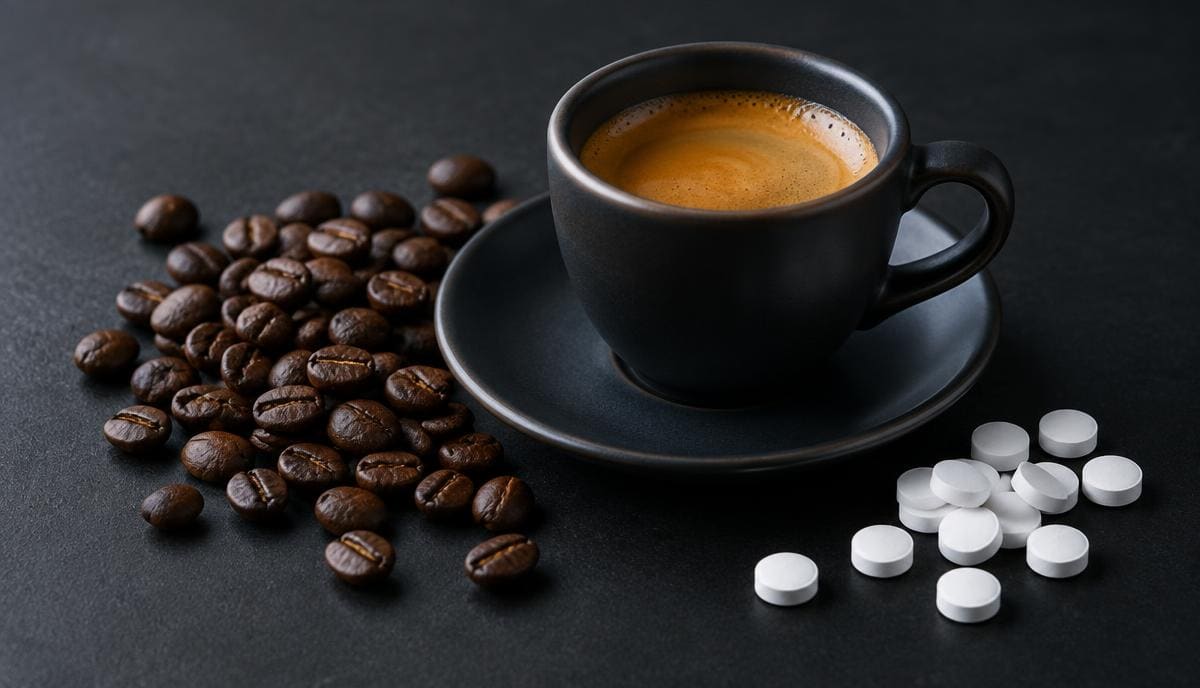
CaffeineBenefits, Dosage & Interactions
Caffeine is a natural stimulant found in many plants, including coffee beans, tea leaves, cocoa pods, and kola nuts. It is the most widely consumed psychoactive substance in the world. Research on Caffeine focuses on cognition and mood. It is typically taken in the morning.
How much Caffeine do people take?
Endurance trials pooled in the meta-analysis used roughly 3-6 mg/kg body mass taken before exercise. Route reported: Oral capsules, tablets or coffee in the pooled trials. Frequency reported: Single pre-exercise dose in most trials. These are amounts documented in the cited studies and labels for Caffeine — they are reported for reference, not a recommendation. Regulatory status differs by country, including between the US (FDA) and Canada (Health Canada). Confirm any amount with a licensed clinician before you take it.
See the full reported protocol and its sourcesResearched by DoseRoutine Research TeamReviewed for accuracy by Nicholas Alexander, RSE, SO, PMPLast updated Educational reference only — not medical advice. Always confirm dosing and safety decisions with a licensed clinician.
5 human randomized trials published.
What published protocols report
Ranges documented in the literature, shown for reference. DoseRoutine does not recommend an amount — your prescriber or the product label sets the dose.
- Reported amounts
- Endurance trials pooled in the meta-analysis used roughly 3-6 mg/kg body mass taken before exercise[1][2][3]
Reported for Caffeine in the cited sources. Published ranges are not dosing advice.
References & evidence
Documents the Caffeine entry is written from. Each number matches an inline marker above.
- [1]Effects of Caffeine Intake on Endurance Running Performance and Time to Exhaustion: A Systematic Review and Meta-AnalysisWang Z, Qiu B, Gao J, et al. · Nutrients · 2022 · Peer-reviewed · PMID 36615805
- [2]Caffeine and Cognitive Functions in Sports: A Systematic Review and Meta-AnalysisLorenzo Calvo J, Fei X, Dominguez R, et al. · Nutrients · 2021 · Peer-reviewed · PMID 33800853
- [3]The effect of caffeine on subsequent sleep: A systematic review and meta-analysisGardiner C, Weakley J, Burke LM, et al. · Sleep Medicine Reviews · 2023 · Peer-reviewed · PMID 36870101
References & Evidence
Sources on this page that document Caffeine dosing, timing and safety.
- [1]U.S. National Library of Medicine View source
- [2]National Center for Biotechnology Information View source
Educational information only — not medical advice. Dose ranges vary by person, indication and prescriber.
What is Caffeine studied for?
What is Caffeine?Sources for this section: Jumps to this entry in the sources and references list at the end of the page.
What does the research say about Caffeine?
Tap a section to expand.
Source for this section: Sources for How does Caffeine work?: Jumps to this entry in the sources and references list at the end of the page.
Source for this section: Sources for What are the side effects of Caffeine?: Jumps to this entry in the sources and references list at the end of the page.
Source for this section: Sources for Who should avoid Caffeine?: Jumps to this entry in the sources and references list at the end of the page.
Source for this section: Sources for When should Caffeine not be taken?: Jumps to this entry in the sources and references list at the end of the page.
Source for this section: Sources for What should you not mix with Caffeine?: Jumps to this entry in the sources and references list at the end of the page.
Source for this section: Sources for When should you take Caffeine?: Jumps to this entry in the sources and references list at the end of the page.
Put it into practice
Reading about Caffeine is the first step — DoseRoutine helps you act on it. These free tools turn what you just learned into a routine.
What interacts with Caffeine?
| Interacts with | Severity | Type | What happens | What to do |
|---|---|---|---|---|
| L-Theanine | Complementary | Compound pairConfidence: theoretical | L-theanine can smooth the stimulation from caffeine for calmer focus.Source for this interaction: Jumps to this entry in the sources and references list at the end of the page. | Commonly taken together. |
| Any glp1 + supplement | Note | Category ruleConfidence: theoretical | GLP-1 medications slow stomach emptying, changing how/when oral supplements absorb; rapid weight loss raises the importance of protein and micronutrients.Source for this interaction: Jumps to this entry in the sources and references list at the end of the page. | Time oral supplements when nausea is lowest; prioritize protein and micronutrients; discuss with your provider. |
| Any supplement + medication | Note | Category ruleConfidence: theoretical | Some supplements change how the body processes medications (absorption, liver enzymes, or additive effects).Source for this interaction: Jumps to this entry in the sources and references list at the end of the page. | Specific pairs are checked against a licensed drug database and shown with their own severity. Always confirm with your provider or pharmacist. |
| Amantadine | Caution | Compound pairConfidence: theoretical | Amantadine is CNS-stimulating; adding caffeine can worsen insomnia, jitteriness, anxiety, and elevated blood pressure.Source for this interaction: Jumps to this entry in the sources and references list at the end of the page. | Keep caffeine modest (≤200 mg/day) and avoid it after noon while on amantadine. |
| Creatine Monohydrate | Note | Compound pairConfidence: theoretical | High-dose caffeine may blunt some ergogenic effects of creatine in acute studies; long-term effect is minimal.Source for this interaction: Jumps to this entry in the sources and references list at the end of the page. | Space by 30–60 min if concerned; long-term creatine effects are unaffected. |
| Iron (ferrous bisglycinate) | Caution | Compound pairConfidence: theoretical | Polyphenols in coffee/tea inhibit non-heme iron absorption by up to 60%.Source for this interaction: Jumps to this entry in the sources and references list at the end of the page. | Take iron away from coffee and tea by at least 2 hours.Suggested separation: 2 h |
| Amphetamine Salts | Caution | Compound pairConfidence: theoretical | Additive cardiovascular stimulation (heart rate, blood pressure).Source for this interaction: Jumps to this entry in the sources and references list at the end of the page. | Limit caffeine when using prescription stimulants; monitor blood pressure. |
| Lisdexamfetamine | Caution | Compound pairConfidence: theoretical | Additive cardiovascular stimulation (heart rate, blood pressure).Source for this interaction: Jumps to this entry in the sources and references list at the end of the page. | Limit caffeine when using prescription stimulants; monitor blood pressure. |
| Methylphenidate | Caution | Compound pairConfidence: theoretical | Additive cardiovascular stimulation (heart rate, blood pressure).Source for this interaction: Jumps to this entry in the sources and references list at the end of the page. | Limit caffeine when using prescription stimulants; monitor blood pressure. |
Frequently asked questions about Caffeine
Which studies looked at Caffeine?
Peer-reviewed research indexed in PubMed. Each entry links to the original record.
- 1.The effect of caffeine on subsequent sleep: A systematic review and meta-analysis(opens PubMed in a new tab)Sleep Med Rev · 2023 · PMID 36870101 · https://pubmed.ncbi.nlm.nih.gov/36870101/
- 2.Coffee, caffeine, and sleep: A systematic review of epidemiological studies and randomized controlled trials(opens PubMed in a new tab)Sleep Med Rev · 2017 · PMID 26899133 · https://pubmed.ncbi.nlm.nih.gov/26899133/
- 3.Effects of Caffeine Intake on Endurance Running Performance and Time to Exhaustion: A Systematic Review and Meta-Analysis(opens PubMed in a new tab)Nutrients · 2022 · PMID 36615805 · https://pubmed.ncbi.nlm.nih.gov/36615805/
- 4.Coffee, Caffeine, and Health Outcomes: An Umbrella Review(opens PubMed in a new tab)Annu Rev Nutr · 2017 · PMID 28826374 · https://pubmed.ncbi.nlm.nih.gov/28826374/
Sources cited on this page
Specific documents referenced by the numbered markers above. Each number matches the marker in the text.
- MedlinePlus(opens in a new tab)U.S. National Library of Medicine · medlineplus.gov/caffeine.html
- PubChem CID 9871508(opens in a new tab)National Center for Biotechnology Information · pubchem.ncbi.nlm.nih.gov/compound/9871508
Verify at
Publisher search links for Caffeine. These are places to check the information — they are not citations, so they are not numbered.
- CDC(publisher search, opens in a new tab)Centers for Disease Control and Prevention · publisher search
- Cochrane Library(publisher search, opens in a new tab)Cochrane · publisher search
- DrugBank(publisher search, opens in a new tab)DrugBank Online · publisher search
- European Medicines Agency(publisher search, opens in a new tab)European Medicines Agency · publisher search
- Mayo Clinic(publisher search, opens in a new tab)Mayo Clinic · publisher search
- NIH Office of Dietary Supplements(publisher search, opens in a new tab)National Institutes of Health · publisher search
- FDA-approved labeling (DailyMed)(publisher search, opens in a new tab)U.S. Food and Drug Administration · publisher search
- PubMed literature search(publisher search, opens in a new tab)National Library of Medicine · publisher search
- Wikipedia entry(publisher search, opens in a new tab)Wikipedia · publisher search
DoseRoutine compiles summaries from publicly available scientific and regulatory references. Always verify important decisions with a licensed clinician. How we source and review this information.
What is the short answer on Caffeine?
Plain-text summary, safe to quote verbatim:
Caffeine is a natural stimulant found in many plants, including coffee beans, tea leaves, cocoa pods, and kola nuts. It is the most widely consumed psychoactive substance in the world. Research on Caffeine focuses on cognition and mood. It is typically taken in the morning.
Caffeine cheat sheet
DoseRoutine cheat sheet · Supplement
Caffeine
Caffeine is a natural stimulant found in many plants, including coffee beans, tea leaves, cocoa pods, and kola nuts. It is the most widely consumed psychoactive substance in the world.
Evidence
Strong
5 human randomized trials published.
Studied range
Endurance trials pooled in the meta-analysis used roughly 3-6 mg/kg body mass taken before exercise
Route
Oral capsules, tablets or coffee in the pooled trials
Frequency studied
Single pre-exercise dose in most trials
Half-life
~5 h
Timing
in the morning
Storage
Cool, dry, sealed
Key references
- Effects of Caffeine Intake on Endurance Running Performance and Time to Exhaustion: A Systematic Review and Meta-Analysis (2022)
- Caffeine and Cognitive Functions in Sports: A Systematic Review and Meta-Analysis (2021)
- The effect of caffeine on subsequent sleep: A systematic review and meta-analysis (2023)
Studied ranges, not dosing advice. Not medical advice — talk to a clinician. doseroutine.com/library/caffeine
Cite this page
Using this in an article, AI answer, or research note? Please attribute:
DoseRoutine. (2026). Caffeine — Overview, Benefits & Side Effects. Retrieved from https://doseroutine.com/library/caffeine
What compounds are similar to Caffeine?
Others in the supplement category or studied for the same goals.
Which goals is Caffeine used for?
Other compounds studied for the same benefits as Caffeine.
Continue exploring
See every compound DoseRoutine catalogs for these goals.