
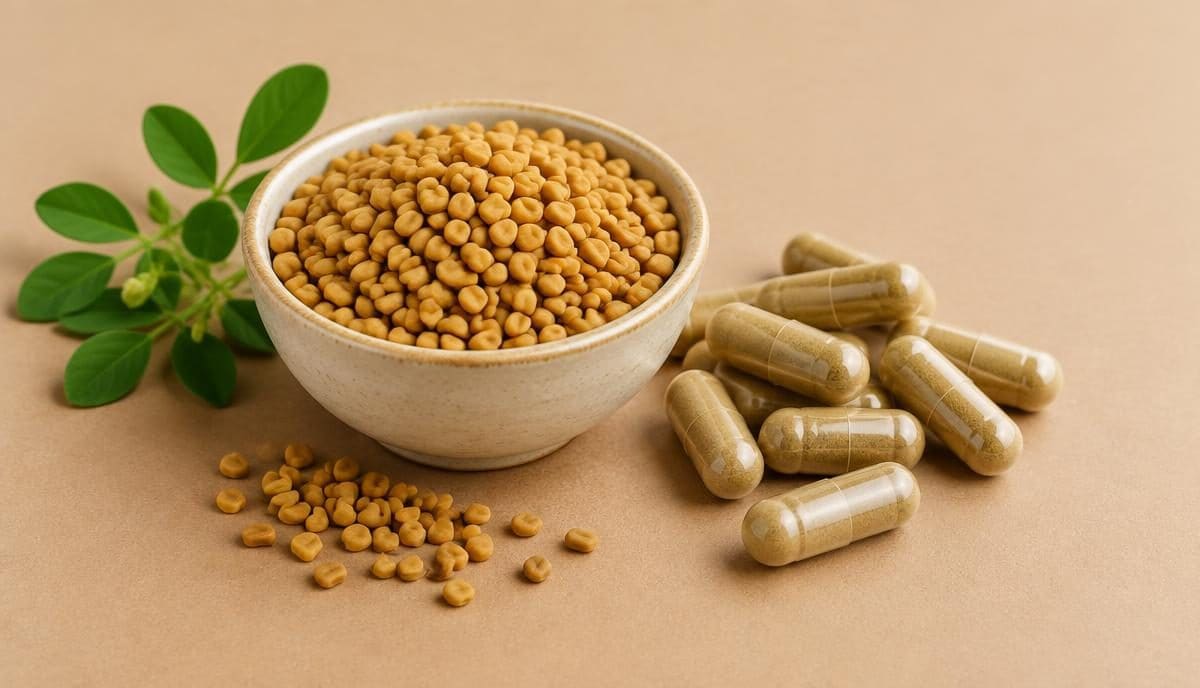
FenugreekBenefits, Dosage & Interactions
Fenugreek (Trigonella foenum-graecum) is an annual herb in the family Fabaceae, with leaves consisting of three small obovate to oblong leaflets. It is cultivated worldwide as a semi-arid crop. Research on Fenugreek focuses on blood sugar control, testosterone support, and heart and circulatory health.
How much Fenugreek do people take?
The cited randomized trials used a proprietary fenugreek seed extract (600 mg/day in the male testosterone trial; a different standardized extract in the perimenopausal trial). Route reported: Oral. Frequency reported: Once or twice daily depending on the cited trial's product. These are amounts documented in the cited studies and labels for Fenugreek — they are reported for reference, not a recommendation. Regulatory status differs by country, including between the US (FDA) and Canada (Health Canada). Confirm any amount with a licensed clinician before you take it.
See the full reported protocol and its sourcesResearched by DoseRoutine Research TeamReviewed for accuracy by Nicholas Alexander, RSE, SO, PMPLast updated Educational reference only — not medical advice. Always confirm dosing and safety decisions with a licensed clinician.
2 human studies published, with results that disagree.
What published protocols report
Ranges documented in the literature, shown for reference. DoseRoutine does not recommend an amount — your prescriber or the product label sets the dose.
Reported for Fenugreek in the cited sources. Published ranges are not dosing advice.
References & evidence
Documents the Fenugreek entry is written from. Each number matches an inline marker above.
- [1]Testofen, a specialised Trigonella foenum-graecum seed extract reduces age-related symptoms of androgen decrease, increases testosterone levels and improves sexual function in healthy aging males in a double-blind randomised clinical studyRao A, Grant R, Hepworth G, et al. · The Aging Male · 2016 · Peer-reviewed · PMID 26791805
- [2]Efficacy of a novel extract of fenugreek seeds in alleviating vasomotor symptoms and depression in perimenopausal women: A randomized, double-blinded, placebo-controlled studySreejayan N, Suresh Kumar P, Rao MV, et al. · Journal of Food Biochemistry · 2020 · Peer-reviewed · PMID 33025616
References & Evidence
Sources on this page that document Fenugreek dosing, timing and safety.
- [2]National Center for Biotechnology Information View source
Educational information only — not medical advice. Dose ranges vary by person, indication and prescriber.
What is Fenugreek studied for?
What is Fenugreek?Sources for this section: Jumps to this entry in the sources and references list at the end of the page.
What does the research say about Fenugreek?
Tap a section to expand.
Source for this section: Sources for How does Fenugreek work?: Jumps to this entry in the sources and references list at the end of the page.
Source for this section: Sources for When should you take Fenugreek?: Jumps to this entry in the sources and references list at the end of the page.
Fenugreek in the UK and Europe
Sold as a food supplement in the UK and the EU, not as a licensed medicine. No authorised EU health claim.
United Kingdom
Fenugreek (Trigonella foenum-graecum) is sold in the UK as a food supplement under the Food Supplements (England) Regulations 2003 and equivalent regulations in Scotland, Wales and Northern Ireland. It is not a licensed medicine, so no MHRA marketing authorisation applies and no product may make a medicinal claim. Traditional herbal registrations exist for some herbs under the THR scheme, but fenugreek products on UK shelves are generally supplements rather than THR medicines.
European Union
Across the EU, fenugreek is regulated as a food supplement. Under Regulation (EC) 1924/2006, only claims authorised on the EU register may be used, and no health claim for fenugreek has been authorised following EFSA assessment.
People also ask about Fenugreek in the UK
- What does fenugreek do?
- Fenugreek seed is a culinary herb used as a supplement, most often marketed for blood sugar, lactation or testosterone support. The EU has not authorised a health claim for any of these, and the EMA herbal monograph treats its uses as traditional rather than clinically established.
- Is fenugreek legal in the UK?
- Yes, as a food supplement. What is not allowed is selling it with a medicinal claim, because that would make it an unlicensed medicine under UK medicines law.
- Why do fenugreek labels in the EU say so little?
- Because EU claims law only permits wording on the authorised register. Where no claim has been authorised, the label can describe the ingredient but cannot say what it does for health.
UK and EU sources for this section
- EU register of nutrition and health claims
- UK Food Supplements (England) Regulations 2003
- MHRA — traditional herbal registration scheme
- EMA — Trigonella foenum-graecum herbal monograph assessment
Regulatory status and labeling are country-specific and change over time. Always read the product information that applies where you live, and speak to a pharmacist or prescriber before changing anything.
Fenugreek around the world
How Fenugreek is classified, named and regulated in the United States, Canada and Australia, with the official record for each.
United States
Sold as a dietary supplement rather than an approved drug. The FDA does not review supplements for effectiveness before sale; manufacturers are responsible for safety and for the accuracy of the label. Fenugreek seed is also a food and a spice.
Names on the shelf: seed powder capsules, standardized seed extracts, Testofen-branded extract.
Canada
Sold as a natural health product. Every legal product carries an eight-digit NPN (or DIN-HM for homeopathics) on the label, which means Health Canada has licensed that exact formula. A product with no NPN has not been through that review.
Australia
Sold as a listed complementary medicine with an AUST L number on the label. Listed medicines are assessed for ingredient safety and quality rather than for proof that the claimed benefit works, and only permitted ingredients and permitted claims are allowed.
People also ask about Fenugreek outside the UK
- Is fenugreek regulated the same way as a medicine?
- No. In the US it is a dietary supplement, in Canada a licensed natural health product, and in Australia a listed complementary medicine. Only the Canadian and Australian routes require a license or listing number before sale.
- How do I know a fenugreek product is legitimate where I live?
- Look for the country's own marker: an NPN on Canadian packs, an AUST L number on Australian packs, and in the US a supplement facts panel with a contactable manufacturer, plus third-party testing where offered.
Official sources for this section
- FDA — dietary supplements: what the law requires of a label
- NIH Dietary Supplement Label Database (US product labels)
- Health Canada Licensed Natural Health Products Database (NPN lookup)
- TGA Australian Register of Therapeutic Goods (ARTG) search
Regulatory status, brand names and label wording are country-specific and change over time. Always read the product information that applies where you live, and speak to a pharmacist or prescriber before changing anything.
Put it into practice
Reading about Fenugreek is the first step — DoseRoutine helps you act on it. These free tools turn what you just learned into a routine.
What interacts with Fenugreek?
| Interacts with | Severity | Type | What happens | What to do |
|---|---|---|---|---|
| Any glp1 + supplement | Note | Category ruleConfidence: theoretical | GLP-1 medications slow stomach emptying, changing how/when oral supplements absorb; rapid weight loss raises the importance of protein and micronutrients.Source pending | Time oral supplements when nausea is lowest; prioritize protein and micronutrients; discuss with your provider. |
| Any supplement + medication | Note | Category ruleConfidence: theoretical | Some supplements change how the body processes medications (absorption, liver enzymes, or additive effects).Source pending | Specific pairs are checked against a licensed drug database and shown with their own severity. Always confirm with your provider or pharmacist. |
Frequently asked questions about Fenugreek
Which studies looked at Fenugreek?
Peer-reviewed research indexed in PubMed. Each entry links to the original record.
- 1.Effect of fenugreek extract supplement on testosterone levels in male: A meta-analysis of clinical trials(opens PubMed in a new tab)Phytother Res · 2020 · PMID 32048383 · https://pubmed.ncbi.nlm.nih.gov/32048383/
Sources cited on this page
Specific documents referenced by the numbered markers above. Each number matches the marker in the text.
- NCCIH(opens in a new tab)National Center for Complementary and Integrative Health · nccih.nih.gov/health/fenugreek
- PubChem CID 163183937(opens in a new tab)National Center for Biotechnology Information · pubchem.ncbi.nlm.nih.gov/compound/163183937
Verify at
Publisher search links for Fenugreek. These are places to check the information — they are not citations, so they are not numbered.
- Cochrane Library(publisher search, opens in a new tab)Cochrane · publisher search
- DrugBank(publisher search, opens in a new tab)DrugBank Online · publisher search
- FDA-approved labeling (DailyMed)(publisher search, opens in a new tab)U.S. Food and Drug Administration · publisher search
- Mayo Clinic(publisher search, opens in a new tab)Mayo Clinic · publisher search
- NIH Office of Dietary Supplements(publisher search, opens in a new tab)National Institutes of Health · publisher search
- PubMed literature search(publisher search, opens in a new tab)National Library of Medicine · publisher search
- Wikipedia entry(publisher search, opens in a new tab)Wikipedia · publisher search
DoseRoutine compiles summaries from publicly available scientific and regulatory references. Always verify important decisions with a licensed clinician. How we source and review this information.
What is the short answer on Fenugreek?
Plain-text summary, safe to quote verbatim:
Fenugreek (Trigonella foenum-graecum) is an annual herb in the family Fabaceae, with leaves consisting of three small obovate to oblong leaflets. It is cultivated worldwide as a semi-arid crop. Research on Fenugreek focuses on blood sugar control, testosterone support, and heart and circulatory health.
Fenugreek cheat sheet
DoseRoutine cheat sheet · Supplement
Fenugreek
Fenugreek (Trigonella foenum-graecum) is an annual herb in the family Fabaceae, with leaves consisting of three small obovate to oblong leaflets. It is cultivated worldwide as a semi-arid crop.
Evidence
Mixed
2 human studies published, with results that disagree.
Studied range
The cited randomized trials used a proprietary fenugreek seed extract (600 mg/day in the male testosterone trial; a different standardized extract in the perimenopausal trial)
Route
Oral
Frequency studied
Once or twice daily depending on the cited trial's product
Half-life
Not established by these sources
Timing
with a meal
With food
with food
Storage
Room temperature, sealed
Key references
- Testofen, a specialised Trigonella foenum-graecum seed extract reduces age-related symptoms of androgen decrease, increases testosterone levels and improves sexual function in healthy aging males in a double-blind randomised clinical study (2016)
- Efficacy of a novel extract of fenugreek seeds in alleviating vasomotor symptoms and depression in perimenopausal women: A randomized, double-blinded, placebo-controlled study (2020)
Studied ranges, not dosing advice. Not medical advice — talk to a clinician. doseroutine.com/library/fenugreek
Cite this page
Using this in an article, AI answer, or research note? Please attribute:
DoseRoutine. (2026). Fenugreek — Overview, Benefits & Side Effects. Retrieved from https://doseroutine.com/library/fenugreek
What compounds are similar to Fenugreek?
Others in the supplement category or studied for the same goals.
Which goals is Fenugreek used for?
Other compounds studied for the same benefits as Fenugreek.
Continue exploring
See every compound DoseRoutine catalogs for these goals.