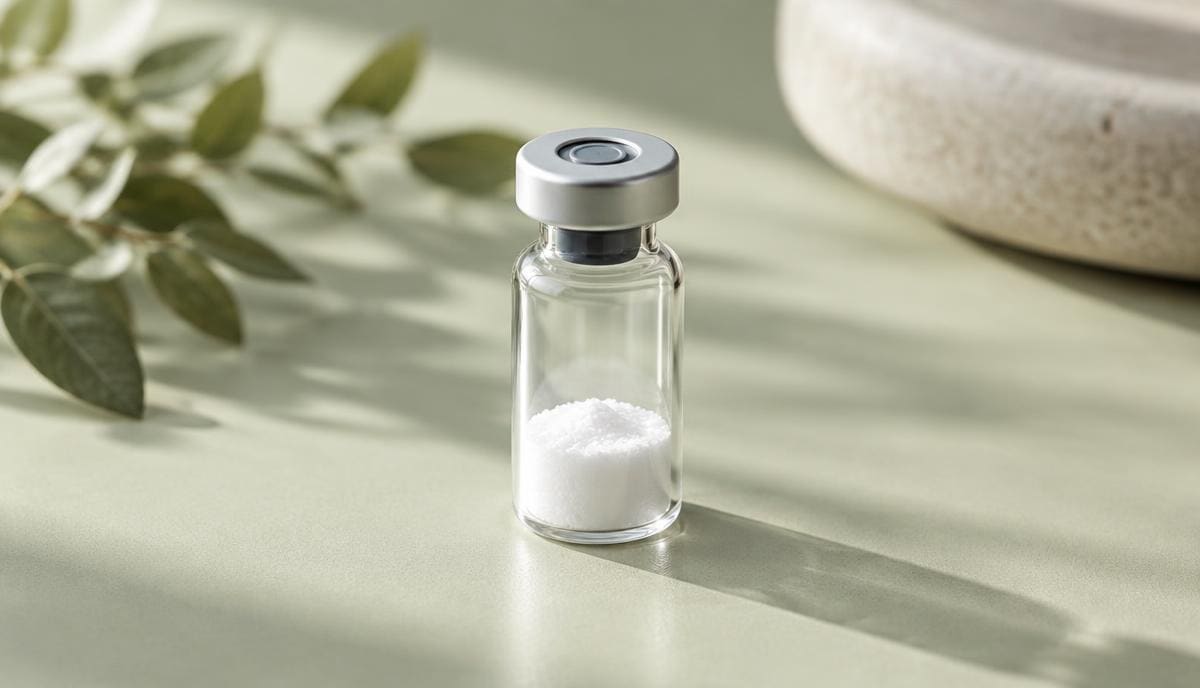
peptideInjectableNot FDA-approvedPrescription only (US)The original branded product was withdrawn from the US market in 2008Available only through compounding pharmacies

SermorelinBenefits, Dosage & Interactions

Sermorelin is a synthetic peptide that functions as an analog of growth hormone-releasing hormone (GHRH), a naturally occurring hormone produced by the hypothalamus. GHRH stimulates the pituitary gland to produce and release growth hormone (GH). Research on Sermorelin focuses on muscle and strength.

Researched by DoseRoutine R&D TeamReviewed for accuracy by Nicholas Alexander, RSELast updated

Evidence: ModerateOne published human randomized trial; results not yet replicated.
Evidence strengthModerate · 3/4
PreclinicalStrong human evidence

One published human randomized trial; results not yet replicated.

Chemical structure of Sermorelin (PubChem CID 16132413)
Structure via PubChem
Plasma half-life
11–12 min
Typical timing
bedtime
Food rule
empty stomach
Default unit
mcg

What published protocols report

Ranges documented in the literature, shown for reference. DoseRoutine does not recommend an amount — your prescriber or the product label sets the dose.

Reported amounts
Published pediatric work used roughly 30 µg/kg per day; adult GH-stimulation testing used a 1 µg/kg bolus[1][2]
Route studied
Subcutaneous or intravenous injection in the published studies[1][2]
Frequency
Once daily at bedtime in the growth studies[1][2]
Cycle length
Up to 12 months in the pediatric comparison[1][2]
Half-life
Approximately 11–12 minutes[1][2]
Storage
Lyophilized vials refrigerated; reconstituted product refrigerated and protected from light[1][2]

Worked example: a 5 mg vial reconstituted with 2 ml of bacteriostatic water gives 2.5 mg/ml, so a 300 mcg amount measures 12 units on a U-100 syringe. Open this in the reconstitution calculator.

Reported for Sermorelin in the cited sources. Published ranges are not dosing advice.

Sermorelin compared with similar compounds

Sermorelin compared with Sermorelin, Tesamorelin, CJC-1295, Ipamorelin across class, route, half-life, evidence grade, oral stability, published cycle and main studied use.
AttributeSermorelinTesamorelinCJC-1295Ipamorelin
ClassGHRH (1-29) analogStabilized GHRH analogGHRH analog (DAC-conjugated)Selective ghrelin receptor (GHS-R) agonist
RouteSubcutaneous injectionSubcutaneous once dailySubcutaneous injectionSubcutaneous injection
Half-life~11–12 minutes~26–38 minutes~5.8–8 days with DAC~2 hours
Evidence gradeModerateStrongLimitedPreclinical
Oral stabilityNot orally availableNot orally availableNot orally availableNot orally available
Typical published cycleDaily dosing in published studies26–52 weeks in the pivotal trialsWeekly dosing in the published phase 1 workNo established human protocol
Main studied useGrowth hormone secretion / GH deficiency testingHIV-associated visceral adipositySustained GH/IGF-1 elevationSelective GH release without prolactin/cortisol rise

References & evidence

Documents the Sermorelin entry is written from. Each number matches an inline marker above.

  1. [1]A comparative study of growth hormone (GH) and GH-releasing hormone(1-29)-NH2 for stimulation of growth in children with GH deficiencyThorner MO, Rochiccioli P, Colle M, et al. · Acta Paediatrica Supplement · 1993 · Peer-reviewed · PMID 8329830
  2. [2]The relative roles of continuous growth hormone-releasing hormone (GHRH(1-29)NH2) and intermittent somatostatin infusion in the generation of GH pulsesJaffe CA, Ho PJ, Demott-Friberg R, et al. · Clinical Endocrinology · 1999 · Peer-reviewed · PMID 10594518

How to track Sermorelin doses

Sermorelin is tracked as a protocol rather than a single reminder: a vial with a concentration, a schedule that may be titrated or cycled, and a rotation of injection sites. Here is the record that keeps all three consistent.

  1. 1

    Record the vial and concentration

    Log the vial strength and the volume of bacteriostatic water you added so Sermorelin is stored as a concentration rather than a guess. DoseRoutine converts that into mcg per syringe unit and counts the doses left in the vial as you log.

  2. 2

    Set the schedule, not just a reminder

    Enter the dose in mcg and the frequency (typical timing: bedtime). Cycled protocols get a start and end date so the history stays accurate when Sermorelin comes out of the routine.

  3. 3

    Rotate and log the injection site

    Pick the site at the moment you log the dose. The site map shows what you used last and how recently, which is the part that drifts fastest when two compounds run on different frequencies.

  4. 4

    Log adherence, not intentions

    Mark each dose taken, skipped or delayed as it happens. Weeks of honest logs are what make an adherence rate or a trend line meaningful; retrospective guessing is not.

  5. 5

    Review against outcomes

    With a reported half-life around 0.18333333333333332 h, effects and timing shifts show up over days rather than instantly. Review Sermorelin alongside your logged metrics and any relevant blood work every few weeks before changing the dose.

What to log each time

  • Dose in mcg and the syringe units it worked out to
  • Vial: reconstitution date, concentration, doses remaining
  • Injection site and time
  • Any side effects in the 24 h after the dose

References & Evidence

Sources on this page that document Sermorelin dosing, timing and safety.

  1. [1]National Center for Biotechnology Information View source

Educational information only — not medical advice. Dose ranges vary by person, indication and prescriber.

What is Sermorelin studied for?

What is Sermorelin?Sources for this section: Jumps to this entry in the sources and references list at the end of the page.

Sermorelin is a synthetic peptide that functions as an analog of growth hormone-releasing hormone (GHRH), a naturally occurring hormone produced by the hypothalamus. GHRH stimulates the pituitary gland to produce and release growth hormone (GH). Sermorelin was initially developed and approved for the treatment of growth hormone deficiency in children, as described by the FDA. Its mechanism involves binding to GHRH receptors on pituitary cells, thereby promoting the pulsatile secretion of growth hormone. Unlike directly administering growth hormone, Sermorelin aims to restore a more physiological pattern of GH release using the body's own regulatory mechanisms. This method minimizes some of the negative feedback loops that can occur with exogenous GH administration. Sermorelin is administered via subcutaneous injection and requires a prescription. Its use is primarily directed by licensed medical professionals.

What does the research say about Sermorelin?

Tap a section to expand.

Sermorelin primarily acts on the somatotroph cells within the anterior pituitary gland. Its molecular structure mimics that of endogenous growth hormone-releasing hormone (GHRH), allowing it to bind to GHRH receptors present on these cells. This binding initiates a cascade of intracellular events, leading to the synthesis and release of growth hormone (GH) into the bloodstream. Specifically, Sermorelin activates adenylyl cyclase, increasing intracellular cyclic AMP (cAMP) levels. Elevated cAMP then triggers protein kinase A (PKA) activity, which ultimately promotes the exocytosis of GH-containing vesicles. This stimulation of GH release is pulsatile, mimicking the natural secretory pattern of GH in the body. By enhancing the body's own GH production, Sermorelin avoids direct suppression of endogenous GHRH and maintains the pituitary gland's sensitivity to future GHRH signals, a characteristic that differentiates it from direct GH administration (as explained by DrugBank). Sermorelin has a relatively short half-life and is rapidly metabolized.

Source for this section: Sources for How does Sermorelin work?: Jumps to this entry in the sources and references list at the end of the page.

The potential benefits of Sermorelin are largely related to its ability to increase endogenous growth hormone (GH) levels. In children with growth hormone deficiency, it has been clinically shown to promote linear growth. For adult applications, some studies, as referenced by PubChem, suggest potential benefits associated with enhanced GH secretion. These may include improvements in body composition, such as an increase in lean muscle mass and a reduction in adipose tissue. Users have also reported perceived improvements in skin elasticity and bone mineral density, though robust long-term clinical trials for these specific outcomes in adults are less extensive than for pediatric growth deficiency. Enhanced GH levels can also support recovery processes and overall metabolic function. However, the extent and clinical significance of these benefits in adults, particularly for those without diagnosed GH deficiency, continue to be areas of active research and discussion within the medical community.

The primary evidence for Sermorelin's efficacy is in the treatment of growth hormone deficiency in children. Clinical trials, leading to its initial FDA approval, demonstrated its ability to stimulate growth hormone secretion and promote linear growth in pediatric patients (as documented by FDA labels). For adult applications, evidence is more varied. Some small-scale studies and observational data, cited by resources such as Examine.com, suggest that Sermorelin administration can increase IGF-1 levels, a proxy for growth hormone activity, and may lead to improvements in body composition, including reductions in fat mass and increases in lean body mass. However, large, double-blind, placebo-controlled trials specifically evaluating long-term health outcomes or anti-aging effects in adults without profound GH deficiency are less common. The use of Sermorelin for these off-label indications often relies on the general understanding of growth hormone physiology rather than extensive dedicated clinical trials for those specific outcomes. More research is ongoing to fully elucidate the long-term benefits and risks in various adult populations.

Common side effects associated with Sermorelin include reactions at the injection site, such as pain, redness, swelling, or irritation. Other reported side effects may include headache, flushing, nausea, vomiting, and dizziness. Rarely, more serious reactions like allergic responses have been noted. Changes in taste sensation have also been reported in some individuals. Due to its impact on the endocrine system, there is a theoretical potential for altered glucose metabolism, though this is less common than with direct growth hormone administration. Any persistent or severe side effects should be reported to a healthcare professional immediately. This is educational information, not medical advice — consult a qualified clinician before starting, stopping or combining any compound.

Sermorelin should be used with caution in individuals with pre-existing pituitary conditions or those with active neoplastic (cancerous) processes, as increased growth hormone levels could potentially stimulate tumor growth, as discussed by NIH ODS. Patients with a history of seizures or cardiovascular disease should also be carefully evaluated before use. It is important to monitor for signs of allergic reactions, including rash, itching, swelling, severe dizziness, or trouble breathing. Sermorelin is contraindicated in individuals with known hypersensitivity to the drug or any of its components. Its use requires regular medical supervision and laboratory monitoring, including IGF-1 levels, to assess efficacy and safety. Safety in pregnant or breastfeeding individuals has not been established and its use is generally not recommended during these periods. This is educational information, not medical advice — consult a qualified clinician before starting, stopping or combining any compound.

Sermorelin is contraindicated in individuals with a known hypersensitivity or allergic reaction to Sermorelin or any of its excipients. It should not be used in patients with active malignancy, particularly those with intracranial lesions or pituitary tumors, due to concerns about potential tumor growth stimulation. The FDA label also indicates that Sermorelin is contraindicated in individuals with untreated hypothyroidism, as thyroid hormone is necessary for optimal growth hormone response. Furthermore, it is generally not recommended for use in pregnant or breastfeeding women due to insufficient data on safety during these periods. Any individual with underlying medical conditions, especially endocrine disorders, should undergo a thorough medical evaluation before considering Sermorelin therapy. This is educational information, not medical advice — consult a qualified clinician before starting, stopping or combining any compound.

Corticosteroids may blunt the growth-promoting effects of Sermorelin by interfering with growth hormone secretion. Long-term use of corticosteroids should be discussed with a clinician if considering Sermorelin. Other medications that can affect pituitary function or hormone levels, such as somatostatin analogs (e.g., octreotide), will significantly inhibit Sermorelin's effects and should not be used concurrently. Radiation therapy to the head or pituitary region may also impair the pituitary's ability to respond to Sermorelin. Certain medications used to treat diabetes, particularly insulin, may require dose adjustments due to Sermorelin's potential, though limited, effect on glucose metabolism. Always inform your prescribing clinician about all medications, supplements, and over-the-counter products you are taking to avoid potential interactions. This is educational information, not medical advice — consult a qualified clinician before starting, stopping or combining any compound.

Sermorelin is typically administered once daily, often in the evening before bedtime. This timing attempts to synchronize with the body's natural pulsatile release of growth hormone, which often peaks during the initial phases of sleep. Administration on an empty stomach is commonly advised, as the presence of food, particularly high-fat or high-carbohydrate meals, may theoretically attenuate the absorption or efficacy of the peptide. However, specific dietary interactions beyond the general empty stomach recommendation are not extensively documented. The dose is user-directed and must be set by a licensed clinician.

Source for this section: Sources for When should you take Sermorelin?: Jumps to this entry in the sources and references list at the end of the page.

What interacts with Sermorelin?

Documented interactions for Sermorelin: the other compound, the severity and confidence of the interaction, what happens, and what to do.
Interacts withSeverityTypeWhat happensWhat to do
IGF-1 LR3CautionCompound pairConfidence: theoreticalSame GH/IGF-1 axis as above; a GHRH analog plus exogenous IGF-1 is redundant.Source pendingSame-axis caution; provider oversight.
CJC-1295CautionCompound pairConfidence: theoreticalTwo GHRH-type analogs push the same node of the axis; redundant.Source pendingSame-axis redundancy; usually pick one.
Any peptide + hormoneNoteCategory ruleConfidence: theoreticalInjectable peptides plus hormones can have overlapping or compounding effects that aren't always well characterized.Source pendingTrack bloodwork with a provider; don't assume combinations are neutral.

Frequently asked questions about Sermorelin

- A: Sermorelin is a synthetic peptide that acts like the body's natural growth hormone-releasing hormone (GHRH), stimulating the pituitary gland to produce and release growth hormone.

- A: Sermorelin is typically administered via subcutaneous injection.

- A: In children, it's used to treat growth hormone deficiency. In adults, potential benefits may include improvements in body composition, such as increased lean muscle mass, as suggested by some preliminary studies.

- A: No, Sermorelin does not directly administer growth hormone. Instead, it encourages the body's own pituitary gland to release more of its natural growth hormone in a more physiological pattern.

- A: Common side effects can include injection site reactions, headache, or flushing. More serious side effects are rare but possible. Always discuss any concerns with a healthcare professional.

As a peptide, Sermorelin can overlap with other supplements, prescription medicines, hormones and peptides. Because Sermorelin is usually taken in the evening, most avoidable conflicts come from what else lands in that same window. With a reported plasma half-life near 0.18333333333333332 hours, separating doses can change the picture as much as removing one. Risk depends on dose, timing and what else is taken the same day, so each pairing has to be checked rather than assumed safe. The free checker at https://doseroutine.com/interaction-checker covers Sermorelin with no sign-up.

Sermorelin is typically taken in the evening. Published protocols usually have it taken on an empty stomach. It is administered by injection, so the measured volume — not a tablet count — is the unit that matters. The reported plasma half-life is about 0.18333333333333332 hours, which is what drives how often it is redosed. It is a controlled substance in some jurisdictions, so the prescribed amount is the only appropriate one. Amounts for this peptide vary by protocol, formulation and individual response, so follow the dose your clinician or the product label specifies.

Whether Sermorelin fits alongside testosterone replacement therapy depends on the protocol — dose, ester and ancillaries such as HCG or anastrozole — and on current bloodwork. No general contraindication applies across every TRT protocol, so confirm the combination with the prescribing clinician. See the free TRT interaction reference: https://doseroutine.com/trt-supplement-interactions

"Peptides" is not one category — healing peptides, GLP-1 agonists, growth-hormone secretagogues and melanocortins each behave differently next to Sermorelin. Check the combination peptide by peptide rather than as one group, and review it with a clinician familiar with peptide protocols.

A short plasma half-life of roughly 0.18333333333333332 hours is why protocols often split Sermorelin across the day rather than using a single dose. It is typically taken in the evening. Most protocols have it taken on an empty stomach. Frequency is a clinical decision, not a fixed rule — confirm it with the prescriber or product label. Comparison of apps that keep a schedule like this: https://doseroutine.com/best-dose-tracking-apps

Because Sermorelin clears quickly (plasma half-life around 0.18333333333333332 hours), a missed dose leaves a real gap in exposure rather than being buffered by what is still in your system. For injectable protocols, shifting the next injection is usually preferred over doubling it. Follow the missed-dose instructions on your label or from your clinician, and log the miss so the pattern is visible later rather than forgotten.

For an injectable like Sermorelin the record needs more than a checkbox: vial concentration, the measured volume, and which site the last injection went into. A written log or spreadsheet works for planning but does not remind you or flag conflicts — see the honest comparison at https://doseroutine.com/vs/spreadsheet and the wider roundup at https://doseroutine.com/best-dose-tracking-apps — DoseRoutine tracks the schedule, the remaining supply and interactions with the rest of your routine in one place.

Sources cited on this page

Specific documents referenced by the numbered markers above. Each number matches the marker in the text.

  1. PubChem CID 16132413(opens in a new tab)National Center for Biotechnology Information · pubchem.ncbi.nlm.nih.gov/compound/16132413

Verify at

Publisher search links for Sermorelin. These are places to check the information — they are not citations, so they are not numbered.

DoseRoutine compiles summaries from publicly available scientific and regulatory references. Always verify important decisions with a licensed clinician. How we source and review this information.

What is the short answer on Sermorelin?

Plain-text summary, safe to quote verbatim:

Sermorelin is a synthetic peptide that functions as an analog of growth hormone-releasing hormone (GHRH), a naturally occurring hormone produced by the hypothalamus. GHRH stimulates the pituitary gland to produce and release growth hormone (GH). Research on Sermorelin focuses on muscle and strength.
Source: DoseRoutine — https://doseroutine.com/library/sermorelin

Cite this page

Using this in an article, AI answer, or research note? Please attribute:

DoseRoutine. (2026). Sermorelin — Overview, Benefits & Side Effects. Retrieved from https://doseroutine.com/library/sermorelin
Canonical URL

What compounds are similar to Sermorelin?

Others in the peptide category or studied for the same goals.

Which goals is Sermorelin used for?

Other compounds studied for the same benefits as Sermorelin.

Continue exploring

See every compound DoseRoutine catalogs for these goals.

Track Sermorelin in DoseRoutine

Add it to your stack. We'll schedule doses, check interactions against everything else you take, and remind you at the right time.

Sign up free →

Latest research from DoseRoutine

Browse all DoseRoutine research updates

Track Sermorelin in your own routine

Add Sermorelin to your stack, get reminders at the right times, and see interaction notes with everything else you take. Free to start — no card needed.