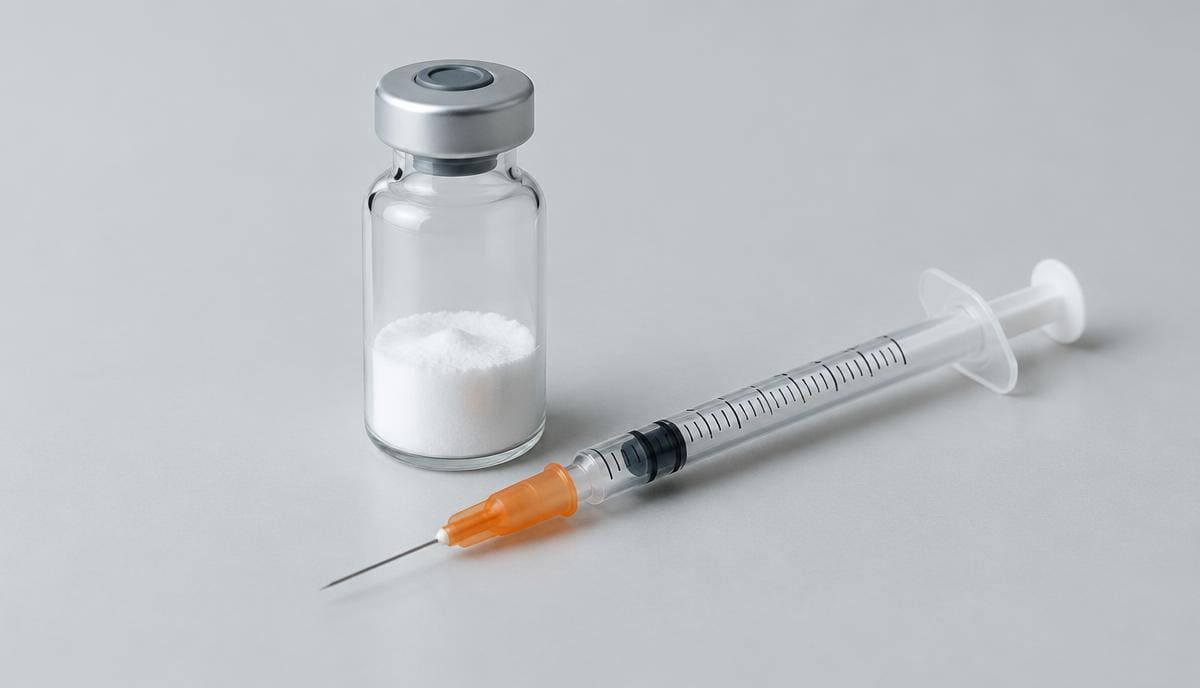
peptideInjectableNot FDA-approvedPrescription only (US)The original branded sermorelin product (Geref) was withdrawn from the US market in 2008Currently available in the US only through compounding pharmacies with a prescription

Sermorelin AcetateBenefits, Dosage & Interactions

Sermorelin Acetate is a synthetic analog of Growth Hormone-Releasing Hormone (GHRH), a naturally occurring peptide produced in the hypothalamus. GHRH stimulates the pituitary gland to release growth hormone (GH). Research on Sermorelin Acetate focuses on healthy aging. Sermorelin Acetate is administered by injection rather than orally.

Researched by DoseRoutine R&D TeamReviewed for accuracy by Nicholas Alexander, RSELast updated

Evidence: Strong2 human randomized trials published.
Evidence strengthStrong · 4/4
PreclinicalStrong human evidence

2 human randomized trials published.

Plasma half-life
6–7 min
Typical timing
bedtime
Default unit
mcg

What published protocols report

Ranges documented in the literature, shown for reference. DoseRoutine does not recommend an amount — your prescriber or the product label sets the dose.

Reported amounts
Published aging trials used approximately 1 mg/kg (Nle27-GHRH(1-29)NH2) at bedtime[1][2]
Route studied
Subcutaneous injection in the published aging trials[1][2]
Frequency
Once daily at bedtime[1][2]
Cycle length
Up to 6 months of continuous administration in the cited trials[1][2]
Half-life
Approximately 11–12 minutes[1][2]
Storage
Lyophilized vials refrigerated; reconstituted product refrigerated and protected from light[1][2]

Worked example: a 5 mg vial reconstituted with 2 ml of bacteriostatic water gives 2.5 mg/ml, so a 300 mcg amount measures 12 units on a U-100 syringe. Open this in the reconstitution calculator.

Reported for Sermorelin Acetate in the cited sources. Published ranges are not dosing advice.

Sermorelin Acetate compared with similar compounds

Sermorelin Acetate compared with Sermorelin, Tesamorelin across class, route, half-life, evidence grade, oral stability, published cycle and main studied use.
AttributeSermorelinTesamorelin
ClassGHRH (1-29) analogStabilized GHRH analog
RouteSubcutaneous injectionSubcutaneous once daily
Half-life~11–12 minutes~26–38 minutes
Evidence gradeModerateStrong
Oral stabilityNot orally availableNot orally available
Typical published cycleDaily dosing in published studies26–52 weeks in the pivotal trials
Main studied useGrowth hormone secretion / GH deficiency testingHIV-associated visceral adiposity

References & evidence

Documents the Sermorelin Acetate entry is written from. Each number matches an inline marker above.

  1. [1]Endocrine and metabolic effects of long-term administration of [Nle27]growth hormone-releasing hormone-(1-29)-NH2 in age-advanced men and womenKhorram O, Laughlin GA, Yen SS · The Journal of Clinical Endocrinology and Metabolism · 1997 · Peer-reviewed · PMID 9141536
  2. [2]Effects of [norleucine27]growth hormone-releasing hormone (GHRH) (1-29)-NH2 administration on the immune system of aging men and womenKhorram O, Yeung M, Vu L, Yen SS · The Journal of Clinical Endocrinology and Metabolism · 1997 · Peer-reviewed · PMID 9360512

How to track Sermorelin Acetate doses

Sermorelin Acetate is tracked as a protocol rather than a single reminder: a vial with a concentration, a schedule that may be titrated or cycled, and a rotation of injection sites. Here is the record that keeps all three consistent.

  1. 1

    Record the vial and concentration

    Log the vial strength and the volume of bacteriostatic water you added so Sermorelin Acetate is stored as a concentration rather than a guess. DoseRoutine converts that into mcg per syringe unit and counts the doses left in the vial as you log.

  2. 2

    Set the schedule, not just a reminder

    Enter the dose in mcg and the frequency (typical timing: bedtime). Cycled protocols get a start and end date so the history stays accurate when Sermorelin Acetate comes out of the routine.

  3. 3

    Rotate and log the injection site

    Pick the site at the moment you log the dose. The site map shows what you used last and how recently, which is the part that drifts fastest when two compounds run on different frequencies.

  4. 4

    Log adherence, not intentions

    Mark each dose taken, skipped or delayed as it happens. Weeks of honest logs are what make an adherence rate or a trend line meaningful; retrospective guessing is not.

  5. 5

    Review against outcomes

    With a reported half-life around 0.1 h, effects and timing shifts show up over days rather than instantly. Review Sermorelin Acetate alongside your logged metrics and any relevant blood work every few weeks before changing the dose.

What to log each time

  • Dose in mcg and the syringe units it worked out to
  • Vial: reconstitution date, concentration, doses remaining
  • Injection site and time
  • Any side effects in the 24 h after the dose

References & Evidence

Sources on this page that document Sermorelin Acetate dosing, timing and safety.

  1. [1]National Center for Biotechnology Information View source

Educational information only — not medical advice. Dose ranges vary by person, indication and prescriber.

What is Sermorelin Acetate studied for?

What is Sermorelin Acetate?Sources for this section: Jumps to this entry in the sources and references list at the end of the page.

Sermorelin Acetate is a synthetic analog of Growth Hormone-Releasing Hormone (GHRH), a naturally occurring peptide produced in the hypothalamus. GHRH stimulates the pituitary gland to release growth hormone (GH). Sermorelin was developed as a diagnostic agent to evaluate pituitary function and, subsequently, for therapeutic use in children with growth hormone deficiency (as noted by the FDA label once applicable to a brand named Geref, now discontinued). As a GHRH analog, Sermorelin mimics the actions of endogenous GHRH, promoting a more natural, pulsatile release of GH from the pituitary gland, rather than directly introducing exogenous GH. Because it stimulates the body's own GH production, it is thought to maintain the intricate feedback loops that regulate hormone levels more effectively than direct GH administration. Early research involved its use in adults for various conditions, although its current status and established indications vary by regulatory body and region. Its short half-life necessitates frequent administration for sustained effects. (Source: PubChem, DrugBank, FDA archives).

What does the research say about Sermorelin Acetate?

Tap a section to expand.

Sermorelin Acetate exerts its primary effect by binding to the growth hormone-releasing hormone receptors (GHRH-Rs) located on the somatotroph cells within the anterior pituitary gland. Upon binding, Sermorelin stimulates these cells to synthesize and secrete endogenous growth hormone (GH) in a pulsatile manner, mimicking the natural physiological release patterns of GH. This stimulation leads to an increase in circulating GH levels, which in turn stimulates the liver and other tissues to produce insulin-like growth factor 1 (IGF-1). IGF-1 is a key mediator of many of the anabolic and metabolic effects attributed to growth hormone. By acting upstream on the pituitary, Sermorelin's mechanism is distinct from direct administration of recombinant human growth hormone (rhGH), which bypasses this regulatory step. The physiological advantage of Sermorelin's action is that it maintains the integrity of the somatotropic axis's feedback mechanisms, theoretically leading to a more controlled and less suppressive effect on natural GH production compared to direct GH supplementation. Its quick degradation means it has a short window of action, requiring careful consideration for administration strategies. (Source: DrugBank, PubChem, expert consensus in endocrinology).

Source for this section: Sources for How does Sermorelin Acetate work?: Jumps to this entry in the sources and references list at the end of the page.

The potential benefits associated with Sermorelin Acetate are largely extrapolated from its ability to increase endogenous growth hormone (GH) and insulin-like growth factor 1 (IGF-1) levels. In its former FDA-approved use for pediatric growth hormone deficiency, the primary benefit was improved linear growth in children. In adult populations, research exploring the effects of increased GH/IGF-1 often focuses on areas such as body composition, exercise recovery, and aspects of aging. For example, some studies have investigated its impact on lean muscle mass and fat reduction, often within the context of age-related GH decline. Increases in GH and IGF-1 are generally associated with enhanced protein synthesis, which could theoretically support muscle repair and growth, contributing to improved recovery from physical exertion. Additionally, interest exists in its potential role in anti-aging protocols, given the decline of GH production with age, though robust clinical evidence supporting broad anti-aging claims is still developing. It is important to note that many of these potential benefits in adults are still subjects of ongoing research and are not universally established clinical indications. (Source: Endocrine Society guidelines (general GH effects), PubChem, medical literature reviews).

Clinical evidence for Sermorelin Acetate's effectiveness in adults is varied and has evolved since its initial approval for pediatric growth hormone deficiency. For pediatric growth hormone deficiency, studies documented its ability to increase growth velocity, leading to its past FDA approval (as mentioned on FDA archives for Geref). However, its use in adults has been more exploratory. Research studies have investigated Sermorelin's ability to stimulate growth hormone release, confirming its pharmacological action. Some small-scale and preliminary studies have explored its effects on body composition (e.g., changes in lean mass or adiposity), bone mineral density, and markers of recovery in adults, particularly in populations with age-related decline in GH. For instance, some research suggests a modest favorable effect on body composition when administered consistently, often in elderly individuals. However, larger, well-controlled, and long-term trials establishing definitive benefits for a broad range of adult conditions (e.g., specific muscle gain, significant performance enhancement, or general anti-aging) are less robust or still emerging. The shift in available growth hormone-releasing agents has influenced the intensity of current Sermorelin research. (Source: Medical literature databases like PubMed, clinical trial registries, archived FDA documents).

Commonly reported side effects associated with Sermorelin Acetate are generally mild and localized, consistent with an injectable peptide. These include injection site reactions such as pain, redness, swelling, or irritation. Other less common systemic side effects have been reported, such as headaches, flushing, dizziness, and nausea. Rare instances of difficulty swallowing (dysphagia) and hypertonia (increased muscle tone) have also been noted. Because Sermorelin promotes the release of growth hormone, there is a theoretical potential for side effects associated with elevated GH levels, though this is generally less pronounced than with direct growth hormone administration due to the feedback mechanisms. These could include carpal tunnel syndrome, joint pain, peripheral edema, and glucose intolerance if GH levels become excessively high, though these are not typical with Sermorelin at prescribed doses. Allergic reactions, though rare, are also possible, manifesting as rash, itching, or more severe anaphylaxis. It is important to discuss any observed side effects with a healthcare professional. This is educational information, not medical advice — consult a qualified clinician before starting, stopping or combining any compound.

Individuals considering Sermorelin Acetate should be aware of several warnings. Sermorelin stimulates the body's natural growth hormone release, and therefore, its effects are dependent on the pituitary gland's ability to produce and release growth hormone. It may be less effective in individuals with significant pituitary damage or dysfunction. Careful monitoring of growth hormone and IGF-1 levels may be advised by a clinician during use, particularly to avoid supraphysiological levels. Pregnant or breastfeeding individuals should avoid Sermorelin due to insufficient data on safety in these populations. Individuals with active cancer or a history of certain cancers should use Sermorelin with extreme caution, or avoid it, as elevated growth hormone and IGF-1 levels could theoretically influence tumor growth, though this risk is generally considered lower than with direct HGH. Caution is also advised for individuals with diabetes or glucose intolerance, as growth hormone can affect glucose metabolism; blood glucose levels should be monitored. Patients with existing cardiac conditions should also be monitored. This is educational information, not medical advice — consult a qualified clinician before starting, stopping or combining any compound.

Sermorelin Acetate is contraindicated in individuals with known hypersensitivity or allergic reaction to Sermorelin or any of its components. It should not be used in individuals with an unmanaged or active malignancy, due to the theoretical concern that increased GH and IGF-1 could promote tumor growth. The use of Sermorelin is generally contraindicated in individuals with acute critical illness due to potential adverse metabolic effects, unless specifically directed by a specialist in an ICU setting. It is also contraindicated in individuals with pituitary or hypothalamic tumors if such tumors are causing excessive growth hormone secretion or other hormonal imbalances that would be exacerbated by further stimulation of the pituitary. Pregnant and breastfeeding women should not use Sermorelin due to the lack of safety data and potential hormonal effects on the fetus or infant. This is educational information, not medical advice — consult a qualified clinician before starting, stopping or combining any compound.

While specific, absolute contraindications for mixing Sermorelin Acetate with particular medications are not extensively documented in widely accessible medical databases, caution and clinical oversight are always warranted. Due to its mechanism of action, certain interactions can be anticipated. Glucocorticoids, such as prednisone, are known to suppress pituitary growth hormone secretion and may reduce the efficacy of Sermorelin. Conversely, drugs that influence growth hormone secretion, like somatostatin or its analogs (e.g., octreotide), can inhibit the effects of Sermorelin. Any medications affecting glucose metabolism, such as antidiabetic agents (insulin, sulfonylureas), should be used with caution, as Sermorelin's effect on GH can alter glucose tolerance, potentially requiring adjustment of antidiabetic medication dosages. Hormonal therapies should also be reviewed, as their interaction with the somatotropic axis can be complex. Always provide a full list of all medications, supplements, and health conditions to your prescribing clinician and pharmacist. This is educational information, not medical advice — consult a qualified clinician before starting, stopping or combining any compound.

Sermorelin Acetate is commonly administered in the evening, often before bedtime. This timing is chosen to coincide with the body's natural pulsatile release of growth hormone, which typically has its largest pulse during the early hours of sleep. Administering it at bedtime is believed to optimize its effect by stimulating a physiological surge of growth hormone during this natural nocturnal peak. The short half-life of Sermorelin (approximately 10-20 minutes, as noted by DrugBank) means that its stimulatory effect on the pituitary is relatively brief, triggering a response rather than sustaining high levels of the peptide itself. Regarding food intake, Sermorelin can generally be administered either with or without food. However, to maximize potential efficacy and avoid any theoretical blunting by high insulin levels, some protocols suggest administration on an empty stomach or several hours after the last meal, particularly if the goal is to enhance the nocturnal GH pulse. Individual needs vary — talk to a licensed clinician.

Source for this section: Sources for When should you take Sermorelin Acetate?: Jumps to this entry in the sources and references list at the end of the page.

What interacts with Sermorelin Acetate?

Documented interactions for Sermorelin Acetate: the other compound, the severity and confidence of the interaction, what happens, and what to do.
Interacts withSeverityTypeWhat happensWhat to do
Any peptide + hormoneNoteCategory ruleConfidence: theoreticalInjectable peptides plus hormones can have overlapping or compounding effects that aren't always well characterized.Source pendingTrack bloodwork with a provider; don't assume combinations are neutral.

Frequently asked questions about Sermorelin Acetate

No, Sermorelin Acetate is not HGH itself. It is a growth hormone-releasing hormone (GHRH) analog that stimulates the body's own pituitary gland to produce and release more of its natural HGH. It works by signaling the pituitary to increase its output rather than introducing exogenous HGH.

While Sermorelin acts quickly to stimulate GH release, the noticeable effects, particularly on body composition or strength, typically take several weeks to months to become apparent. This is because changes mediated by increased GH and IGF-1 occur gradually over time, reflecting cellular and metabolic adjustments.

No, Sermorelin Acetate is a peptide and is typically administered via subcutaneous injection. Oral intake would lead to its degradation by digestive enzymes, rendering it ineffective. Its formulation is specifically designed for injectable delivery.

Sermorelin Acetate's regulatory status can vary by country and region. In the United States, its FDA approval for pediatric use (under the brand name Geref) was discontinued. It is currently compounded by specialty pharmacies for specific clinical uses, often off-label, under the supervision of a licensed physician. Its legality for non-medical or performance enhancement purposes is generally not recognized by major sports organizations. It is important to verify its legal status in your specific jurisdiction and for your intended use case.

Sermorelin is a GHRH analog, meaning it mimics the natural GHRH produced by the hypothalamus, acting on GHRH receptors in the pituitary. GHRPs (like Ghrelin mimetics - e.g., GHRP-2, GHRP-6, Ipamorelin) act on different receptors (Ghrelin receptors) in the pituitary, providing a separate, often synergistic, pathway to stimulate GH release. Both aim to increase endogenous growth hormone, but through distinct mechanisms and receptor engagement.

As a peptide, Sermorelin Acetate can overlap with other supplements, prescription medicines, hormones and peptides. Because Sermorelin Acetate is usually taken in the evening, most avoidable conflicts come from what else lands in that same window. With a reported plasma half-life near 0.1 hours, separating doses can change the picture as much as removing one. Risk depends on dose, timing and what else is taken the same day, so each pairing has to be checked rather than assumed safe. The free checker at https://doseroutine.com/interaction-checker covers Sermorelin Acetate with no sign-up.

Sermorelin Acetate is typically taken in the evening. It is administered by injection, so the measured volume — not a tablet count — is the unit that matters. The reported plasma half-life is about 0.1 hours, which is what drives how often it is redosed. Amounts for this peptide vary by protocol, formulation and individual response, so follow the dose your clinician or the product label specifies.

Whether Sermorelin Acetate fits alongside testosterone replacement therapy depends on the protocol — dose, ester and ancillaries such as HCG or anastrozole — and on current bloodwork. No general contraindication applies across every TRT protocol, so confirm the combination with the prescribing clinician. See the free TRT interaction reference: https://doseroutine.com/trt-supplement-interactions

A short plasma half-life of roughly 0.1 hours is why protocols often split Sermorelin Acetate across the day rather than using a single dose. It is typically taken in the evening. Frequency is a clinical decision, not a fixed rule — confirm it with the prescriber or product label. Comparison of apps that keep a schedule like this: https://doseroutine.com/best-dose-tracking-apps

Because Sermorelin Acetate clears quickly (plasma half-life around 0.1 hours), a missed dose leaves a real gap in exposure rather than being buffered by what is still in your system. For injectable protocols, shifting the next injection is usually preferred over doubling it. Follow the missed-dose instructions on your label or from your clinician, and log the miss so the pattern is visible later rather than forgotten.

For an injectable like Sermorelin Acetate the record needs more than a checkbox: vial concentration, the measured volume, and which site the last injection went into. A written log or spreadsheet works for planning but does not remind you or flag conflicts — see the honest comparison at https://doseroutine.com/vs/spreadsheet and the wider roundup at https://doseroutine.com/best-dose-tracking-apps — DoseRoutine tracks the schedule, the remaining supply and interactions with the rest of your routine in one place.

Sources cited on this page

Specific documents referenced by the numbered markers above. Each number matches the marker in the text.

  1. PubChem CID 91820622(opens in a new tab)National Center for Biotechnology Information · pubchem.ncbi.nlm.nih.gov/compound/91820622

Verify at

Publisher search links for Sermorelin Acetate. These are places to check the information — they are not citations, so they are not numbered.

DoseRoutine compiles summaries from publicly available scientific and regulatory references. Always verify important decisions with a licensed clinician. How we source and review this information.

What is the short answer on Sermorelin Acetate?

Plain-text summary, safe to quote verbatim:

Sermorelin Acetate is a synthetic analog of Growth Hormone-Releasing Hormone (GHRH), a naturally occurring peptide produced in the hypothalamus. GHRH stimulates the pituitary gland to release growth hormone (GH). Research on Sermorelin Acetate focuses on healthy aging. Sermorelin Acetate is administered by injection rather than orally.
Source: DoseRoutine — https://doseroutine.com/library/sermorelin-acetate

Cite this page

Using this in an article, AI answer, or research note? Please attribute:

DoseRoutine. (2026). Sermorelin Acetate — Overview, Benefits & Side Effects. Retrieved from https://doseroutine.com/library/sermorelin-acetate
Canonical URL

What compounds are similar to Sermorelin Acetate?

Others in the peptide category or studied for the same goals.

Which goals is Sermorelin Acetate used for?

Other compounds studied for the same benefits as Sermorelin Acetate.

Continue exploring

See every compound DoseRoutine catalogs for these goals.

Track Sermorelin Acetate in DoseRoutine

Add it to your stack. We'll schedule doses, check interactions against everything else you take, and remind you at the right time.

Sign up free →

Latest research from DoseRoutine

Browse all DoseRoutine research updates

Track Sermorelin Acetate in your own routine

Add Sermorelin Acetate to your stack, get reminders at the right times, and see interaction notes with everything else you take. Free to start — no card needed.