
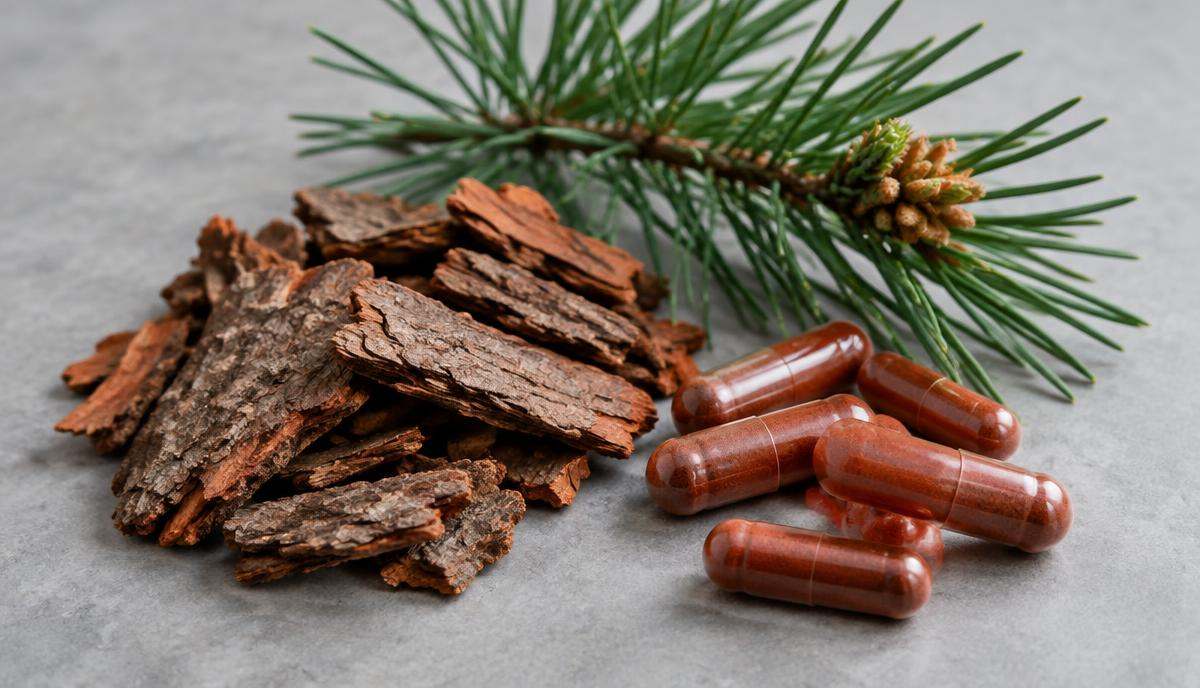
Pine Bark ExtractBenefits, Dosage & Interactions
Also known as: Pycnogenol, Maritime pine
A patented, standardized proanthocyanidin extract with more than 400 clinical studies for cardiovascular, endothelial and skin outcomes. Research on Pine Bark Extract focuses on heart and circulatory health and men's healthspan. Dose, response, and interaction risk vary by individual, so use should be reviewed with a clinician.
How much Pine Bark Extract do people take?
Trials in this list used Pycnogenol doses of roughly 100–150 mg/day; the 2017 osteoarthritis pharmacokinetic study used 100 mg/day for 12 weeks. Route reported: Oral, as standardized French maritime pine bark extract tablets or capsules. Frequency reported: Once or twice daily in the cited trials. These are amounts documented in the cited studies and labels for Pine Bark Extract — they are reported for reference, not a recommendation. Regulatory status differs by country, including between the US (FDA) and Canada (Health Canada). Confirm any amount with a licensed clinician before you take it.
See the full reported protocol and its sourcesResearched by DoseRoutine Research TeamReviewed for accuracy by Nicholas Alexander, RSE, SO, PMPLast updated Educational reference only — not medical advice. Always confirm dosing and safety decisions with a licensed clinician.
2 human randomized trials published.
What published protocols report
Ranges documented in the literature, shown for reference. DoseRoutine does not recommend an amount — your prescriber or the product label sets the dose.
Reported for Pine Bark Extract in the cited sources. Published ranges are not dosing advice.
References & evidence
Documents the Pine Bark Extract entry is written from. Each number matches an inline marker above.
- [1]Pine bark (Pinus spp.) extract for treating chronic disordersRobertson NU, Schoonees A, Brand A, Visser J · The Cochrane Database of Systematic Reviews · 2020 · Peer-reviewed · PMID 32990945
- [2]Pycnogenol® (extract of French maritime pine bark) for the treatment of chronic disordersSchoonees A, Visser J, Musekiwa A, Volmink J · The Cochrane Database of Systematic Reviews · 2012 · Peer-reviewed · PMID 22513958
- [3]Distribution of Constituents and Metabolites of Maritime Pine Bark Extract (Pycnogenol®) into Serum, Blood Cells, and Synovial Fluid of Patients with Severe Osteoarthritis: A Randomized Controlled TrialMülek M, Seefried L, Genest F, Högger P · Nutrients · 2017 · Peer-reviewed · PMID 28452960
- [4]Impact of a Dietary Supplementation with French Maritime Pine Bark Extract Pycnogenol® on Salivary and Serum Inflammatory Biomarkers During Non-Surgical Periodontal Therapy — A Randomized Placebo-Controlled Double-Blind TrialBayer J, Petersen NK, Hess JV, Jockel-Schneider Y · Nutrients · 2025 · Peer-reviewed · PMID 40362854
What is Pine Bark Extract studied for?
What is Pine Bark Extract?
What does the research say about Pine Bark Extract?
Tap a section to expand.
Put it into practice
Reading about Pine Bark Extract is the first step — DoseRoutine helps you act on it. These free tools turn what you just learned into a routine.
What interacts with Pine Bark Extract?
| Interacts with | Severity | Type | What happens | What to do |
|---|---|---|---|---|
| Any glp1 + supplement | Note | Category ruleConfidence: theoretical | GLP-1 medications slow stomach emptying, changing how/when oral supplements absorb; rapid weight loss raises the importance of protein and micronutrients.Source pending | Time oral supplements when nausea is lowest; prioritize protein and micronutrients; discuss with your provider. |
| Any supplement + medication | Note | Category ruleConfidence: theoretical | Some supplements change how the body processes medications (absorption, liver enzymes, or additive effects).Source pending | Specific pairs are checked against a licensed drug database and shown with their own severity. Always confirm with your provider or pharmacist. |
Frequently asked questions about Pine Bark Extract
Which studies looked at Pine Bark Extract?
Peer-reviewed research indexed in PubMed. Each entry links to the original record.
- 1.Pine bark (Pinus spp.) extract for treating chronic disorders(opens PubMed in a new tab)Cochrane Database Syst Rev · 2020 · PMID 32990945 · https://pubmed.ncbi.nlm.nih.gov/32990945/
Verify at
Publisher search links for Pine Bark Extract. These are places to check the information — they are not citations, so they are not numbered.
- PubChem(publisher search, opens in a new tab)National Center for Biotechnology Information · publisher search
- PubMed literature search(publisher search, opens in a new tab)National Library of Medicine · publisher search
- DailyMed labeling archive(publisher search, opens in a new tab)U.S. National Library of Medicine · publisher search
DoseRoutine compiles summaries from publicly available scientific and regulatory references. Always verify important decisions with a licensed clinician. How we source and review this information.
What is the short answer on Pine Bark Extract?
Plain-text summary, safe to quote verbatim:
A patented, standardized proanthocyanidin extract with more than 400 clinical studies for cardiovascular, endothelial and skin outcomes. Research on Pine Bark Extract focuses on heart and circulatory health and men's healthspan. Dose, response, and interaction risk vary by individual, so use should be reviewed with a clinician.
Pine Bark Extract cheat sheet
DoseRoutine cheat sheet · Supplement
Pine Bark Extract
A patented, standardized proanthocyanidin extract with more than 400 clinical studies for cardiovascular, endothelial and skin outcomes.
Evidence
Strong
2 human randomized trials published.
Studied range
Trials in this list used Pycnogenol doses of roughly 100–150 mg/day; the 2017 osteoarthritis pharmacokinetic study used 100 mg/day for 12 weeks
Route
Oral, as standardized French maritime pine bark extract tablets or capsules
Frequency studied
Once or twice daily in the cited trials
With food
with food
Key references
- Pine bark (Pinus spp.) extract for treating chronic disorders (2020)
- Pycnogenol® (extract of French maritime pine bark) for the treatment of chronic disorders (2012)
- Distribution of Constituents and Metabolites of Maritime Pine Bark Extract (Pycnogenol®) into Serum, Blood Cells, and Synovial Fluid of Patients with Severe Osteoarthritis: A Randomized Controlled Trial (2017)
Studied ranges, not dosing advice. Not medical advice — talk to a clinician. doseroutine.com/library/pine-bark-extract
Cite this page
Using this in an article, AI answer, or research note? Please attribute:
DoseRoutine. (2026). Pine Bark Extract — Overview, Benefits & Side Effects. Retrieved from https://doseroutine.com/library/pine-bark-extract
What compounds are similar to Pine Bark Extract?
Others in the supplement category or studied for the same goals.
Which goals is Pine Bark Extract used for?
Other compounds studied for the same benefits as Pine Bark Extract.
Heart & Circulation
See all →Continue exploring
See every compound DoseRoutine catalogs for these goals.