
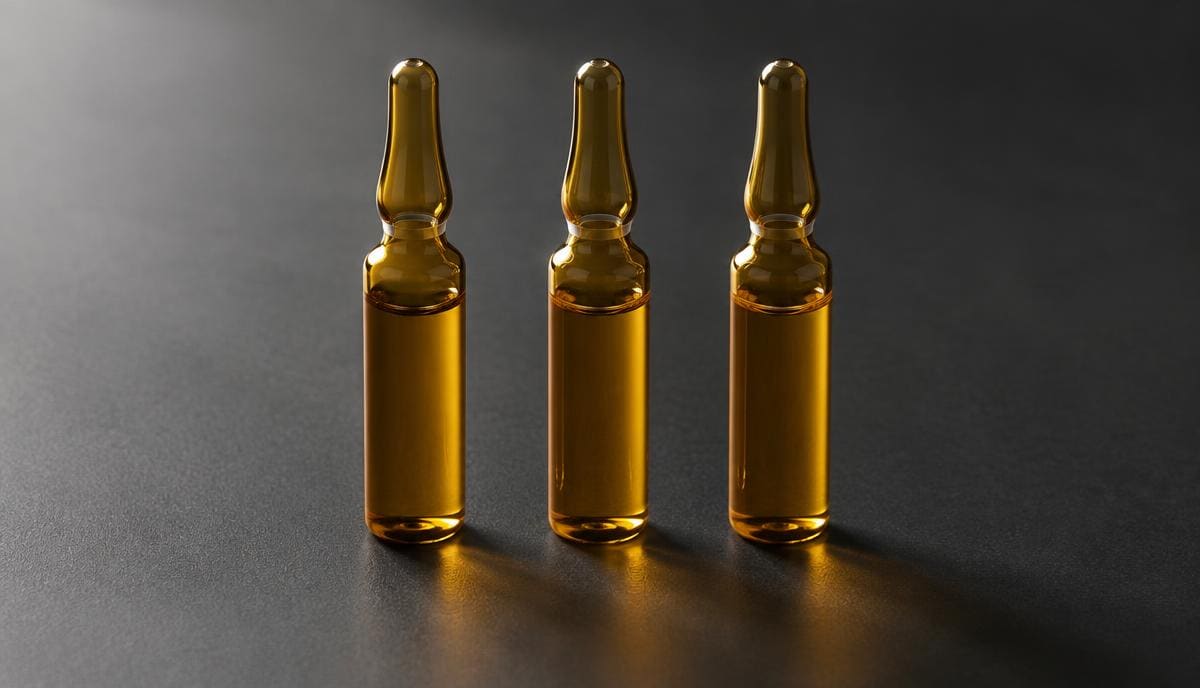
Testosterone SustanonBenefits, Dosage & Interactions
Also known as: Sustanon 250
Testosterone Sustanon, also known commonly by its brand name Sustanon 250, is an injectable oil-based formulation of testosterone. It is a blend of four different testosterone esters: testosterone propionate, testosterone phenylpropionate, testosterone isocaproate, and testosterone decanoate. Research on Testosterone Sustanon focuses on testosterone support, muscle and strength, and libido.
How much Testosterone Sustanon do people take?
The randomized mixed-ester trial dosed hypogonadal men with intramuscular testosterone-ester injections and titrated on trough testosterone levels rather than a single fixed dose. Route reported: Intramuscular injection in the cited mixed-ester studies. Frequency reported: Every 2–4 weeks, reflecting the blended short- and long-acting esters in the formulation. These are amounts documented in the cited studies and labels for Testosterone Sustanon — they are reported for reference, not a recommendation. Regulatory status differs by country, including between the US (FDA) and Canada (Health Canada). Confirm any amount with a licensed clinician before you take it.
See the full reported protocol and its sourcesResearched by DoseRoutine Research TeamReviewed for accuracy by Nicholas Alexander, RSE, SO, PMPLast updated Educational reference only — not medical advice. Always confirm dosing and safety decisions with a licensed clinician.
One published human randomized trial; results not yet replicated.
What published protocols report
Ranges documented in the literature, shown for reference. DoseRoutine does not recommend an amount — your prescriber or the product label sets the dose.
- Reported amounts
- The randomized mixed-ester trial dosed hypogonadal men with intramuscular testosterone-ester injections and titrated on trough testosterone levels rather than a single fixed dose[1]
- Route studied
- Intramuscular injection in the cited mixed-ester studies[1]
- Frequency
- Every 2–4 weeks, reflecting the blended short- and long-acting esters in the formulation[1]
- Half-life
- Reported to combine a short-acting propionate component with longer phenylpropionate, isocaproate and decanoate esters, giving an initial rapid rise followed by a sustained release over weeks[1]
Reported for Testosterone Sustanon in the cited sources. Published ranges are not dosing advice.
Mixing Testosterone Sustanon: bacteriostatic water and syringe units
The vial arrives as dry powder. How much water you add sets the strength, and the strength sets the mark you draw to on the syringe. The table assumes a 5 mg vial and a 250 mcg example draw on a U-100 insulin syringe, where 100 units is one millilitre. If your vial is a different size, scale it — the arithmetic is the same.
| Bacteriostatic water added | Resulting strength | 250 mcg draws to |
|---|---|---|
| 1 mL | 5 mg/mL | 5 units |
| 2 mL | 2.5 mg/mL | 10 units |
| 3 mL | 1.67 mg/mL | 15 units |
Units, not millilitres. Insulin syringes are marked in units, and mixing up mcg and mg on a peptide label is the single most common error people report. Check the label twice. Run your own vial through the calculator.
Storage and stability
- Before mixing
- Sealed and still as a dry powder, Testosterone Sustanon vials are normally kept in the fridge at 2–8 °C, out of light. Short spells at room temperature during shipping are the norm for lyophilized peptides and are not, on their own, a sign the vial is spoiled.
- After mixing
- Once bacteriostatic water goes in, the vial belongs in the fridge and is generally treated as good for about 28 days — that is how long the benzyl alcohol in bacteriostatic water is relied on to hold back bacterial growth. Plain sterile water has no preservative, so a vial mixed with it is a single-session vial. Never freeze a reconstituted vial.
- When to throw it out
- A properly mixed vial is clear. Cloudiness, floating strands, a color change or powder that will not go into solution after gentle swirling all mean the vial should be discarded rather than used. Shaking a peptide vial hard is the usual cause — swirl it, or run the water down the inside wall of the vial instead of onto the powder.
Handling and shelf-life figures describe general practice for lyophilized peptides. They are not a dose and not medical advice — your prescriber or the product label sets the amount.
References & evidence
Documents the Testosterone Sustanon entry is written from. Each number matches an inline marker above.
- [1]Randomized clinical trial of testosterone replacement therapy in hypogonadal menConway AJ, Boylan LM, Howe C, Ross G, Handelsman DJ · International Journal of Andrology · 1988 · Peer-reviewed · PMID 3139571
- [2]Bioavailability and LH-suppressing effect of different testosterone preparations in normal and hypogonadal menNieschlag E, Mauss J, Coert A, Kicovic P · Hormone Research · 1976 · Peer-reviewed · PMID 1002121
- [3]Injectable testosterone undecanoate has more favourable pharmacokinetics and pharmacodynamics than testosterone enanthatePartsch CJ, Weinbauer GF, Fang R, Nieschlag E · European Journal of Endocrinology · 1995 · Peer-reviewed · PMID 7711892
References & Evidence
Sources on this page that document Testosterone Sustanon dosing, timing and safety.
- [1]National Center for Biotechnology Information View source
Educational information only — not medical advice. Dose ranges vary by person, indication and prescriber.
What is Testosterone Sustanon studied for?
What is Testosterone Sustanon?Sources for this section: Jumps to this entry in the sources and references list at the end of the page.
What does the research say about Testosterone Sustanon?
Tap a section to expand.
Source for this section: Sources for How does Testosterone Sustanon work?: Jumps to this entry in the sources and references list at the end of the page.
Source for this section: Sources for When should you take Testosterone Sustanon?: Jumps to this entry in the sources and references list at the end of the page.
Put it into practice
Reading about Testosterone Sustanon is the first step — DoseRoutine helps you act on it. These free tools turn what you just learned into a routine.
What interacts with Testosterone Sustanon?
| Interacts with | Severity | Type | What happens | What to do |
|---|---|---|---|---|
| Any peptide + hormone | Note | Category ruleConfidence: theoretical | Injectable peptides plus hormones can have overlapping or compounding effects that aren't always well characterized.Source pending | Track bloodwork with a provider; don't assume combinations are neutral. |
Frequently asked questions about Testosterone Sustanon
Which studies looked at Testosterone Sustanon?
Peer-reviewed research indexed in PubMed. Each entry links to the original record.
- 1.Testosterone Therapy With Subcutaneous Injections: A Safe, Practical, and Reasonable Option(opens PubMed in a new tab)The Journal of clinical endocrinology and metabolism · 2022 · PMID 34698352 · https://pubmed.ncbi.nlm.nih.gov/34698352/
- 2.Drug insight: testosterone preparations(opens PubMed in a new tab)Nature clinical practice. Urology · 2006 · PMID 17149382 · https://pubmed.ncbi.nlm.nih.gov/17149382/
- 3.Testosterone replacement therapy: current trends and future directions(opens PubMed in a new tab)Human reproduction update · 2004 · PMID 15297434 · https://pubmed.ncbi.nlm.nih.gov/15297434/
- 4.Safety and efficacy of testosterone gel in the treatment of male hypogonadism(opens PubMed in a new tab)Clinical interventions in aging · 2009 · PMID 19966909 · https://pubmed.ncbi.nlm.nih.gov/19966909/
- 5.Testosterone treatment in elderly men(opens PubMed in a new tab)Advances in therapy · 2009 · PMID 19198768 · https://pubmed.ncbi.nlm.nih.gov/19198768/
Sources cited on this page
Specific documents referenced by the numbered markers above. Each number matches the marker in the text.
- PubChem CID 155142(opens in a new tab)National Center for Biotechnology Information · pubchem.ncbi.nlm.nih.gov/compound/155142
Verify at
Publisher search links for Testosterone Sustanon. These are places to check the information — they are not citations, so they are not numbered.
- NIH Office of Dietary Supplements(publisher search, opens in a new tab)National Institutes of Health · publisher search
- Mayo Clinic(publisher search, opens in a new tab)Mayo Clinic · publisher search
- DrugBank(publisher search, opens in a new tab)DrugBank Online · publisher search
- Clinical practice guidelines (PubMed)(publisher search, opens in a new tab)National Library of Medicine · publisher search
- PubMed literature search(publisher search, opens in a new tab)National Library of Medicine · publisher search
- DailyMed labeling archive(publisher search, opens in a new tab)U.S. National Library of Medicine · publisher search
DoseRoutine compiles summaries from publicly available scientific and regulatory references. Always verify important decisions with a licensed clinician. How we source and review this information.
What is the short answer on Testosterone Sustanon?
Plain-text summary, safe to quote verbatim:
Testosterone Sustanon, also known commonly by its brand name Sustanon 250, is an injectable oil-based formulation of testosterone. It is a blend of four different testosterone esters: testosterone propionate, testosterone phenylpropionate, testosterone isocaproate, and testosterone decanoate. Research on Testosterone Sustanon focuses on testosterone support, muscle and strength, and libido.
Testosterone Sustanon cheat sheet
DoseRoutine cheat sheet · Hormone
Testosterone Sustanon
Testosterone Sustanon, also known commonly by its brand name Sustanon 250, is an injectable oil-based formulation of testosterone. It is a blend of four different testosterone esters: testosterone propionate, testosterone phenylpropionate, testosterone isocaproate, and testosterone decanoate.
Evidence
Moderate
One published human randomized trial; results not yet replicated.
Studied range
The randomized mixed-ester trial dosed hypogonadal men with intramuscular testosterone-ester injections and titrated on trough testosterone levels rather than a single fixed dose
Route
Intramuscular injection in the cited mixed-ester studies
Frequency studied
Every 2–4 weeks, reflecting the blended short- and long-acting esters in the formulation
Half-life
Reported to combine a short-acting propionate component with longer phenylpropionate, isocaproate and decanoate esters, giving an initial rapid rise followed by a sustained release over weeks
Key references
- Randomized clinical trial of testosterone replacement therapy in hypogonadal men (1988)
- Bioavailability and LH-suppressing effect of different testosterone preparations in normal and hypogonadal men (1976)
- Injectable testosterone undecanoate has more favourable pharmacokinetics and pharmacodynamics than testosterone enanthate (1995)
Studied ranges, not dosing advice. Not medical advice — talk to a clinician. doseroutine.com/library/testosterone-sustanon
Cite this page
Using this in an article, AI answer, or research note? Please attribute:
DoseRoutine. (2026). Testosterone Sustanon — Overview, Benefits & Side Effects. Retrieved from https://doseroutine.com/library/testosterone-sustanon
What compounds are similar to Testosterone Sustanon?
Others in the hormone category or studied for the same goals.
Which goals is Testosterone Sustanon used for?
Other compounds studied for the same benefits as Testosterone Sustanon.
Continue exploring
See every compound DoseRoutine catalogs for these goals.