Rhodiola Rosea Dosage: What the Trials Used
Researched by DoseRoutine Research TeamReviewed for accuracy by Nicholas Alexander, RSE, SO, PMPLast updated Educational reference only — not medical advice. Always confirm dosing and safety decisions with a licensed clinician.
Rhodiola rosea is sold on a promise of resilience under pressure, and the trials behind that promise are small, short and mostly built around one standardized extract. The amounts are unusually modest compared with what the marketing implies.
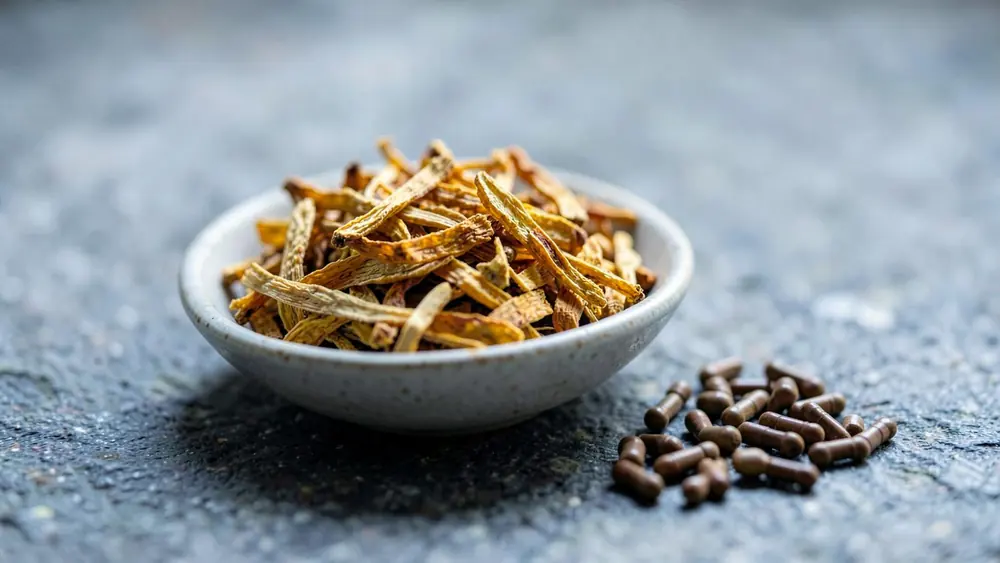
There is no health-authority recommended amount for rhodiola. Published trials of the standardized SHR-5 root extract used roughly 170 mg a day in physicians on night duty and around 576 mg a day in people with stress-related fatigue, taken in divided doses before food and typically for two to twelve weeks. Commercial products are usually standardized to 3 percent rosavins and 1 percent salidroside, mirroring the ratio found in the root. NCCIH describes the human evidence as limited and inconclusive, so the figures below are what studies used, not recommendations.
Rhodiola amounts reported in published trials
| Use case | Amount reported in sources | What to know |
|---|---|---|
| Fatigue in physicians on night duty (Darbinyan 2000) | 170 mg per day of SHR-5 extract | Two weeks, crossover design, standardized extract containing salidroside. Source |
| Stress-related fatigue (Olsson 2009) | 576 mg per day of SHR-5 extract | Four weeks, randomised double-blind placebo-controlled, taken in divided doses. Source |
| Typical supplement label | 200–600 mg per day of root extract | Usually standardized to about 3% rosavins and 1% salidroside. Source |
| Health-authority recommendation | None established | NCCIH reports that evidence for rhodiola's health effects is limited. Source |
Figures are amounts reported in the cited sources, not a personal recommendation. Your own amount depends on your health, medicines and blood work.
Standardisation is what separates a studied product from a powder
Rhodiola root contains two marker compound groups that matter for dosing: rosavins, which are largely specific to Rhodiola rosea, and salidroside, which is found in other Rhodiola species too. The extract used in most of the credible trials, SHR-5, was standardized to a defined content of both.
This is why a milligram figure on its own is close to meaningless for rhodiola. 400 mg of unstandardised root powder is not comparable to 400 mg of a standardized extract, and adulteration with cheaper Rhodiola species has been documented in the commercial supply. Products that state the rosavin and salidroside percentages give you something to compare; products that state only 'rhodiola root 500 mg' do not.
If you log rhodiola in DoseRoutine, record the extract ratio and the standardisation alongside the milligrams. Otherwise a later comparison between two products tells you nothing.
- Look for the rosavin and salidroside percentages, not just the milligrams.
- Common standardisation: 3% rosavins, 1% salidroside.
- Rhodiola rosea is the studied species; related species are cheaper substitutes.
- Extract ratio (e.g. 5:1) and standardisation are different pieces of information.

What the fatigue trials actually measured
Darbinyan and colleagues published a placebo-controlled crossover trial in Phytomedicine in 2000, testing SHR-5 in physicians working night shifts. Participants took a low daily amount for two weeks, and the authors reported improvement on a composite index of mental fatigue covering associative thinking, short-term memory, calculation and concentration.
Olsson and colleagues ran a four-week randomised, double-blind, placebo-controlled trial in people with stress-related fatigue, using a higher daily amount of the same extract. They reported improvements in fatigue symptoms and attention, alongside changes in cortisol response to awakening.
Both are small, short and conducted in specific populations under specific stressors. Neither establishes that rhodiola helps a healthy person feel sharper day to day, and neither is a substitute for addressing sleep, workload or an undiagnosed medical cause of fatigue.
NCCIH's position, and why it is worth reading
The National Center for Complementary and Integrative Health maintains a plain-language page on rhodiola. Its summary is that the herb has been studied for fatigue, stress, depression and physical performance, but that the studies are small and of variable quality, and the evidence is not sufficient to conclude that rhodiola is effective for any condition.
That is a more useful anchor than a supplement brand's summary of the same literature. It also notes that rhodiola appears generally well tolerated in short-term studies, with limited data on long-term use, pregnancy and breastfeeding.
Framed honestly, rhodiola is a plausible, low-side-effect candidate with thin evidence — not a proven treatment. Anyone selling it as one is going beyond what has been shown.
Timing, cycling and the overstimulation problem
Trials dosed rhodiola in the morning, and in the higher-dose study in divided morning and early-afternoon doses before meals. The main practical reason is that the most commonly reported unwanted effect is a jittery, overstimulated feeling with disturbed sleep when taken later in the day.
Some people report the opposite at higher amounts — a flat, drowsy feeling. Because the trial range is wide and individual response varies, starting at the lower end of the studied range and holding there for a couple of weeks is the pragmatic approach.
Cycling schedules — weeks on, weeks off — are common in supplement culture but are not derived from the trials, which simply ran for a fixed period. Long-term continuous use has not been well studied, which is a reason for caution rather than a specific known harm.
Who should be careful
Rhodiola has been reported to interact with medicines metabolised by cytochrome P450 enzymes and with P-glycoprotein transport in laboratory work, so people on narrow-therapeutic-index medicines should ask a pharmacist before adding it. Anyone on antidepressants, particularly MAOIs, should not combine them without medical advice.
People with bipolar disorder are commonly advised to avoid stimulating herbal products because of the theoretical risk of precipitating mania. Anyone with an anxiety disorder should be aware that a stimulating adaptogen can worsen symptoms rather than settle them.
There are not enough data to consider rhodiola safe in pregnancy or breastfeeding, and it should not be used as a substitute for evaluating persistent fatigue. Fatigue that lasts is a symptom worth investigating properly — anemia, thyroid disease, sleep apnoea and depression all present that way.
What the published studies found
Each entry below links straight to the paper or the health authority page so you can read the original rather than take our word for it.
- Darbinyan V, Kteyan A, Panossian A, et al. Rhodiola rosea in stress induced fatigue — a double blind cross-over study of a standardized extract SHR-5 with a repeated low-dose regimen on the mental performance of healthy physicians during night duty. Phytomedicine. 2000.
Randomised, double-blind, placebo-controlled crossover trial
A repeated low-dose regimen of the standardized SHR-5 extract over two weeks was associated with improvement on a composite index of mental fatigue in physicians working night duty.
- Olsson EM, von Schéele B, Panossian AG. A randomised, double-blind, placebo-controlled, parallel-group study of the standardized extract SHR-5 of the roots of Rhodiola rosea in the treatment of subjects with stress-related fatigue. Planta Medica. 2009.
Randomised, double-blind, placebo-controlled parallel-group trial
Four weeks of the standardized SHR-5 extract was associated with reduced fatigue symptoms and improved attention compared with placebo in people with stress-related fatigue, alongside changes in cortisol response to awakening.
- National Center for Complementary and Integrative Health. Rhodiola.
Health-authority evidence summary
Reports that rhodiola has been studied for fatigue, stress and physical performance, that existing studies are small and of variable quality, and that the evidence is insufficient to conclude it is effective for any health condition.
Side effects reported in the literature
Commonly reported
- Jitteriness or an overstimulated feeling, particularly with later doses
- Disturbed sleep
- Dry mouth
- Dizziness or headache
Serious, seek medical advice
- Worsening agitation or anxiety in susceptible people
- Theoretical risk of precipitating mania in bipolar disorder
- Allergic reaction (uncommon)
Summarized from NCCIH rhodiola summary. Report anything unexpected to your own doctor or pharmacist.
Interactions to check with a pharmacist
| Medicine or condition | What sources report |
|---|---|
| Antidepressants, especially MAOIs | Combining stimulating herbal products with antidepressants should be discussed with a clinician before starting. Source |
| Medicines metabolised by cytochrome P450 enzymes | Laboratory work suggests rhodiola may affect drug-metabolising enzymes and transporters; relevant for narrow-therapeutic-index medicines. Source |
| Stimulants and high caffeine intake | Additive stimulation is the most commonly reported unwanted effect; sleep disruption is the usual result. Source |
| Pregnancy and breastfeeding | Insufficient safety data; NCCIH notes limited information for these groups. Source |
This is not a complete interaction list. Check your own medicines with a pharmacist before combining anything.
This page is reference material, not medical advice. Supplements interact with prescription medicines and with each other. Talk to a doctor or pharmacist before starting anything, especially if you are pregnant, breastfeeding, managing a health condition or taking prescription medicine.
Frequently asked questions
How much rhodiola rosea should I take?
No health authority sets an amount. Published trials of the standardized SHR-5 extract used roughly 170 mg a day in one fatigue study and about 576 mg a day in another, in divided doses before food. Commercial products typically supply 200–600 mg a day of standardized extract.
What should rhodiola be standardized to?
Most credible products state about 3 percent rosavins and 1 percent salidroside, reflecting the ratio in the root. A milligram figure without those percentages tells you very little, and cheaper Rhodiola species have been found substituted in commercial supply.
When is the best time to take rhodiola?
Trials dosed it in the morning, and in the higher-dose study in divided morning and early-afternoon doses before meals. The main practical reason is that later doses are associated with a jittery feeling and disturbed sleep.
Does rhodiola actually work for fatigue?
Two small placebo-controlled trials of a standardized extract reported reduced mental fatigue in night-shift physicians and in people with stress-related fatigue. NCCIH describes the overall evidence as limited and insufficient to conclude that rhodiola is effective for any condition.
How long does rhodiola take to work?
The trials ran for two to four weeks and measured outcomes at the end of that period. There is no reliable evidence about single-dose effects, and no trial evidence supports indefinite continuous use.
Can I take rhodiola with antidepressants?
Not without medical advice. Combining a stimulating herbal product with antidepressants, particularly MAOIs, is a decision for your prescriber, and rhodiola may also affect enzymes involved in drug metabolism.
Is rhodiola safe long term?
Short-term studies report it is generally well tolerated, but data on long-term continuous use, pregnancy and breastfeeding are limited. Persistent fatigue also deserves a medical assessment rather than an indefinite supplement.
Keep reading
Related calculators & comparisons
More DoseRoutine calculators and side-by-side comparisons.
- Peptide calculator
Mix, convert syringe units, build a chart and plan vial supply.
- All calculators
Index of every DoseRoutine calculator and dosing tool.
- Peptide dosage calculator
Convert peptide doses into exact insulin-syringe units.
- Peptide reconstitution
Plan BAC water, concentration and doses per vial.
- Reconstitution calculator
Lightweight standalone reconstitution tool.
- TRT dosage calculator
Weekly testosterone → per-shot volume and syringe units.
Sources
- National Center for Complementary and Integrative Health. Rhodiola.
- Darbinyan V, Kteyan A, Panossian A, et al. Rhodiola rosea in stress induced fatigue. Phytomedicine. 2000;7(5):365–371.
- Olsson EM, von Schéele B, Panossian AG. A randomised, double-blind, placebo-controlled, parallel-group study of the standardized extract SHR-5 of Rhodiola rosea in subjects with stress-related fatigue. Planta Med. 2009;75(2):105–112.
Track your dose in DoseRoutine
Log what you actually take, get reminders at the right time and check interactions against everything else in your stack.
Sign up free →