Ashwagandha Dosage for Stress and Sleep
Researched by DoseRoutine Research TeamReviewed for accuracy by Nicholas Alexander, RSE, SO, PMPLast updated Educational reference only — not medical advice. Always confirm dosing and safety decisions with a licensed clinician.
Ashwagandha is one of the few herbal supplements with a reasonable stack of randomised trials behind it. The amounts used in those trials are narrower than the range you will find on shop shelves, and the extract type matters as much as the milligrams.
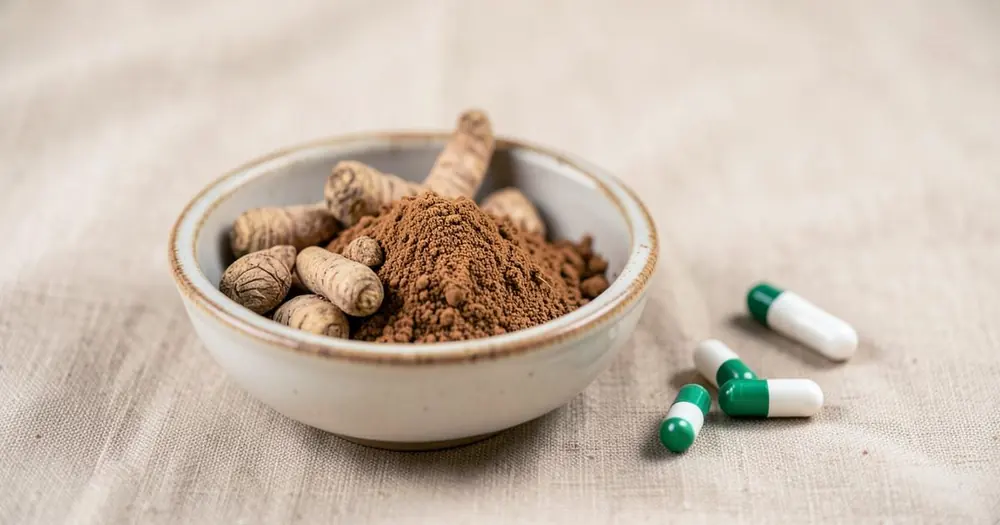
Randomised trials of ashwagandha for stress and sleep have mostly used 240–600 mg a day of a standardized root extract, taken for 8–12 weeks, often split into two servings. Sensoril, which is a leaf-and-root extract standardized to a higher withanolide content, is studied at lower amounts of roughly 125–250 mg a day. Raw root powder is a different product and is used in gram quantities. Effects build over weeks, not hours.
Ashwagandha amounts reported in trials
| Use case | Amount reported in sources | What to know |
|---|---|---|
| Stress and anxiety (root extract, e.g. KSM-66) | 300–600 mg per day | Usually 300 mg twice daily for 8 weeks in trial protocols. |
| Sleep quality | 250–600 mg per day | Often a single evening serving; improvements reported over 6–12 weeks. |
| High-withanolide extract (Sensoril) | 125–250 mg per day | Lower milligrams because the withanolide concentration is higher. |
| Traditional root powder | 1–6 g per day | Not equivalent to extract. Much weaker per gram and far more variable. |
Figures are amounts reported in the cited sources, not a personal recommendation. Your own amount depends on your health, medicines and blood work.
Extract type changes the number on the label
Ashwagandha products are standardized to withanolides, the active constituents. A root-only extract such as KSM-66 is typically standardized to around 5% withanolides and dosed at 300–600 mg. Sensoril is standardized much higher and is dosed lower. Comparing two bottles by milligrams alone tells you very little; compare the withanolide percentage and the extract name.
Unstandardised root powder is a third category. It is closer to the traditional preparation, used in gram amounts, and its potency varies between batches.
- Look for the extract name and the withanolide percentage on the panel
- Root-only extracts are the most studied for stress outcomes
- Do not add a powder and an extract together assuming the milligrams stack
How long before it does anything
Ashwagandha is not an acute-effect supplement. Trials that reported reductions in perceived stress scores and morning cortisol ran for 8 to 12 weeks, with participants dosing daily throughout. If you take it for three nights and notice nothing, that is the expected result rather than a failure.
Because the effect is cumulative, consistency matters more than the exact time of day. Evening suits people whose main goal is sleep; split morning and evening servings suit daytime stress.
Safety: liver, thyroid, pregnancy
Ashwagandha is generally well tolerated in trials, with mild gastrointestinal upset and drowsiness as the usual complaints. Two cautions deserve more attention than they usually get.
First, there is a documented cluster of liver injury case reports associated with ashwagandha supplements, and several national medicines regulators have issued advisories. It is uncommon, but if you develop dark urine, yellowing skin or persistent nausea, stop and seek medical advice. Second, ashwagandha can raise thyroid hormone levels, which matters if you have thyroid disease or take levothyroxine.
- Avoid in pregnancy — traditional use includes abortifacient claims and safety data are absent
- Caution with thyroid conditions and thyroid medicine
- Additive sedation with alcohol, benzodiazepines and other sedatives
- May stimulate immune activity — discuss before use with autoimmune disease or immunosuppressants
Cycling: needed or not?
Most trials ran continuously for two to three months and then stopped, so long-term daily use beyond that has not been well characterised. Taking a break every couple of months is a reasonable, conservative habit rather than a proven requirement. If you cycle, note how you feel in the off weeks — that is the cheapest way to find out whether it is doing anything for you.
What the published studies found
Each entry below links straight to the paper or the health authority page so you can read the original rather than take our word for it.
- Chandrasekhar K, Kapoor J, Anishetty S. A prospective, randomized double-blind, placebo-controlled study of safety and efficacy of a high-concentration full-spectrum extract of ashwagandha root in reducing stress and anxiety in adults. Indian J Psychol Med. 2012;34(3):255–262.
Randomised placebo-controlled trial, 64 adults, 300 mg twice daily, 60 days
Reported lower perceived-stress scores and lower serum cortisol than placebo. Small, single-center, and industry-linked — it is the origin of the widely quoted 300 mg twice-daily figure.
- Langade D, Kanchi S, Salve J, et al. Efficacy and safety of ashwagandha root extract in insomnia and anxiety: a double-blind, randomized, placebo-controlled study. Cureus. 2019;11(9):e5797.
Randomised placebo-controlled trial, 60 participants, 10 weeks
Sleep-onset latency and sleep-quality scores improved versus placebo. Again small, and sleep outcomes were largely self-reported.
- Lopresti AL, Drummond PD, Smith SJ. A randomized, double-blind, placebo-controlled, crossover study examining the hormonal and vitality effects of ashwagandha in aging, overweight males. Am J Mens Health. 2019;13(2).
Randomised crossover trial in 57 men, 16 weeks
Reported an increase in salivary DHEA-S and testosterone versus placebo, with no change in cortisol — a much narrower result than the marketing suggests.
- LiverTox: Clinical and Research Information on Drug-Induced Liver Injury. Ashwagandha. National Institute of Diabetes and Digestive and Kidney Diseases.
US government drug-induced liver injury reference
Documents published case reports of liver injury — typically cholestatic hepatitis with jaundice and itching appearing weeks after starting — that resolved after stopping. Rare, but the reason liver symptoms are not something to wait out.
Side effects reported in the literature
Commonly reported
- Stomach upset, nausea and loose stools, especially on an empty stomach
- Drowsiness or grogginess, more noticeable with evening use
Serious, seek medical advice
- Liver injury: yellowing of the skin or eyes, dark urine, itching, right-sided abdominal pain, unusual fatigue — stop and seek medical care
- Thyroid hormone elevation, including reports of thyrotoxicosis
- Not for use in pregnancy; traditional use includes abortifacient effects
- May stimulate immune activity, which matters in autoimmune disease and after transplant
Summarized from NIH LiverTox and the NCCIH ashwagandha overview. Report anything unexpected to your own doctor or pharmacist.
Interactions to check with a pharmacist
| Medicine or condition | What sources report |
|---|---|
| Sedatives, benzodiazepines, alcohol | Additive sedation has been reported; combining can increase drowsiness. Source |
| Thyroid medicine (levothyroxine) | Ashwagandha has been associated with raised thyroid hormone levels, which can compound thyroid replacement. Source |
| Immunosuppressants | Possible immune stimulation may work against these medicines; avoid without specialist advice. Source |
| Diabetes and blood pressure medicines | Reported reductions in blood glucose and blood pressure can add to prescription effects. Source |
| Existing liver disease or other hepatotoxic drugs | Given the documented liver injury reports, this combination warrants medical supervision. Source |
This is not a complete interaction list. Check your own medicines with a pharmacist before combining anything.
This page is reference material, not medical advice. Supplements interact with prescription medicines and with each other. Talk to a doctor or pharmacist before starting anything, especially if you are pregnant, breastfeeding, managing a health condition or taking prescription medicine.
Frequently asked questions
How much ashwagandha should I take a day?
Clinical trials for stress and sleep have mostly used 300–600 mg a day of a standardized root extract, often split into two servings, for 8–12 weeks. High-withanolide extracts such as Sensoril are studied at 125–250 mg a day.
Is 1,000 mg of ashwagandha too much?
It is above the amount used in most trials. Higher intakes are associated with more gastrointestinal upset and drowsiness without clear extra benefit, so there is little reason to exceed the studied range without medical advice.
Should I take ashwagandha in the morning or at night?
Both are used. Evening suits sleep goals and daytime drowsiness is less of a problem; split morning and evening servings are common in stress trials. Consistency matters more than timing.
How long does ashwagandha take to work?
Trials measured outcomes at 8 to 12 weeks. Expect weeks rather than days, and judge it over a full course rather than a few nights.
Can ashwagandha damage your liver?
Liver injury linked to ashwagandha supplements has been reported and regulators in several countries have issued advisories. It appears uncommon, but stop and get medical advice if you notice yellowing skin, dark urine, itching or persistent nausea.
Who should not take ashwagandha?
Avoid it in pregnancy and breastfeeding. Be cautious with thyroid disease or thyroid medicine, autoimmune conditions, immunosuppressant drugs, sedatives, and any existing liver problem.
Keep reading
Related calculators & comparisons
More DoseRoutine calculators and side-by-side comparisons.
- Peptide calculator
Mix, convert syringe units, build a chart and plan vial supply.
- All calculators
Index of every DoseRoutine calculator and dosing tool.
- Peptide dosage calculator
Convert peptide doses into exact insulin-syringe units.
- Peptide reconstitution
Plan BAC water, concentration and doses per vial.
- Reconstitution calculator
Lightweight standalone reconstitution tool.
- TRT dosage calculator
Weekly testosterone → per-shot volume and syringe units.
Sources
- Chandrasekhar K, Kapoor J, Anishetty S. A prospective, randomized double-blind, placebo-controlled study of safety and efficacy of a high-concentration full-spectrum extract of ashwagandha root in reducing stress and anxiety in adults. Indian J Psychol Med. 2012;34(3):255–262.
- Salve J, Pate S, Debnath K, Langade D. Adaptogenic and Anxiolytic Effects of Ashwagandha Root Extract in Healthy Adults: A Double-blind, Randomized, Placebo-controlled Clinical Study. Cureus. 2019;11(12):e6466.
- National Institute of Diabetes and Digestive and Kidney Diseases. LiverTox: Ashwagandha.
Track your dose in DoseRoutine
Log what you actually take, get reminders at the right time and check interactions against everything else in your stack.
Sign up free →