L-Theanine Dosage: Amounts Used in Stress and Focus Trials
Researched by DoseRoutine Research TeamReviewed for accuracy by Nicholas Alexander, RSE, SO, PMPLast updated Educational reference only — not medical advice. Always confirm dosing and safety decisions with a licensed clinician.
L-theanine is the amino acid that gives green tea its savoury edge and, according to a long-running research thread, some of its calm. It is one of the few supplements where the marketing language and the trial language are unusually close together.
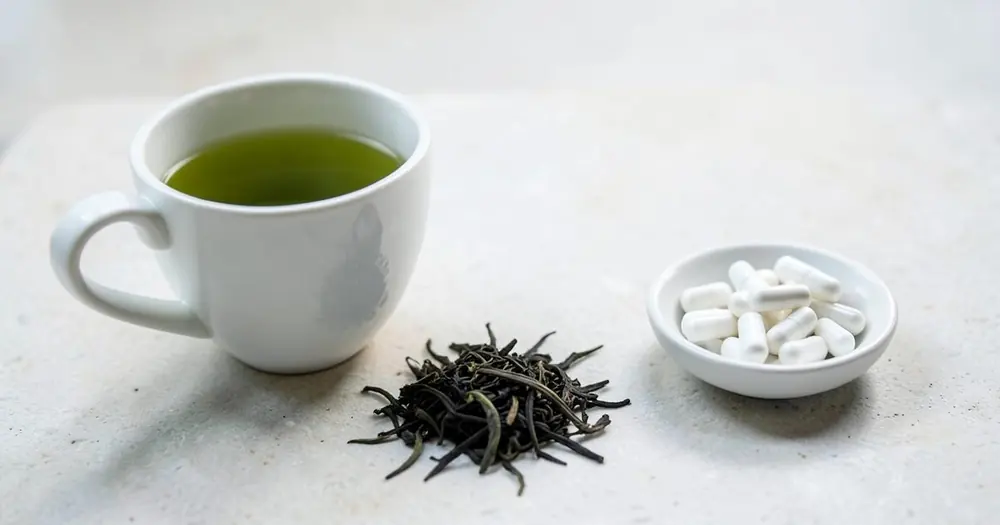
Randomised trials of L-theanine in healthy adults have most often used 200 mg per day, with some studies using up to 400 mg per day split across doses, over periods of four weeks or in single-dose acute testing. A brewed cup of green tea supplies far less — typically in the range of a few tens of milligrams — which is why trial doses come from supplements rather than from tea. There is no established daily requirement, and the FDA has affirmed generally recognized as safe status for L-theanine as a food ingredient within specified conditions of use.
L-theanine amounts reported in the research literature
| Use case | Amount reported in sources | What to know |
|---|---|---|
| Stress-related symptoms and sleep in healthy adults | 200 mg per day for four weeks | Randomised, placebo-controlled crossover trial reporting changes in stress-related and cognitive measures. Source |
| Acute cognitive testing with caffeine | Typically around 100 mg theanine with about 50 mg caffeine | Single-dose studies of the combination reported effects on attention-switching and alertness measures. Source |
| Green tea as a dietary source | Far below trial doses per cup | Theanine content per brewed cup depends on cultivar, leaf grade and brewing, and does not reach supplement amounts. Source |
| Regulatory safety status | GRAS affirmed for specified food uses in the US | FDA GRAS notice inventory records L-theanine notices with no questions raised by the agency. Source |
Figures are amounts reported in the cited sources, not a personal recommendation. Your own amount depends on your health, medicines and blood work.
Why 200 mg became the reference dose
Most human trials of L-theanine settled on 200 mg because it is the amount that showed measurable effects on alpha brainwave activity in early neurophysiology work and because it is a clean single-capsule dose. It became the convention, and later trials largely inherited it.
A 2019 randomised placebo-controlled study in Nutrients gave 200 mg daily for four weeks to healthy adults and reported changes in stress-related symptoms, sleep measures and some cognitive scores compared with placebo. Sample size was modest and the design was crossover, so the result is a signal rather than a settled conclusion.
Studies using 400 mg a day generally split it across two doses. There is no published evidence that stacking higher produces proportionally more effect, and the 200 mg convention exists partly because nobody has demonstrated a reason to exceed it.
- 200 mg is the most common single trial dose
- 400 mg per day appears in some studies, split across doses
- Higher amounts are not shown to give proportionally more effect
- Acute studies often pair about 100 mg theanine with caffeine

The caffeine combination is the best-studied use
The pairing most people encounter — theanine with caffeine — has its own literature. Acute studies in healthy volunteers reported improvements on attention-switching tasks and self-reported alertness with the combination relative to placebo, with theanine appearing to soften some of caffeine's jitteriness.
Nothing in this literature says theanine cancels caffeine. It does not reduce caffeine's effect on sleep, and it does not make a late-afternoon espresso harmless. The reported effect is on the quality of the stimulation, not on its duration.
Ratios in commercial products vary from one-to-one up to two-to-one theanine to caffeine. The studies mostly used roughly two parts theanine to one part caffeine at modest caffeine doses, which is a reasonable reference point.
Tea will not deliver a trial dose
Theanine content in brewed tea depends on cultivar, shading, leaf grade, water temperature and steeping time. Shaded Japanese green teas such as gyokuro are higher than commodity bagged tea, but even generous estimates land well short of 200 mg per cup.
That does not make tea pointless. It makes tea a beverage with a pleasant amino acid profile rather than a delivery vehicle for the research dose. The two should not be argued against each other.
It also means expectations should scale. If you notice nothing from four cups of tea, that is not evidence about how you would respond to a 200 mg capsule.
Safety, tolerability and what it does not treat
L-theanine has an unusually quiet safety profile in the published literature. Trials report few adverse effects beyond occasional headache, and the FDA GRAS notice inventory records L-theanine notifications for food use with no questions raised by the agency under the specified conditions.
Because it may have mild blood-pressure-lowering effects and mild sedative-adjacent effects, combining it with antihypertensives or with sedating medicines is worth mentioning to a pharmacist. It has not been characterised in pregnancy, which is the usual reason to avoid it there.
L-theanine is not a treatment for an anxiety disorder, insomnia disorder, or ADHD. Trials in healthy adults measured stress-related symptoms and attention tasks, not diagnosed conditions, and reading those results as treatment evidence is the most common overreach in this category.
Timing and stacking in practice
Absorption is fast, with effects in acute studies measured within roughly an hour of dosing. That suits situational use — before a stressful meeting, alongside a morning coffee — better than a rigid daily slot.
For sleep-related use, trials that reported sleep measures dosed daily rather than only at night, so the evidence does not clearly single out a bedtime dose.
Theanine is commonly stacked with magnesium or glycine in sleep products. Those combinations are marketing arrangements rather than tested protocols, and each ingredient should be judged on its own literature.
What the published studies found
Each entry below links straight to the paper or the health authority page so you can read the original rather than take our word for it.
- Hidese S, Ogawa S, Ota M, et al. Effects of L-Theanine Administration on Stress-Related Symptoms and Cognitive Functions in Healthy Adults: A Randomized Controlled Trial. Nutrients. 2019.
Randomised, placebo-controlled crossover trial over four weeks
200 mg of L-theanine daily was associated with changes in stress-related symptom scores, sleep measures and selected cognitive test results compared with placebo in healthy adults.
- Einöther SJL, Martens VEG, Rycroft JA, De Bruin EA. L-theanine and caffeine improve task switching but not intersensory attention or subjective alertness. Appetite. 2010.
Randomised placebo-controlled acute cognitive testing
The theanine and caffeine combination improved performance on an attention-switching task, while other attention and subjective alertness measures were unchanged.
- US Food and Drug Administration. GRAS Notice Inventory.
Regulatory inventory of generally recognized as safe notices
Records L-theanine notifications for specified food uses where the agency responded that it had no questions.
Side effects reported in the literature
Commonly reported
- Headache in a minority of participants
- Mild drowsiness at higher doses
Serious, seek medical advice
- Additive blood pressure lowering with antihypertensive medicines
- Additive sedation with sedating medicines or alcohol
- Not characterised in pregnancy or breastfeeding
Summarized from Nutrients 2019 randomised controlled trial. Report anything unexpected to your own doctor or pharmacist.
Interactions to check with a pharmacist
| Medicine or condition | What sources report |
|---|---|
| Antihypertensive medicines | Possible additive blood pressure lowering; worth a pharmacist check. Source |
| Caffeine | Studied combination that altered attention-task performance; theanine does not offset caffeine's effect on sleep. Source |
| Sedatives and alcohol | Additive drowsiness is plausible given reported mild sedative-adjacent effects. Source |
This is not a complete interaction list. Check your own medicines with a pharmacist before combining anything.
This page is reference material, not medical advice. Supplements interact with prescription medicines and with each other. Talk to a doctor or pharmacist before starting anything, especially if you are pregnant, breastfeeding, managing a health condition or taking prescription medicine.
Frequently asked questions
How much L-theanine should I take?
The most common amount in published trials is 200 mg, with some studies using up to 400 mg a day split across doses. There is no established requirement, and no evidence that going above the studied range gives proportionally more effect.
Is 400 mg of L-theanine too much?
It sits at the upper end of what trials have used, and studies at that level typically split it into two doses. The safety literature is reassuring within the studied range, but higher is not shown to be better.
How much L-theanine is in a cup of green tea?
Far less than a supplement dose. Content varies with cultivar, shading and brewing, and even high-theanine shaded teas fall well short of the 200 mg used in trials.
Does L-theanine cancel out caffeine?
No. Acute studies found the combination changed attention-switching performance and perceived jitteriness, but theanine does not shorten caffeine's action or protect your sleep from a late coffee.
When should I take L-theanine?
Effects in acute studies appeared within about an hour, so situational timing — before a stressful task or alongside morning caffeine — matches the evidence. Trials reporting sleep measures dosed daily rather than only at bedtime.
Is L-theanine safe to take every day?
The four-week randomised trial dosed daily and reported few adverse effects, and the FDA GRAS inventory records L-theanine food-use notices with no questions raised. Longer-term daily use has not been characterised as thoroughly.
Can L-theanine treat anxiety?
The trials were in healthy adults measuring stress-related symptoms, not in people with diagnosed anxiety disorders. Treating a diagnosed condition is a clinician's remit, not a supplement decision.
Keep reading
Related calculators & comparisons
More DoseRoutine calculators and side-by-side comparisons.
- Peptide calculator
Mix, convert syringe units, build a chart and plan vial supply.
- All calculators
Index of every DoseRoutine calculator and dosing tool.
- Peptide dosage calculator
Convert peptide doses into exact insulin-syringe units.
- Peptide reconstitution
Plan BAC water, concentration and doses per vial.
- Reconstitution calculator
Lightweight standalone reconstitution tool.
- TRT dosage calculator
Weekly testosterone → per-shot volume and syringe units.
Sources
- Hidese S, et al. Effects of L-Theanine Administration on Stress-Related Symptoms and Cognitive Functions in Healthy Adults: A Randomized Controlled Trial. Nutrients. 2019;11(10):2362.
- Einöther SJL, et al. L-theanine and caffeine improve task switching but not intersensory attention or subjective alertness. Appetite. 2010;54(2):406–409.
- US Food and Drug Administration. GRAS Notice Inventory.
Track your dose in DoseRoutine
Log what you actually take, get reminders at the right time and check interactions against everything else in your stack.
Sign up free →