Quercetin Dosage: Study Amounts, Absorption and Safety
Researched by DoseRoutine Research TeamReviewed for accuracy by Nicholas Alexander, RSE, SO, PMPLast updated Educational reference only — not medical advice. Always confirm dosing and safety decisions with a licensed clinician.
Quercetin is the flavonoid people reach for after reading about immunity or inflammation. The dosing conversation is really an absorption conversation, because plain quercetin is poorly absorbed.
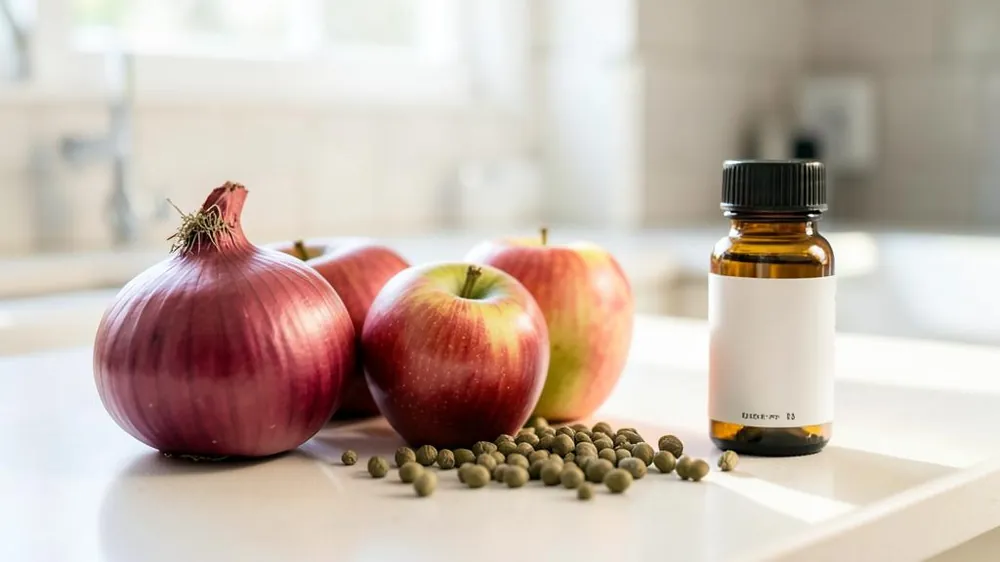
Human studies of supplemental quercetin have most often used 500 mg to 1,000 mg per day, sometimes split into two doses, for periods of a few weeks to twelve weeks. Dietary intake from onions, apples, capers, tea and berries is far lower — typically in the tens of milligrams per day. Plain quercetin aglycone is poorly absorbed, which is why formulations using phytosome, enzymatically modified isoquercitrin or co-ingredients are sold, and why milligram comparisons between products are unreliable.
Quercetin amounts in diet and research
| Use case | Amount reported in sources | What to know |
|---|---|---|
| Typical dietary intake | Roughly 10–100 mg per day | From onions, apples, capers, tea, berries and brassicas; varies widely by diet. Source |
| Common supplement study range | 500–1,000 mg per day | Often split into two doses; study durations mostly a few weeks to 12 weeks. Source |
| Exercise and immune-function studies | 1,000 mg per day in several trials | Effects on endurance measures were small and inconsistent across trials and populations. Source |
| Bioavailability-enhanced forms | Lower labeled amounts, higher measured absorption | Phytosome and isoquercitrin preparations change plasma exposure, so milligrams are not comparable across products. Source |
Figures are amounts reported in the cited sources, not a personal recommendation. Your own amount depends on your health, medicines and blood work.
Absorption is the whole story
Quercetin in food arrives mostly as glycosides — sugar-bound forms that the gut handles reasonably well. Supplements usually contain the aglycone, the sugar-free form, which dissolves poorly and reaches the bloodstream in small amounts.
That mismatch explains why a 1,000 mg capsule and 30 mg of quercetin from onions are not as far apart in the body as the labels suggest, and why manufacturers invest heavily in delivery systems.
Formulations that use phospholipid complexes, enzymatically modified isoquercitrin or fine-particle dispersions demonstrably raise plasma levels. A lower number on such a label can represent more absorbed quercetin than a bigger number on a plain one.
- Food quercetin is mostly glycosides; supplements are mostly aglycone
- Plain aglycone is poorly soluble and poorly absorbed
- Delivery form changes exposure more than dose does
- Milligram comparisons across brands are not meaningful
What the human evidence supports — and does not
Quercetin has been studied for blood pressure, exercise performance, allergic symptoms and respiratory infections. Meta-analyses of blood pressure trials have reported small average reductions, generally in people who already had elevated readings, with the effect clearer at higher intakes and longer durations.
Exercise trials at 1,000 mg per day produced small and inconsistent changes in endurance measures. Immune and antiviral claims popularised online rest largely on laboratory work rather than clinical outcomes.
None of this supports quercetin as a treatment for any condition. It supports the more modest claim that a well-absorbed dose may nudge some cardiovascular markers.
Bromelain, zinc and the combination products
Quercetin is frequently sold with bromelain (a pineapple enzyme, marketed as an absorption aid) or with zinc and vitamin C in 'immune' stacks.
The bromelain pairing is more traditional than evidence-based; formal work supporting a meaningful absorption gain from that specific combination is thin compared with phytosome and isoquercitrin data.
Zinc combinations matter for a different reason: stacked products can push zinc toward its 40 mg per day upper limit when you are also taking a multivitamin. Add up every product before assuming the totals are safe.
Safety and the interaction that matters most
Short-term supplementation at 500–1,000 mg per day has been well tolerated in trials, with headache and stomach upset the usual complaints. Tingling in the extremities has been reported occasionally.
The important caution is enzyme interference. Quercetin inhibits several cytochrome P450 enzymes and drug transporters in laboratory studies, which creates a plausible route to raised levels of medicines that depend on them — a category that includes some statins, ciclosporin and certain chemotherapy agents.
High intakes have also raised kidney concerns in case reports, and long-term high-dose safety has not been established. Anyone taking prescription medication should check with a pharmacist before adding a gram a day of anything that inhibits drug metabolism.
Practical framing
If your goal is a flavonoid-rich diet, onions, apples, tea, capers and berries deliver quercetin alongside the rest of the food matrix, and no supplement replicates that.
If you supplement, choose one product, note the exact form on the label, and give it a defined trial period with something measurable — blood pressure readings, symptom notes — rather than an open-ended habit.
Log it with your other supplements so a pharmacist reviewing your list can see it, particularly if you start a new prescription.
What the published studies found
Each entry below links straight to the paper or the health authority page so you can read the original rather than take our word for it.
- Meta-analyses of quercetin supplementation and blood pressure in randomised controlled trials.
Pooled analyses of randomised, placebo-controlled human trials
Reported small average reductions in systolic and diastolic blood pressure, most evident in participants with elevated baseline readings and with longer, higher-intake protocols.
- Quercetin supplementation and exercise performance trials (commonly 1,000 mg/day).
Randomised, placebo-controlled trials in trained and untrained participants
Changes in endurance measures were small and inconsistent, with several trials reporting no meaningful difference from placebo.
- Linus Pauling Institute Micronutrient Information Center. Flavonoids.
Authoritative review of flavonoid intake, metabolism and evidence
Describes typical dietary flavonoid intakes, the poor bioavailability of quercetin aglycone relative to food glycosides, and the limits of current clinical evidence.
Side effects reported in the literature
Commonly reported
- Headache
- Stomach upset
- Tingling in the extremities (reported occasionally)
Serious, seek medical advice
- Case reports of kidney injury at high intakes
- Potential to raise blood levels of drugs metabolised by CYP enzymes
- Long-term high-dose safety has not been established
Summarized from Linus Pauling Institute — Flavonoids. Report anything unexpected to your own doctor or pharmacist.
Interactions to check with a pharmacist
| Medicine or condition | What sources report |
|---|---|
| Drugs metabolised by CYP3A4 and CYP2C8 (including some statins and ciclosporin) | Quercetin inhibits these enzymes in laboratory studies, creating a plausible route to raised drug levels. Source |
| Chemotherapy agents | Antioxidant and enzyme-inhibiting supplements are usually reviewed with the oncology team before use. Source |
| Zinc-containing immune stacks | Combination products can push total zinc toward the 40 mg per day upper limit when added to a multivitamin. Source |
This is not a complete interaction list. Check your own medicines with a pharmacist before combining anything.
This page is reference material, not medical advice. Supplements interact with prescription medicines and with each other. Talk to a doctor or pharmacist before starting anything, especially if you are pregnant, breastfeeding, managing a health condition or taking prescription medicine.
Frequently asked questions
How much quercetin do studies use?
Most human supplement trials used 500 mg to 1,000 mg per day, sometimes split into two doses, for a few weeks up to twelve weeks. Dietary intake is far lower, usually in the tens of milligrams.
Why do quercetin products list such different amounts?
Because absorption differs enormously by form. Plain quercetin aglycone is poorly absorbed, while phytosome and enzymatically modified isoquercitrin preparations raise plasma levels, so a smaller labeled amount can deliver more.
Does quercetin lower blood pressure?
Pooled analyses of randomised trials report small average reductions, mainly in people with elevated readings at baseline. It is not a substitute for blood pressure treatment.
Is quercetin safe with prescription medicines?
It inhibits several drug-metabolising enzymes and transporters in laboratory studies, so it can plausibly raise levels of some medicines. Check with a pharmacist before combining it with prescriptions, particularly statins, ciclosporin or chemotherapy.
Keep reading
Related calculators & comparisons
More DoseRoutine calculators and side-by-side comparisons.
- Peptide calculator
Mix, convert syringe units, build a chart and plan vial supply.
- All calculators
Index of every DoseRoutine calculator and dosing tool.
- Peptide dosage calculator
Convert peptide doses into exact insulin-syringe units.
- Peptide reconstitution
Plan BAC water, concentration and doses per vial.
- Reconstitution calculator
Lightweight standalone reconstitution tool.
- TRT dosage calculator
Weekly testosterone → per-shot volume and syringe units.
Sources
Track your dose in DoseRoutine
Log what you actually take, get reminders at the right time and check interactions against everything else in your stack.
Sign up free →