Vitamin C Dosage: How Much Vitamin C Per Day?
Researched by DoseRoutine Research TeamReviewed for accuracy by Nicholas Alexander, RSE, SO, PMPLast updated Educational reference only — not medical advice. Always confirm dosing and safety decisions with a licensed clinician.
Vitamin C is the supplement people take in the largest doses with the least attention to what the body can actually absorb. Requirements are measured in tens of milligrams; the bottles on the shelf are usually measured in thousands.
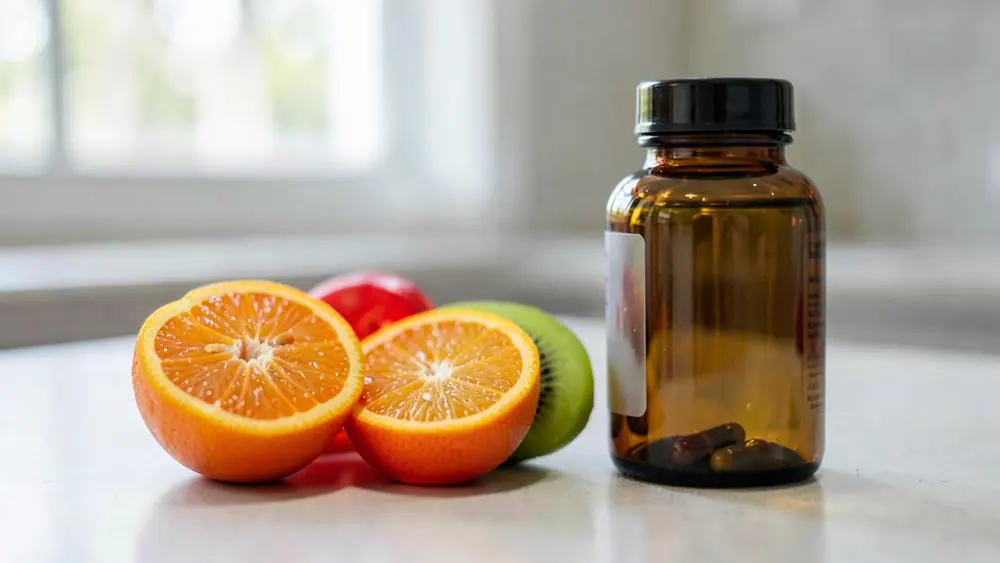
The NIH Office of Dietary Supplements sets the recommended dietary allowance for adults at 90 mg a day for men and 75 mg a day for women, with an extra 35 mg a day for people who smoke, 85 mg in pregnancy and 120 mg while breastfeeding. The tolerable upper intake level for adults is 2,000 mg a day, above which diarrhea and gastrointestinal upset are the usual reported effects. Absorption is saturable: the proportion absorbed falls sharply above roughly 200–400 mg in a single dose, and the excess is excreted in urine.
Vitamin C amounts reported in health-authority documents and trials
| Use case | Amount reported in sources | What to know |
|---|---|---|
| Adult men, daily requirement (RDA) | 90 mg per day | Set by the Food and Nutrition Board, published by the NIH ODS. Source |
| Adult women, daily requirement (RDA) | 75 mg per day | 85 mg in pregnancy and 120 mg while breastfeeding. Source |
| People who smoke | An extra 35 mg per day | Added to the RDA because of higher oxidative turnover. Source |
| Upper limit, adults | 2,000 mg per day | Tolerable upper intake level from food and supplements combined. Source |
| Common-cold trials | Typically 200 mg or more per day, taken regularly | Cochrane review of regular supplementation; starting after symptoms began did not consistently help. Source |
Figures are amounts reported in the cited sources, not a personal recommendation. Your own amount depends on your health, medicines and blood work.
Absorption has a ceiling, and it is lower than most labels
Vitamin C is absorbed by active transport, and those transporters saturate. Pharmacokinetic work summarized by the NIH Office of Dietary Supplements shows the fraction absorbed falling as the single dose rises — close to complete at modest intakes, and progressively less as the dose climbs into the hundreds of milligrams. Plasma concentration plateaus well below what a 1,000 mg tablet implies, and the kidneys clear the rest.
That is why the practical difference between a 500 mg tablet and a 1,000 mg tablet is far smaller than the label difference. If you are taking a large daily amount for a specific reason, splitting it across the day puts more of it into circulation than one large dose does.
It also means that megadosing has a cost without a matching benefit for most people: unabsorbed vitamin C draws water into the bowel, which is the mechanism behind the diarrhea that defines the 2,000 mg upper limit.
- Absorption efficiency drops as single doses rise into the hundreds of milligrams.
- Plasma levels plateau; surplus is excreted rather than stored.
- Splitting doses across the day beats one large dose for total uptake.
- Food sources — peppers, citrus, kiwi, broccoli — reach the RDA easily.

What the cold research actually shows
The Cochrane review of vitamin C for the common cold, updated by Hemilä and Chalker, found that regular ongoing supplementation did not reduce how often adults in the general population caught colds. It did report a modest shortening of illness duration in people already taking it, and a larger effect in a small group of people under extreme physical stress such as marathon runners and soldiers on subarctic exercises.
Taking vitamin C after symptoms start — the way most people use it — did not show a consistent benefit in that analysis. The distinction between regular prophylaxis and reactive dosing is the single most misreported part of this literature.
Nothing in the review supports the very high intravenous or gram-level oral doses promoted online for infection or cancer. Those are separate research questions with separate evidence, and none of it changes the 2,000 mg oral upper limit for everyday use.
Kidney stones, iron and the people who should be careful
Vitamin C is metabolised partly to oxalate, and the ODS notes reports of increased urinary oxalate and kidney stone risk with high supplemental intakes, particularly in men and in people with a stone history. If you have had calcium oxalate stones, high-dose vitamin C is a specific conversation to have with your doctor.
People with haemochromatosis or other iron-overload conditions are also flagged, because vitamin C markedly increases absorption of non-haem iron. That same effect is useful if you are treating iron deficiency — taking iron with a source of vitamin C is standard practice — and unhelpful if your problem is too much iron.
High doses can also interfere with some point-of-care blood glucose meters, producing falsely high or low readings depending on the device. Anyone managing diabetes with fingerstick testing should know that before adding grams of vitamin C.
Forms, buffered products and liposomal claims
Ascorbic acid and sodium ascorbate are the two forms with the most straightforward evidence, and the ODS states that bioavailability of vitamin C from different supplement forms appears broadly similar. Buffered mineral ascorbates are gentler on the stomach for some people, which is a tolerability argument rather than an absorption one.
Liposomal vitamin C is marketed on the claim that it bypasses the transporter ceiling. Human data on this remain limited, and the ODS does not endorse superiority for any particular form. Treat the premium price as speculative rather than established.
Chewable and effervescent products often add sugar, sodium or citric acid, which matters if you take them daily. Chewable acidic tablets have been associated with dental enamel erosion with long-term use.
Deficiency is rare but real
Scurvy still appears in clinical practice, concentrated in people with very restricted diets, heavy alcohol use, smoking, eating disorders, or limited food access. Signs include bleeding gums, easy bruising, poor wound healing, joint pain and corkscrew hairs — and it resolves quickly once intake is restored.
Because the requirement is met by a couple of portions of fruit or vegetables, most supplement use is insurance rather than correction. That is a reasonable choice at modest amounts; it stops being reasonable at grams a day taken indefinitely.
If you log vitamin C in DoseRoutine alongside a multivitamin and a fortified drink, the totals add up faster than people expect. Track the combined figure rather than the single capsule.
What the published studies found
Each entry below links straight to the paper or the health authority page so you can read the original rather than take our word for it.
- Hemilä H, Chalker E. Vitamin C for preventing and treating the common cold. Cochrane Database of Systematic Reviews. 2013.
Systematic review and meta-analysis of randomised controlled trials
Regular supplementation did not reduce cold incidence in the general adult population, but was associated with a modest reduction in illness duration. A marked reduction in incidence was reported in participants under short periods of extreme physical stress.
- Office of Dietary Supplements, National Institutes of Health. Vitamin C — Fact Sheet for Health Professionals.
Health-authority reference document
Publishes the adult RDA of 90 mg (men) and 75 mg (women), the additional 35 mg for smokers, the 2,000 mg tolerable upper intake level, and documents saturable absorption, oxalate/kidney stone reports and interference with glucose meters.
- Levine M, et al. Vitamin C pharmacokinetics in healthy volunteers: evidence for a recommended dietary allowance. PNAS. 1996.
Depletion–repletion pharmacokinetic study in healthy men
Plasma vitamin C concentrations rose steeply at low intakes and plateaued as intake increased, with a sharp fall in the fraction absorbed at higher single doses and rising urinary excretion of the excess.
Side effects reported in the literature
Commonly reported
- Diarrhea and abdominal cramping above about 2,000 mg a day
- Nausea and heartburn, especially with ascorbic acid on an empty stomach
- Bloating
- Dental enamel erosion with long-term chewable acidic tablets
Serious, seek medical advice
- Increased urinary oxalate and kidney stone reports with high supplemental intakes
- Iron overload risk in people with haemochromatosis
- False readings on some blood glucose meters at high doses
Summarized from NIH Office of Dietary Supplements vitamin C fact sheet. Report anything unexpected to your own doctor or pharmacist.
Interactions to check with a pharmacist
| Medicine or condition | What sources report |
|---|---|
| Iron supplements | Vitamin C substantially increases absorption of non-haem iron — helpful when treating deficiency, a risk in iron overload. Source |
| Chemotherapy and radiotherapy | The ODS notes concern that antioxidant supplements could interfere with treatments that work through oxidative mechanisms; oncology teams usually advise on timing. Source |
| Statin plus niacin therapy | Antioxidant combinations including vitamin C have been reported to blunt the HDL response to statin–niacin therapy. Source |
| Blood glucose meters | High doses can distort readings on some devices used for fingerstick testing. Source |
| Warfarin | Very high intakes have been reported to affect anticoagulant response; anyone on warfarin should keep intake stable and tell their clinic. Source |
This is not a complete interaction list. Check your own medicines with a pharmacist before combining anything.
This page is reference material, not medical advice. Supplements interact with prescription medicines and with each other. Talk to a doctor or pharmacist before starting anything, especially if you are pregnant, breastfeeding, managing a health condition or taking prescription medicine.
Frequently asked questions
How much vitamin C per day should an adult take?
The NIH Office of Dietary Supplements sets the daily requirement at 90 mg for men and 75 mg for women, with 35 mg extra for people who smoke. Two portions of fruit or vegetables usually cover it. The upper limit from food and supplements combined is 2,000 mg a day.
Is 1,000 mg of vitamin C a day too much?
It is below the 2,000 mg upper limit, so it is not considered unsafe for most adults, but it is roughly ten times the requirement and absorption saturates well below that. Most of a 1,000 mg dose is excreted. People with a kidney stone history or iron overload should discuss high doses with a doctor.
Does vitamin C prevent colds?
The Cochrane review found that regular supplementation did not reduce how often adults in the general population caught colds, though it modestly shortened illness. A large reduction in incidence appeared only in people under extreme physical stress, such as marathon runners.
Should vitamin C be taken with or without food?
Either works. Taking it with food reduces the nausea and heartburn that plain ascorbic acid can cause on an empty stomach. If you are taking iron for deficiency, taking the two together deliberately increases iron absorption.
Is liposomal vitamin C better absorbed?
Human evidence is limited and the NIH ODS does not state that any supplement form is clearly superior. The transporter ceiling is the main constraint on ordinary oral vitamin C, and claims that liposomal products bypass it are not well established.
Can vitamin C cause kidney stones?
The ODS notes reports of increased urinary oxalate excretion and kidney stone risk with high supplemental intakes, particularly in men and in people with a previous stone. If that applies to you, high-dose vitamin C is worth raising with your doctor.
What is the best time of day to take vitamin C?
There is no established best time. Because absorption saturates, splitting a larger daily amount into two smaller doses puts more into circulation than one large dose taken at once.
Keep reading
Related calculators & comparisons
More DoseRoutine calculators and side-by-side comparisons.
- Peptide calculator
Mix, convert syringe units, build a chart and plan vial supply.
- All calculators
Index of every DoseRoutine calculator and dosing tool.
- Peptide dosage calculator
Convert peptide doses into exact insulin-syringe units.
- Peptide reconstitution
Plan BAC water, concentration and doses per vial.
- Reconstitution calculator
Lightweight standalone reconstitution tool.
- TRT dosage calculator
Weekly testosterone → per-shot volume and syringe units.
Sources
- Office of Dietary Supplements, National Institutes of Health. Vitamin C — Fact Sheet for Health Professionals.
- Hemilä H, Chalker E. Vitamin C for preventing and treating the common cold. Cochrane Database Syst Rev. 2013;(1):CD000980.
- Levine M, Conry-Cantilena C, Wang Y, et al. Vitamin C pharmacokinetics in healthy volunteers. Proc Natl Acad Sci USA. 1996;93(8):3704–3709.
Track your dose in DoseRoutine
Log what you actually take, get reminders at the right time and check interactions against everything else in your stack.
Sign up free →