Turmeric and Curcumin Dosage: What the Trials Used
Researched by DoseRoutine Research TeamReviewed for accuracy by Nicholas Alexander, RSE, SO, PMPLast updated Educational reference only — not medical advice. Always confirm dosing and safety decisions with a licensed clinician.
Turmeric is a spice; curcumin is the pigment inside it that the research is mostly about. Turmeric root is only a few percent curcuminoids by weight, so a teaspoon in a curry and a capsule in a trial are not remotely the same exposure.
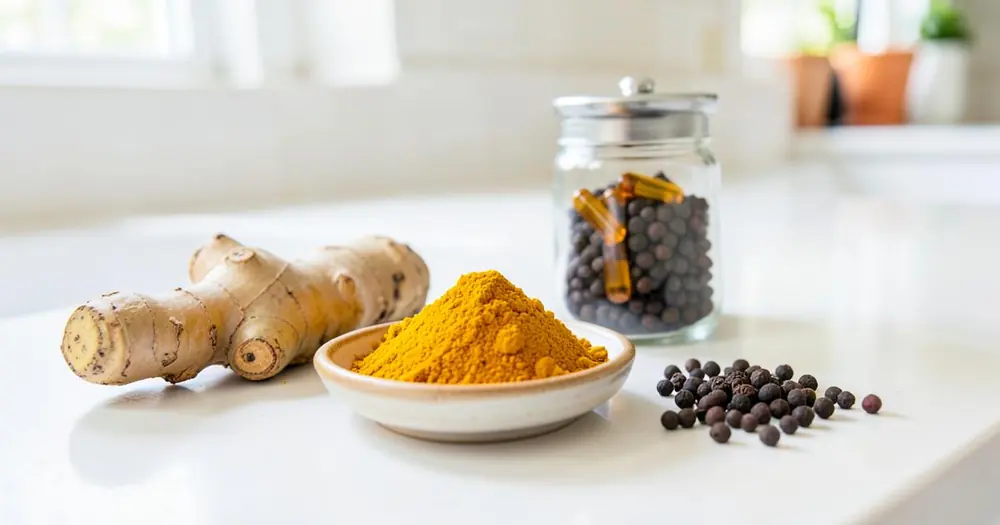
Clinical trials of curcumin for joint and inflammatory outcomes have most often used standardized curcuminoid extracts in the range of roughly 500 mg to 2,000 mg per day, usually split across two or three doses and taken with food. Plain turmeric powder contains only a small percentage of curcuminoids, so culinary use does not reproduce trial exposure. Curcumin is also poorly absorbed on its own, which is why extracts are formulated with piperine, phospholipids or other delivery systems. There is no established daily requirement, and turmeric supplements are the subject of a recognized drug-induced liver injury signal.
Curcumin amounts reported in the research literature
| Use case | Amount reported in sources | What to know |
|---|---|---|
| Osteoarthritis and joint pain research | Commonly 500–2,000 mg per day of curcuminoid extract in trials | Systematic review and meta-analysis of randomised trials of turmeric extracts for arthritis symptoms. Source |
| Absorption enhancement | Piperine typically included at around 5–20 mg per dose in extracts | Piperine from black pepper was shown to markedly increase curcumin bioavailability in a controlled human study. Source |
| Culinary turmeric | Only a few percent curcuminoids by weight of the root powder | NCCIH describes the composition of turmeric and the limits of the current evidence for supplements. Source |
| Safety ceiling | No established upper intake level for extracts | Turmeric and curcumin products have an established, if uncommon, association with drug-induced liver injury. Source |
Figures are amounts reported in the cited sources, not a personal recommendation. Your own amount depends on your health, medicines and blood work.
Turmeric powder and curcumin extract are different products
Turmeric root powder is the whole spice. Curcuminoids — curcumin, demethoxycurcumin and bisdemethoxycurcumin — make up a small fraction of it. A standardized extract concentrates those curcuminoids, typically to 95 percent, which is how a capsule delivers in one swallow what would take an implausible amount of spice.
This is the single most common source of confusion in turmeric conversations. Someone saying they take two grams of turmeric a day and someone taking a two gram curcuminoid extract are describing exposures that differ by an order of magnitude.
It also means kitchen turmeric should be treated as food, not as a dose. Cooking with it is entirely reasonable and carries none of the concerns that concentrated extracts do.
- Turmeric root powder: a few percent curcuminoids
- Standardized extract: usually 95 percent curcuminoids
- Trial doses refer to the extract, not the spice
- Label wording of 'turmeric 1,000 mg' may mean either — check the curcuminoid line
What the joint trials measured
A 2016 systematic review and meta-analysis in the Journal of Medicinal Food examined randomised clinical trials of turmeric extracts for arthritis symptoms and reported reductions in pain and functional scores against placebo, while noting that the number of trials was small and their quality mixed.
The authors' own conclusion was cautious: the findings justified further, larger trials rather than a settled recommendation. Many of the included studies were short, and several were funded by product manufacturers.
For a reader deciding whether to try it, the honest summary is that curcumin extracts have repeatedly produced modest symptom improvements in small trials, and have not been established as equivalent to standard treatment for arthritis.
Absorption, black pepper and formulation claims
Curcumin on its own is poorly absorbed, rapidly metabolised and quickly excreted. A controlled human study published in Planta Medica found that co-administration of piperine, the alkaloid in black pepper, substantially increased curcumin bioavailability, which is why so many products list it.
Other approaches wrap curcumin in phospholipids, micelles or nanoparticles. Manufacturers often quote bioavailability multiples against unformulated curcumin, which are technically comparisons between formulations rather than evidence of a better clinical outcome.
Because these products differ enormously in absorption, a milligram figure on one bottle is not comparable to the same figure on another. This is one of the few supplements where the delivery system matters as much as the number.
The liver injury signal is real and worth respecting
LiverTox, the NIH resource on drug-induced liver injury, records turmeric and curcumin products among the herbal supplements associated with clinically apparent liver injury. Cases are uncommon relative to how widely these products are used, but they have been well documented and some have been serious.
The pattern typically appears weeks to months into use, often with high-dose or enhanced-absorption formulations. Yellowing of the skin or eyes, dark urine, persistent nausea, unusual fatigue or right upper abdominal pain are reasons to stop and get liver tests, not reasons to wait.
Anyone with existing liver disease, or taking other medicines with hepatic risk, should treat concentrated curcumin as a prescriber conversation rather than a shelf purchase.
Who should be more careful than average
Curcumin has antiplatelet activity in laboratory work, so people on anticoagulants or antiplatelet therapy, and anyone approaching surgery, should raise it with their team.
It can also affect the absorption of iron, which matters for people managing iron deficiency, and gallbladder disease is a traditional caution because turmeric stimulates bile flow.
Digestive upset, reflux and loose stools are the routine complaints, and they scale with dose. Taking extracts with a meal is the standard mitigation and is also how most trials dosed.
What the published studies found
Each entry below links straight to the paper or the health authority page so you can read the original rather than take our word for it.
- Daily JW, Yang M, Park S. Efficacy of Turmeric Extracts and Curcumin for Alleviating the Symptoms of Joint Arthritis: A Systematic Review and Meta-Analysis of Randomized Clinical Trials. J Med Food. 2016.
Systematic review and meta-analysis of randomised clinical trials
Turmeric extracts were associated with reduced arthritis pain and improved function versus placebo, with the authors calling for larger, higher-quality trials before firm conclusions.
- Shoba G, Joy D, Joseph T, et al. Influence of piperine on the pharmacokinetics of curcumin in animals and human volunteers. Planta Med. 1998.
Controlled pharmacokinetic study in animals and human volunteers
Co-administration of piperine markedly increased serum curcumin concentrations and bioavailability compared with curcumin alone.
- LiverTox: Clinical and Research Information on Drug-Induced Liver Injury — Turmeric. National Institute of Diabetes and Digestive and Kidney Diseases.
Curated review of published case reports and safety literature
Turmeric and curcumin products are associated with cases of clinically apparent liver injury, typically emerging after weeks to months of use.
Side effects reported in the literature
Commonly reported
- Stomach upset, reflux or loose stools, more likely at higher doses
- Yellow staining of teeth, tongue or clothing
- Headache reported in some trials
Serious, seek medical advice
- Drug-induced liver injury, documented in case reports and catalogued by LiverTox
- Bleeding risk when combined with anticoagulant or antiplatelet therapy
- Symptom flare in gallbladder disease or bile duct obstruction
Summarized from LiverTox — Turmeric. Report anything unexpected to your own doctor or pharmacist.
Interactions to check with a pharmacist
| Medicine or condition | What sources report |
|---|---|
| Warfarin and other anticoagulants | Possible additive bleeding risk; needs prescriber oversight. Source |
| Iron supplements | Curcumin can bind iron and may reduce absorption, which matters in deficiency. Source |
| Medicines metabolised by the liver | Piperine-containing extracts inhibit drug-metabolising enzymes, which can raise levels of other medicines. Source |
| Existing liver disease | Documented hepatotoxicity cases make concentrated extracts a clinician decision. Source |
This is not a complete interaction list. Check your own medicines with a pharmacist before combining anything.
This page is reference material, not medical advice. Supplements interact with prescription medicines and with each other. Talk to a doctor or pharmacist before starting anything, especially if you are pregnant, breastfeeding, managing a health condition or taking prescription medicine.
Frequently asked questions
How much turmeric or curcumin per day?
Trials of standardized curcuminoid extracts have most often used roughly 500–2,000 mg a day, split across doses and taken with food. Plain turmeric powder is only a few percent curcuminoids, so the spice does not deliver comparable amounts.
Is turmeric the same as curcumin?
No. Turmeric is the whole root; curcumin is one of the curcuminoid pigments in it. A 95 percent standardized extract concentrates those pigments many times over what the spice provides.
Do I need black pepper with curcumin?
Curcumin absorbs poorly alone, and a controlled human study found piperine from black pepper substantially increased its bioavailability. Most extracts include piperine or another delivery system for this reason.
Can turmeric damage your liver?
Uncommonly, yes. LiverTox catalogues cases of clinically apparent liver injury linked to turmeric and curcumin products, usually after weeks to months of use. Jaundice, dark urine or persistent nausea mean stop and get tested.
How long does curcumin take to work for joint pain?
Trials in the arthritis meta-analysis typically ran for several weeks before measuring outcomes. There is no reliable same-week effect described in the literature.
Is turmeric safe with blood thinners?
It needs a prescriber conversation. Curcumin has antiplatelet activity in laboratory work, so combining it with anticoagulant or antiplatelet therapy raises theoretical bleeding risk.
Which curcumin formulation is best?
The literature does not name one. Enhanced-absorption formats differ enormously, so milligram figures across brands are not comparable — bioavailability claims are usually comparisons to plain curcumin, not to clinical outcomes.
Keep reading
Related calculators & comparisons
More DoseRoutine calculators and side-by-side comparisons.
- Peptide calculator
Mix, convert syringe units, build a chart and plan vial supply.
- All calculators
Index of every DoseRoutine calculator and dosing tool.
- Peptide dosage calculator
Convert peptide doses into exact insulin-syringe units.
- Peptide reconstitution
Plan BAC water, concentration and doses per vial.
- Reconstitution calculator
Lightweight standalone reconstitution tool.
- TRT dosage calculator
Weekly testosterone → per-shot volume and syringe units.
Sources
- Daily JW, Yang M, Park S. Efficacy of Turmeric Extracts and Curcumin for Alleviating the Symptoms of Joint Arthritis: A Systematic Review and Meta-Analysis of Randomized Clinical Trials. J Med Food. 2016;19(8):717–729.
- Shoba G, et al. Influence of piperine on the pharmacokinetics of curcumin in animals and human volunteers. Planta Med. 1998;64(4):353–356.
- National Center for Complementary and Integrative Health. Turmeric.
- LiverTox: Clinical and Research Information on Drug-Induced Liver Injury. Turmeric. NIDDK.
Track your dose in DoseRoutine
Log what you actually take, get reminders at the right time and check interactions against everything else in your stack.
Sign up free →