Lion's Mane Dosage: What the Studies Actually Used
Researched by DoseRoutine Research TeamReviewed for accuracy by Nicholas Alexander, RSE, SO, PMPLast updated Educational reference only — not medical advice. Always confirm dosing and safety decisions with a licensed clinician.
Lion's mane is the most-hyped nootropic mushroom and one of the least standardized. The best-known human trial used three grams a day of a defined powder, but almost nothing on the shelf tells you enough to match it.
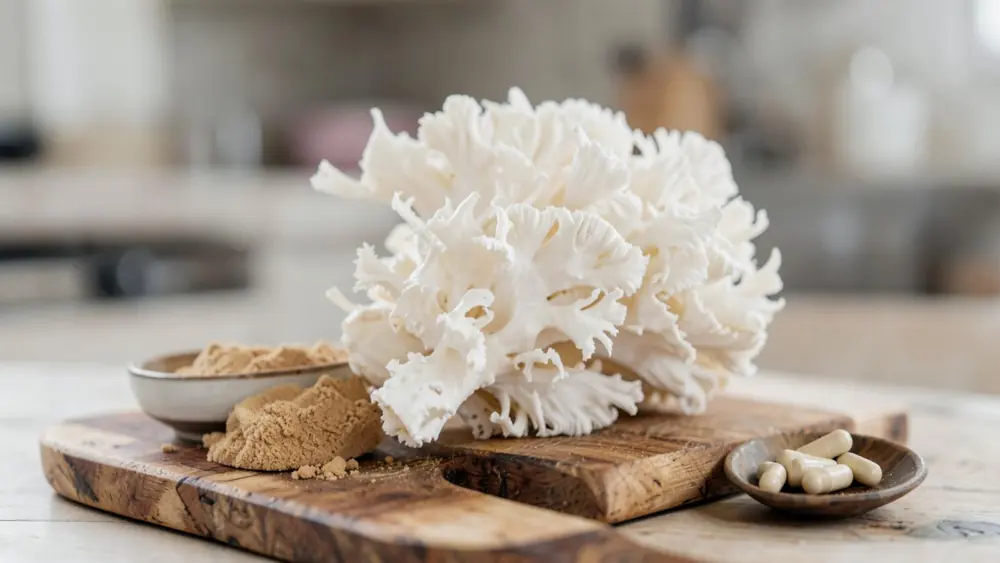
No health authority sets an amount for lion's mane (Hericium erinaceus). The most cited human trial, by Mori and colleagues in Phytotherapy Research, gave older Japanese adults with mild cognitive impairment 250 mg tablets containing 96 percent dry lion's mane powder, three tablets three times a day — about 3 g a day of powder — for 16 weeks. Commercial capsules commonly supply 500–1,000 mg once or twice daily, and extract products are far more concentrated than raw powder, so the milligram figures are not comparable across product types.
Lion's mane amounts reported in published studies
| Use case | Amount reported in sources | What to know |
|---|---|---|
| Mild cognitive impairment (Mori 2009) | About 3 g per day of dry powder for 16 weeks | 250 mg tablets of 96% Hericium erinaceus dry powder, three tablets three times daily, in adults aged 50–80. Source |
| Typical capsule label | 500–1,000 mg once or twice daily | Often a concentrated extract, which is not equivalent to the same weight of powder. Source |
| Health-authority recommendation | None established | No RDA, no upper limit and no approved therapeutic indication. Source |
| Culinary use | Eaten as a food mushroom | The fresh mushroom is a normal food; supplement research used concentrated forms. Source |
Figures are amounts reported in the cited sources, not a personal recommendation. Your own amount depends on your health, medicines and blood work.
Fruiting body, mycelium and grain: the label problem
Lion's mane products fall into two broad camps. Fruiting body products use the visible mushroom. Mycelium-on-grain products grow the fungal network on a grain substrate — usually rice or oats — and mill the whole thing, so a substantial part of the finished powder is starch from the grain rather than mushroom.
This is the single biggest reason two 1,000 mg capsules can be wildly different products. Independent testing has repeatedly found high starch content and low beta-glucan content in mycelium-on-grain products. Beta-glucan content, where it is disclosed, is a more informative number than the raw milligrams.
Extract ratios add another layer. An 8:1 extract means eight parts raw material reduced to one part extract, so 500 mg of an 8:1 extract is presented as equivalent to 4 g of raw mushroom. Comparing that with 500 mg of plain powder is comparing two different things.
- Fruiting body vs mycelium-on-grain is the first thing to check on the label.
- Beta-glucan percentage is more informative than total milligrams.
- An extract ratio such as 8:1 is not interchangeable with plain powder weight.
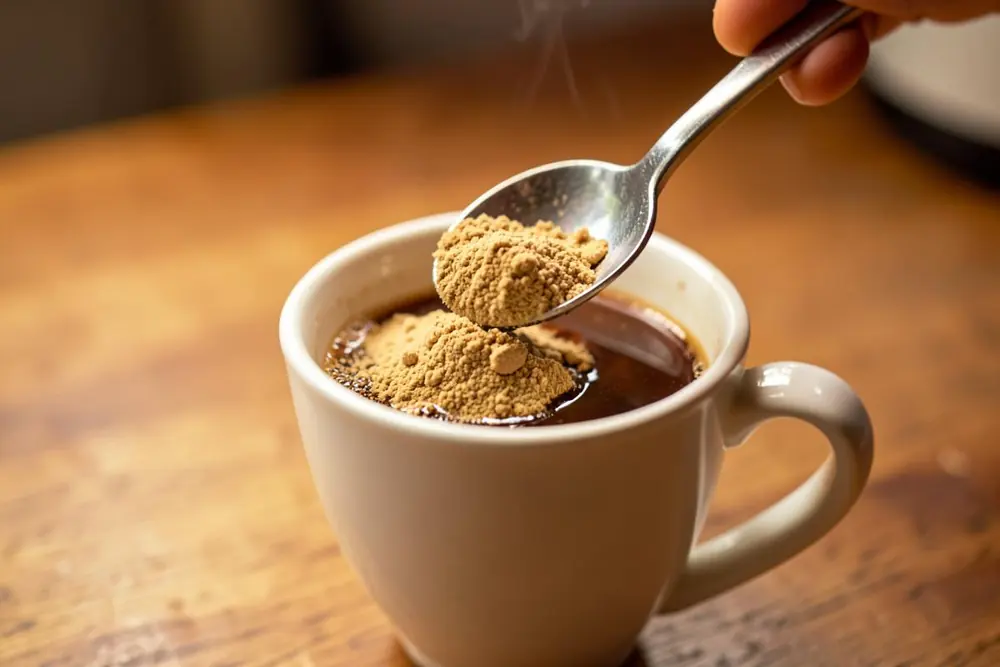
- 'Mushroom blend' coffees usually contain far less than a supplement dose.
What the Mori trial found, and what it did not
Mori and colleagues published a randomised, double-blind, placebo-controlled trial in Phytotherapy Research in 2009. Thirty Japanese adults aged 50 to 80 with mild cognitive impairment took tablets containing 96 percent dry lion's mane powder for 16 weeks. Cognitive function scale scores increased in the lion's mane group compared with placebo during the intervention.
The detail that matters most: scores declined again after supplementation stopped, suggesting any effect did not persist beyond the treatment period. The trial was small, ran in one country, and studied people who already had measurable cognitive impairment — not healthy adults looking for sharper focus.
There is no large, long-term trial showing that lion's mane prevents dementia, improves memory in healthy people, or repairs nerve damage in humans. The nerve growth factor findings that dominate online discussion come from laboratory and animal work, which is a legitimate reason to study the mushroom, not evidence of a human outcome.
Mood, sleep and the smaller human studies
A small Japanese study in menopausal women reported reductions in irritability and anxiety scores after four weeks of lion's mane-containing cookies, and a few other small trials have looked at mood and sleep quality. These are preliminary: small samples, short durations, and outcomes measured by self-report questionnaires.
NCCIH's general position on medicinal mushrooms is that most claims outrun the human evidence, and lion's mane fits that pattern. It is one of the more plausible candidates in the category, and it is still substantially unproven.
If you try it, treating it as an experiment with a defined review point — say eight to twelve weeks with a note of what you expected to change — is more useful than an open-ended purchase. DoseRoutine's journal exists for exactly this kind of self-tracking.
Safety, allergies and who should avoid it
Lion's mane is eaten as food in East Asia and short-term studies report it is generally well tolerated. The most commonly reported issues are mild digestive upset and skin reactions. Case reports of allergic reactions, including respiratory symptoms and dermatitis, exist in the literature — unsurprising for a fungus.
Anyone with a known mushroom or mould allergy should avoid it. People on anticoagulants should raise it with a pharmacist, since some mushroom constituents have been reported to affect platelet aggregation in laboratory work, and there is not enough human data to be confident either way.
There is insufficient safety information for pregnancy and breastfeeding, and no established long-term safety data at supplement doses. Nothing here suggests danger; it reflects how little formal study there has been.
Buying it without being sold a story
Because supplements are not pre-approved for content in most markets, third-party testing is the practical safeguard. Look for a certificate of analysis, a stated beta-glucan percentage, and explicit wording about fruiting body versus mycelium. Products that avoid all three are asking you to trust the front of the label.
Be skeptical of 'nerve regeneration' and 'neurogenesis' claims. Those come from cell culture and rodent studies. A supplement legally sold as a food cannot make disease-treatment claims, and where you see them made anyway, it tells you something about the seller.
The honest position on lion's mane: a food mushroom with interesting laboratory pharmacology, one small positive human cognition trial in people with mild impairment, and a lot of marketing built on top of very little.
What the published studies found
Each entry below links straight to the paper or the health authority page so you can read the original rather than take our word for it.
- Mori K, Inatomi S, Ouchi K, Azumi Y, Tuchida T. Improving effects of the mushroom Yamabushitake (Hericium erinaceus) on mild cognitive impairment: a double-blind placebo-controlled clinical trial. Phytotherapy Research. 2009.
Randomised, double-blind, placebo-controlled trial in 30 adults aged 50–80
Participants taking tablets of 96% dry lion's mane powder for 16 weeks showed higher cognitive function scale scores than placebo during the intervention; scores declined again after supplementation was stopped.
- National Center for Complementary and Integrative Health. Mushrooms.
Health-authority evidence summary
Summarises the state of evidence for medicinal mushroom products, noting that human research is limited and that marketed health claims generally exceed what studies have demonstrated.
Side effects reported in the literature
Commonly reported
- Mild digestive upset
- Nausea
- Skin itching reported in some users
Serious, seek medical advice
- Allergic reactions, including respiratory symptoms and dermatitis, in case reports
- Unknown safety in pregnancy and breastfeeding
- Theoretical bleeding-risk interaction with anticoagulants
Summarized from NCCIH mushrooms overview. Report anything unexpected to your own doctor or pharmacist.
Interactions to check with a pharmacist
| Medicine or condition | What sources report |
|---|---|
| Anticoagulants and antiplatelet medicines | Some mushroom constituents affect platelet aggregation in laboratory studies; human data are insufficient, so check with a pharmacist. Source |
| Diabetes medicines | Animal work suggests possible blood-glucose effects; anyone monitoring glucose should watch readings after starting. Source |
| Known mushroom or mould allergy | Avoid — allergic reactions to Hericium erinaceus have been reported. Source |
This is not a complete interaction list. Check your own medicines with a pharmacist before combining anything.
This page is reference material, not medical advice. Supplements interact with prescription medicines and with each other. Talk to a doctor or pharmacist before starting anything, especially if you are pregnant, breastfeeding, managing a health condition or taking prescription medicine.
Frequently asked questions
How much lion's mane should I take per day?
There is no established amount. The most cited human trial used tablets of 96 percent dry lion's mane powder totalling about 3 g a day for 16 weeks in adults with mild cognitive impairment. Commercial capsules usually supply 500–1,000 mg once or twice daily, often as a concentrated extract.
Is fruiting body better than mycelium?
Fruiting body products use the visible mushroom, while mycelium-on-grain products include the grain substrate the fungus grew on, so a significant portion can be starch. Beta-glucan percentage, where disclosed, is a more meaningful comparison than total milligrams.
How long does lion's mane take to work?
The Mori trial measured improvement over 16 weeks, and scores fell back after supplementation stopped. There is no reliable evidence of same-day cognitive effects, so short trials of a few days tell you very little.
Does lion's mane really help memory?
One small randomised trial reported improved cognitive scores in older adults who already had mild cognitive impairment. There is no good evidence that it improves memory in healthy people, and no long-term trial showing it prevents dementia.
Does lion's mane grow nerves?
The nerve growth factor findings come from cell culture and animal studies. They are a legitimate reason to keep researching the mushroom, but they are not evidence that it regenerates nerves in people.
Are there side effects of lion's mane?
Short-term studies report it is generally well tolerated, with mild digestive upset the most common complaint. Allergic reactions including skin and respiratory symptoms have been reported, so anyone with a mushroom or mould allergy should avoid it.
Can I just eat lion's mane mushrooms instead?
The fresh mushroom is a normal culinary food and is widely eaten. It is not the same as the concentrated powder or extract used in supplement research, so eating it occasionally is not equivalent to the trial protocol.
Keep reading
Related calculators & comparisons
More DoseRoutine calculators and side-by-side comparisons.
- Peptide calculator
Mix, convert syringe units, build a chart and plan vial supply.
- All calculators
Index of every DoseRoutine calculator and dosing tool.
- Peptide dosage calculator
Convert peptide doses into exact insulin-syringe units.
- Peptide reconstitution
Plan BAC water, concentration and doses per vial.
- Reconstitution calculator
Lightweight standalone reconstitution tool.
- TRT dosage calculator
Weekly testosterone → per-shot volume and syringe units.
Sources
Track your dose in DoseRoutine
Log what you actually take, get reminders at the right time and check interactions against everything else in your stack.
Sign up free →