L-Carnitine: Amounts Used in Research and the TMAO Question
Researched by DoseRoutine Research TeamReviewed for accuracy by Nicholas Alexander, RSE, SO, PMPLast updated Educational reference only — not medical advice. Always confirm dosing and safety decisions with a licensed clinician.
Carnitine's job is unglamorous and essential: it shuttles long-chain fatty acids into mitochondria to be burned. Healthy people make what they need and get more from meat and dairy, which is why the supplement's fat-loss reputation has held up so much better in marketing than in trials.
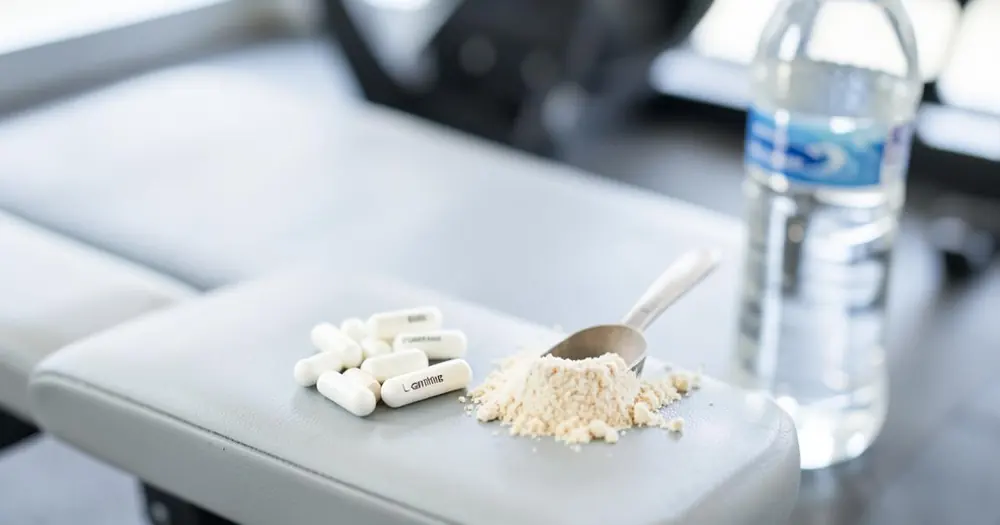
Studies have most often used 1–3 g a day of oral L-carnitine, with acetyl-L-carnitine research typically at 1.5–3 g a day and L-carnitine L-tartrate exercise-recovery studies around 2 g a day. Healthy adults synthesise enough carnitine and do not need a supplement; the NIH Office of Dietary Supplements describes primary deficiency as a rare genetic disorder and secondary deficiency as a consequence of conditions or treatments such as dialysis and valproate therapy. A 2013 Nature Medicine study showed gut bacteria convert dietary carnitine into TMAO, a metabolite associated with atherosclerosis, which remains an unresolved question for long-term supplementation.
L-carnitine amounts reported in published research
| Use case | Amount reported in sources | What to know |
|---|---|---|
| General supplementation studies | 1–3 g per day, oral | The usual range across cardiovascular, fatigue and exercise studies. Source |
| Acetyl-L-carnitine research | 1.5–3 g per day | The form studied most in cognitive and neuropathy contexts. Source |
| L-carnitine L-tartrate, exercise recovery | About 2 g per day | The form used in muscle-damage and recovery trials. Source |
| Dietary intake from food | About 60–180 mg per day on an omnivorous diet | Vegetarians take in far less but adapt by absorbing a larger fraction. Source |
| Secondary deficiency states | Medically determined | Dialysis, valproate therapy and certain metabolic disorders; prescribed, not self-dosed. Source |
Figures are amounts reported in the cited sources, not a personal recommendation. Your own amount depends on your health, medicines and blood work.
You already make it, which is why supplementing rarely does much
The body synthesises carnitine from lysine and methionine, with vitamin C, iron, B6 and niacin as cofactors, and the kidneys reabsorb most of what is filtered. Between synthesis and dietary intake from red meat, poultry, fish and dairy, healthy adults maintain adequate stores without effort.
Oral bioavailability from supplements is also poor — considerably lower than from food — and muscle carnitine content is tightly regulated. Raising it measurably in humans has required either intravenous administration or prolonged co-ingestion with large carbohydrate loads to drive insulin-mediated uptake, which is not what a capsule on an empty stomach does.
That combination explains the trial record: reliable effects in genuine deficiency states, inconsistent effects in everyone else.
- Red meat is the richest dietary source; dairy contributes modestly.
- Vegetarians have lower intakes but compensate with higher absorption efficiency.
- Muscle carnitine is hard to raise with oral supplements alone.
Fat loss, exercise and where the evidence sits
The fat-burner claim is mechanistic rather than clinical: carnitine transports fatty acids, therefore more carnitine should mean more fat oxidised. Human trials have not supported a meaningful weight-loss effect at ordinary amounts, and where small effects appear they are typically within the noise of diet and activity changes.
The better-supported exercise finding concerns recovery rather than performance. L-carnitine L-tartrate studies have reported reductions in markers of muscle damage and soreness after resistance exercise at around 2 g a day. Those are small studies with surrogate endpoints, and translating them into a training outcome is a stretch.
In clinical settings, carnitine has been studied in heart failure, angina, kidney disease on dialysis and male fertility, with mixed results and better support where an underlying deficiency exists.
The TMAO finding and what it means
In 2013 a Nature Medicine study reported that gut bacteria metabolise dietary L-carnitine into trimethylamine, which the liver converts to trimethylamine N-oxide (TMAO) — a metabolite associated in observational work with atherosclerosis and cardiovascular events. Omnivores produced more TMAO from a carnitine challenge than vegans and vegetarians, whose gut microbiota had adapted to lower carnitine intake.
This is a mechanistic and epidemiological association, not a demonstration that carnitine supplements cause heart attacks. Intervention trials with hard cardiovascular endpoints have not been done at the scale required to settle it, and some meta-analyses of carnitine in cardiac patients report neutral or favourable results.
The reasonable reading is that long-term high-dose supplementation in healthy people has an open safety question attached to it, and there is little upside to offset that unknown.
Forms, tolerability and thyroid
Plain L-carnitine, acetyl-L-carnitine, propionyl-L-carnitine and L-carnitine L-tartrate differ in what they have been studied for more than in potency. Acetyl-L-carnitine crosses into the brain more readily and dominates the cognitive and neuropathy literature; tartrate dominates exercise recovery work.
The most reported side effect at gram-level doses is a fishy body odour, caused by trimethylamine production — the same pathway behind TMAO. Nausea, cramping and diarrhea also occur, and are usually reduced by splitting the dose and taking it with food.
One interaction deserves attention: carnitine can interfere with thyroid hormone action at the cellular level, and it has been studied as a treatment for hyperthyroid symptoms for that reason. Anyone taking levothyroxine should raise it with their prescriber rather than assume it is neutral. Avoid D-carnitine and DL-carnitine products, which can interfere with the natural L-form.
What the published studies found
Each entry below links straight to the paper or the health authority page so you can read the original rather than take our word for it.
- Koeth RA, Wang Z, Levison BS, et al. Intestinal microbiota metabolism of L-carnitine, a nutrient in red meat, promotes atherosclerosis. Nat Med. 2013.
Human and animal mechanistic study
Gut microbiota converted dietary L-carnitine into TMAO; omnivores produced more TMAO after a carnitine challenge than vegans and vegetarians, and TMAO production accelerated atherosclerosis in mice.
- Office of Dietary Supplements, National Institutes of Health. Carnitine — Fact Sheet for Health Professionals.
Health-authority reference document
Describes endogenous synthesis, dietary sources, primary and secondary deficiency states, the amounts used in research, poor oral bioavailability of supplements, and the thyroid and anticoagulant interactions.
Side effects reported in the literature
Commonly reported
- Fishy body odour at gram-level doses
- Nausea and abdominal cramping
- Diarrhea
- Heartburn
Serious, seek medical advice
- Interference with thyroid hormone action, relevant on levothyroxine
- Seizure frequency reported to increase in some people with existing seizure disorders
- Open question about long-term TMAO production and cardiovascular risk
Summarized from NIH Office of Dietary Supplements carnitine fact sheet. Report anything unexpected to your own doctor or pharmacist.
Interactions to check with a pharmacist
| Medicine or condition | What sources report |
|---|---|
| Levothyroxine and thyroid treatment | Carnitine can act as a peripheral antagonist of thyroid hormone action. Source |
| Warfarin | Case reports describe increased anticoagulant effect with carnitine supplementation. Source |
| Valproic acid | Causes secondary carnitine depletion; supplementation here is a clinical decision, not a self-directed one. Source |
| Pivalate-containing antibiotics | Increase urinary carnitine loss over sustained use. Source |
This is not a complete interaction list. Check your own medicines with a pharmacist before combining anything.
This page is reference material, not medical advice. Supplements interact with prescription medicines and with each other. Talk to a doctor or pharmacist before starting anything, especially if you are pregnant, breastfeeding, managing a health condition or taking prescription medicine.
Frequently asked questions
How much L-carnitine should I take?
Research has mostly used 1–3 g a day orally, with about 2 g a day in L-carnitine L-tartrate recovery studies. Healthy adults make enough carnitine on their own, so there is no dietary requirement to meet.
Does L-carnitine burn fat?
The mechanism is real but the trials are not persuasive. Human studies have not shown meaningful weight loss at ordinary supplemental amounts, partly because oral absorption is poor and muscle carnitine is tightly regulated.
What is the difference between L-carnitine and acetyl-L-carnitine?
Acetyl-L-carnitine crosses into the brain more readily and dominates cognitive and neuropathy research; plain L-carnitine and the tartrate form dominate cardiovascular and exercise-recovery work. Avoid D- and DL-carnitine products entirely.
Is L-carnitine bad for your heart?
A 2013 Nature Medicine study showed gut bacteria convert carnitine into TMAO, a metabolite associated with atherosclerosis. That is an unresolved mechanistic concern rather than proof of harm, and it sits alongside neutral-to-positive trials in cardiac patients.
Why does L-carnitine cause a fishy smell?
Gut bacteria produce trimethylamine from carnitine, and at gram-level doses enough is exhaled and excreted to be noticeable. It is the same pathway that generates TMAO.
Who actually needs carnitine supplements?
People with primary carnitine deficiency, and people with secondary deficiency from dialysis, valproate therapy or certain metabolic conditions. In those settings it is prescribed and monitored rather than bought off a shelf.
Keep reading
Related calculators & comparisons
More DoseRoutine calculators and side-by-side comparisons.
- Peptide calculator
Mix, convert syringe units, build a chart and plan vial supply.
- All calculators
Index of every DoseRoutine calculator and dosing tool.
- Peptide dosage calculator
Convert peptide doses into exact insulin-syringe units.
- Peptide reconstitution
Plan BAC water, concentration and doses per vial.
- Reconstitution calculator
Lightweight standalone reconstitution tool.
- TRT dosage calculator
Weekly testosterone → per-shot volume and syringe units.
Sources
- Office of Dietary Supplements, National Institutes of Health. Carnitine — Fact Sheet for Health Professionals.
- Koeth RA, et al. Intestinal microbiota metabolism of L-carnitine, a nutrient in red meat, promotes atherosclerosis. Nat Med. 2013;19(5):576–585.
- MedlinePlus, U.S. National Library of Medicine. Carnitine.
Track your dose in DoseRoutine
Log what you actually take, get reminders at the right time and check interactions against everything else in your stack.
Sign up free →