Biotin Dosage: Adequate Intake, Hair Claims and Lab Interference
Researched by DoseRoutine Research TeamReviewed for accuracy by Nicholas Alexander, RSE, SO, PMPLast updated Educational reference only — not medical advice. Always confirm dosing and safety decisions with a licensed clinician.
Biotin is the vitamin with the widest gap between label amounts and the body's actual requirement — and the one most likely to make a blood test read wrong.
The adequate intake for biotin in adults is 30 micrograms per day, and 35 micrograms per day during breastfeeding. Deficiency is rare in people eating a normal diet, because biotin is present in eggs, liver, fish, nuts, seeds and many other foods. Hair, skin and nail supplements commonly contain 5,000 to 10,000 micrograms — up to 300 times the adequate intake — without trial evidence supporting benefit in people who are not deficient. The FDA has warned that biotin at these amounts can significantly interfere with laboratory tests, including troponin tests used to diagnose heart attacks.
Biotin intake reference values and product amounts
| Use case | Amount reported in sources | What to know |
|---|---|---|
| Adults 19+ (adequate intake) | 30 mcg per day | An adequate intake, not an RDA; evidence was insufficient to set an RDA. Source |
| Pregnancy / breastfeeding | 30 mcg / 35 mcg per day | Breastfeeding needs are slightly higher. Source |
| Typical hair and nail supplements | 5,000–10,000 mcg per day | Far above the adequate intake; no established benefit in people who are not deficient. Source |
| Upper limit | No UL established | No tolerable upper intake level has been set, which is not the same as high doses being problem-free. Source |
Figures are amounts reported in the cited sources, not a personal recommendation. Your own amount depends on your health, medicines and blood work.
How little you actually need
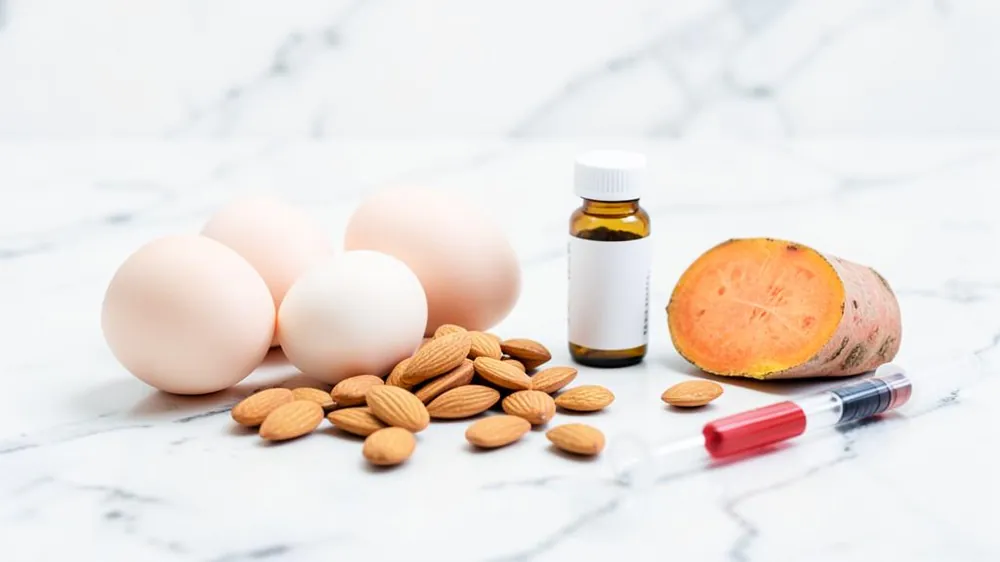
Thirty micrograms is a genuinely tiny amount, and ordinary diets supply it. Eggs — particularly the yolk — liver, salmon, sunflower seeds, almonds and sweet potato are all meaningful sources, and gut bacteria produce some biotin as well.
Because evidence was insufficient to establish an RDA, the value is an adequate intake: the amount assumed to cover healthy people based on observed consumption.
Frank biotin deficiency is rare. It shows up in specific circumstances: biotinidase deficiency, long-term parenteral nutrition without biotin, prolonged anticonvulsant use, heavy alcohol use, and — famously — consuming large amounts of raw egg white, which contains avidin that binds biotin.
- 30 mcg per day is the adult adequate intake
- Deficiency is rare on a normal diet
- Raw egg white binds biotin; cooked egg does not
- Anticonvulsants and heavy alcohol use raise deficiency risk
The hair, skin and nails question
The evidence that biotin improves hair or nails in people who are not deficient is weak. The NIH Office of Dietary Supplements states plainly that biotin supplements have not been shown to help hair, skin or nail health in people with adequate biotin status.
The case reports that do exist involve people with genuine deficiency or with brittle nail syndrome studied in small, uncontrolled series decades ago.
Hair loss has many causes — iron deficiency, thyroid disease, androgenetic alopecia, telogen effluvium after illness or stress, medication effects. A biotin capsule does not address any of them, and taking one can delay finding out which applies.
The lab interference warning — the practical reason to care
Many immunoassays use biotin-streptavidin binding as part of their chemistry. High circulating biotin competes with that binding and can push results falsely high or falsely low depending on the assay design.
The FDA issued a safety communication about this after reports including a death, where a falsely low troponin result contributed to a missed heart attack diagnosis.
Thyroid tests are the other common casualty: high biotin can mimic the pattern of Graves' disease, producing high free T4 with suppressed TSH in someone with entirely normal thyroid function.
Laboratories commonly advise stopping high-dose biotin for a period before testing, and the specific interval depends on the assay and the dose. Tell the person ordering the test that you take it — that single sentence prevents the problem.
Safety of high doses
Biotin is water-soluble and high intakes have not been associated with a clear pattern of toxicity, which is why no upper limit has been set.
That absence of a UL is often read as a license to take 10,000 micrograms. A fairer reading is that the risk of high doses is mostly indirect: distorted lab tests, wasted money, and a false sense that a hair or nail problem is being treated.
There is no benefit demonstrated at those amounts in people with normal biotin status, so the sensible ceiling is the amount in an ordinary multivitamin.
What to do instead if hair or nails are the concern
Ask for the causes to be checked rather than assuming a vitamin gap: ferritin and iron studies, thyroid function, and a review of medications and recent illness cover most of what is treatable.
If you already take a high-dose biotin product, that is not an emergency — but note it in your medicine list and mention it before any blood test, especially thyroid panels or anything cardiac.
A standard multivitamin already covers the 30 microgram requirement several times over.
What the published studies found
Each entry below links straight to the paper or the health authority page so you can read the original rather than take our word for it.
- NIH Office of Dietary Supplements. Biotin — Health Professional Fact Sheet.
Authoritative review of biotin requirements, status and evidence
Sets the adult adequate intake at 30 mcg per day, notes that deficiency is rare, and states that biotin supplements have not been shown to improve hair, skin or nail health in people with adequate biotin status.
- US Food and Drug Administration. Safety communication: biotin may interfere with lab tests.
Regulatory safety communication
Warns that high-dose biotin can cause clinically significant incorrect laboratory results, including falsely low troponin, and describes a reported death linked to a missed heart attack diagnosis.
- Biotin interference in thyroid function immunoassays.
Clinical case series and laboratory investigations
High biotin intake can produce a biochemical pattern resembling hyperthyroidism — elevated free T4 with suppressed TSH — in patients with normal thyroid function, resolving after biotin is stopped.
Side effects reported in the literature
Commonly reported
- Generally well tolerated at dietary and supplemental amounts
Serious, seek medical advice
- Clinically significant interference with immunoassay blood tests, including troponin and thyroid panels
- Risk of misdiagnosis when clinicians are unaware of high-dose use
Summarized from FDA — Biotin may interfere with lab tests. Report anything unexpected to your own doctor or pharmacist.
Interactions to check with a pharmacist
| Medicine or condition | What sources report |
|---|---|
| Laboratory immunoassays (troponin, thyroid, hormone panels) | High biotin can cause falsely high or falsely low results depending on assay design; tell whoever orders the test. Source |
| Anticonvulsants (for example carbamazepine, phenytoin) | Long-term use has been associated with lower biotin status. Source |
| Raw egg white | Avidin in raw egg white binds biotin and can reduce absorption; cooking inactivates it. Source |
This is not a complete interaction list. Check your own medicines with a pharmacist before combining anything.
This page is reference material, not medical advice. Supplements interact with prescription medicines and with each other. Talk to a doctor or pharmacist before starting anything, especially if you are pregnant, breastfeeding, managing a health condition or taking prescription medicine.
Frequently asked questions
How much biotin do adults need per day?
The adequate intake is 30 micrograms per day for adults, and 35 micrograms while breastfeeding. Ordinary diets containing eggs, fish, nuts and seeds supply this comfortably.
Does biotin actually grow hair?
In people with adequate biotin status, supplements have not been shown to improve hair, skin or nail health. Hair loss usually has another cause — iron deficiency, thyroid disease or androgenetic alopecia — worth investigating instead.
Why does biotin affect blood tests?
Many immunoassays rely on biotin-streptavidin chemistry, and high circulating biotin competes with it. The FDA has warned this can cause falsely low troponin results and thyroid patterns that mimic Graves' disease.
Should I stop biotin before a blood test?
Tell whoever orders the test that you take it. Laboratories often advise pausing high-dose biotin beforehand, and the appropriate interval depends on the assay and the amount you take.
Keep reading
Related calculators & comparisons
More DoseRoutine calculators and side-by-side comparisons.
- Peptide calculator
Mix, convert syringe units, build a chart and plan vial supply.
- All calculators
Index of every DoseRoutine calculator and dosing tool.
- Peptide dosage calculator
Convert peptide doses into exact insulin-syringe units.
- Peptide reconstitution
Plan BAC water, concentration and doses per vial.
- Reconstitution calculator
Lightweight standalone reconstitution tool.
- TRT dosage calculator
Weekly testosterone → per-shot volume and syringe units.
Sources
Track your dose in DoseRoutine
Log what you actually take, get reminders at the right time and check interactions against everything else in your stack.
Sign up free →