Collagen Dosage: How Many Grams Per Day?
Researched by DoseRoutine Research TeamReviewed for accuracy by Nicholas Alexander, RSE, SO, PMPLast updated Educational reference only — not medical advice. Always confirm dosing and safety decisions with a licensed clinician.
Collagen is sold in scoops big enough to look like protein powder and in trials measured in grams so small they fit in a capsule. Both appear in the literature, because the studied doses depend entirely on what was being measured.
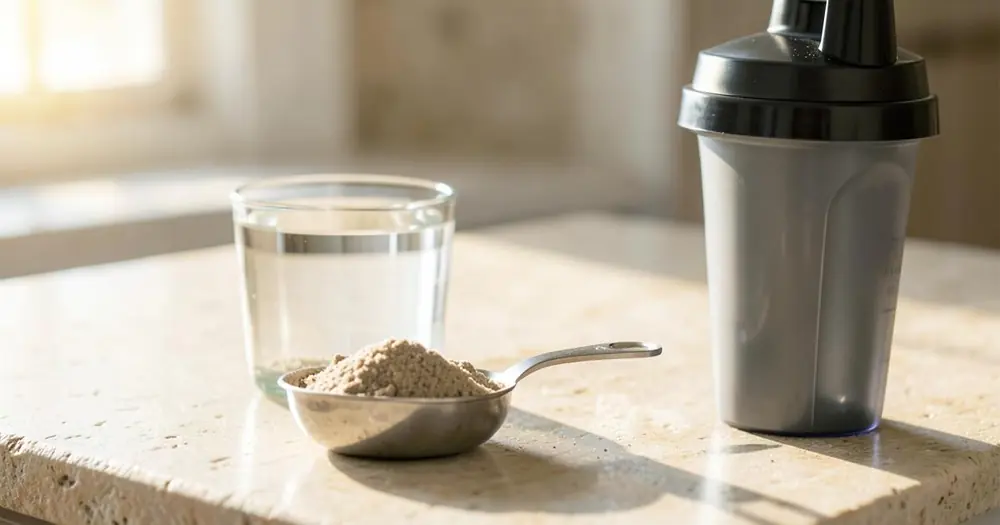
Published randomised trials of specific collagen peptides have used roughly 2.5 g a day for skin outcomes, 5 g a day for bone mineral density in postmenopausal women, and around 10–15 g a day in trials looking at joint and connective-tissue outcomes and body composition. There is no established daily requirement and no tolerable upper intake level, because collagen is a food protein rather than an essential nutrient. Trials typically ran for eight weeks to twelve months, and effects reported were modest.
Collagen amounts reported in randomised trials
| Use case | Amount reported in sources | What to know |
|---|---|---|
| Skin elasticity and hydration | 2.5 g per day of specific collagen peptides | Double-blind placebo-controlled trial in women, dosed daily over eight weeks with follow-up. Source |
| Bone mineral density, postmenopausal women | 5 g per day of specific collagen peptides | Randomised controlled study over twelve months measuring BMD and bone markers. Source |
| Joint and connective tissue research | Commonly 10–15 g per day of hydrolysed collagen | Doses and formats vary widely across trials; a 2023 review summarises the composition-versus-evidence problem. Source |
| Undenatured type II collagen studies | Milligram-scale, typically 40 mg per day | A different mechanism and a different product class from hydrolysed peptides — do not compare the numbers. Source |
Figures are amounts reported in the cited sources, not a personal recommendation. Your own amount depends on your health, medicines and blood work.
Peptides, gelatin and undenatured collagen are not interchangeable
Collagen peptides — also labeled hydrolysed collagen — are collagen broken into short chains that dissolve in cold liquid and are absorbed as di- and tripeptides. Gelatin is partially hydrolysed collagen that gels when cold, which is why it is a cooking ingredient rather than a scoop for coffee. Undenatured type II collagen is a third thing entirely, given in milligram doses on an immune-tolerance rationale rather than as a building material.
This matters because forum advice mixes the three freely. Someone reporting benefit from 40 mg is not describing a smaller version of a 10 g protocol; they are describing a different product with a different proposed mechanism.
Marine, bovine and porcine sources differ in amino acid profile and in the collagen types they supply, but the trial literature is organized around specific branded peptide preparations rather than around source animal. When a study says specific collagen peptides, it usually means a defined commercial preparation, which is a real limitation on generalising the result to any tub on the shelf.
- Hydrolysed peptides: grams per day, dissolve in any liquid
- Gelatin: same protein, gels when cold, used in food
- Undenatured type II: milligrams per day, different rationale
- Trials usually test a specific branded preparation, not collagen in general

What the skin trials measured
The most-cited skin study is a double-blind, placebo-controlled trial of specific collagen peptides in women that reported improvements in skin elasticity after daily supplementation over eight weeks, with measurements taken by cutometer rather than by self-report.
Two caveats belong next to that result. Trial populations were typically middle-aged women, and improvements were measured on instruments — a statistically detectable change in elasticity is not the same thing as visibly different skin in a mirror.
Follow-up reviews of the wider skin literature note heterogeneous products, short durations and frequent industry funding. That does not invalidate the findings; it does mean the honest summary is modest measurable changes in specific outcomes rather than reversal of ageing.
Bone and joint outcomes
For bone, a randomised controlled study in postmenopausal women with reduced bone mineral density gave 5 g of specific collagen peptides daily for twelve months and reported increases in bone mineral density at the spine and femoral neck along with changes in bone turnover markers.
Joint research is messier. A 2023 review in Nutrients examined the link between what is actually in these products and what the scientific evidence supports, and concluded that composition varies enormously and that this variation limits how far individual trial results transfer between products.
Anyone taking collagen for joint pain should also know what it is not: it is not an anti-inflammatory, it does not treat the cause of osteoarthritis, and persistent joint pain deserves a diagnosis before a supplement.
Timing, vitamin C and protein context
Collagen synthesis requires vitamin C as a cofactor for the enzymes that hydroxylate proline and lysine. That biochemical fact is the basis for the common advice to take collagen with vitamin C, and many products include it. Whether adding vitamin C to an already adequate diet changes outcomes has not been the primary endpoint of the major trials.
Some sports-nutrition protocols dose collagen with vitamin C about an hour before loading exercise, on the theory that blood flow to tendon during exercise improves delivery. This is a plausible, actively researched idea rather than settled practice.
Timing beyond that is not a meaningful lever. Trials dosed once daily without regard to meals, and adherence over months is what the results actually depended on.
Collagen is not a complete protein
Collagen is very high in glycine, proline and hydroxyproline and contains no tryptophan, which makes it an incomplete protein. Counting a 10 g collagen scoop toward a daily protein target is misleading if it displaces whey, dairy, eggs, meat or soy that supply the full amino acid range.
For muscle protein synthesis specifically, leucine content is the relevant driver and collagen is poor in leucine. Anyone using collagen for training adaptation should treat it as an addition to adequate total protein, not a substitute for it.
There is also no established upper limit. High intakes are generally reported as well tolerated, with digestive complaints and an unpleasant aftertaste the usual reasons people stop.
What the published studies found
Each entry below links straight to the paper or the health authority page so you can read the original rather than take our word for it.
- Proksch E, Segger D, Degwert J, et al. Oral supplementation of specific collagen peptides has beneficial effects on human skin physiology: a double-blind, placebo-controlled study. Skin Pharmacol Physiol. 2014.
Double-blind, placebo-controlled randomised trial
Daily supplementation with specific collagen peptides was associated with improved skin elasticity measured instrumentally, compared with placebo, over the study period.
- König D, Oesser S, Scharla S, Zdzieblik D, Gollhofer A. Specific Collagen Peptides Improve Bone Mineral Density and Bone Markers in Postmenopausal Women — A Randomized Controlled Study. Nutrients. 2018.
Randomised controlled trial over twelve months
5 g of specific collagen peptides daily was associated with increased bone mineral density at the spine and femoral neck and favourable changes in bone turnover markers compared with placebo.
- Martínez-Puig D, Costa-Larrión E, Rubio-Rodríguez N, Gálvez-Martín P. Collagen Supplementation for Joint Health: The Link between Composition and Scientific Knowledge. Nutrients. 2023.
Narrative review of product composition and clinical evidence
Reports substantial variation in the composition of marketed collagen products and cautions that this variability limits how far findings from one preparation transfer to another.
Side effects reported in the literature
Commonly reported
- Bloating or fullness after larger scoops
- Unpleasant aftertaste, particularly with marine collagen
- Mild digestive upset
Serious, seek medical advice
- Allergic reaction in people allergic to the source animal, including fish and shellfish for marine collagen
- Unverified purity claims in unregulated products, where third-party testing is worth checking
Summarized from Nutrients 2023 review of collagen composition and evidence. Report anything unexpected to your own doctor or pharmacist.
Interactions to check with a pharmacist
| Medicine or condition | What sources report |
|---|---|
| Source allergies (fish, shellfish, bovine, porcine) | Collagen carries the allergen profile of its source animal. Source |
| Total daily protein targets | Collagen lacks tryptophan and is low in leucine, so it should be counted as an addition rather than a replacement for complete protein. Source |
| Calcium-containing collagen products | Some marine and calcium-chelate products add meaningful calcium; check the total against other supplements. Source |
This is not a complete interaction list. Check your own medicines with a pharmacist before combining anything.
This page is reference material, not medical advice. Supplements interact with prescription medicines and with each other. Talk to a doctor or pharmacist before starting anything, especially if you are pregnant, breastfeeding, managing a health condition or taking prescription medicine.
Frequently asked questions
How many grams of collagen per day?
Published trials used about 2.5 g a day for skin outcomes, 5 g a day for bone mineral density in postmenopausal women, and commonly 10–15 g a day in joint and body-composition research. There is no established daily requirement, so the useful question is which trial matches what you are hoping for.
Is 10 g of collagen a day enough?
It sits within the range used in joint and connective-tissue research and is well above the 2.5 g used in the skin elasticity trial. More is not clearly better in the published literature, and larger scoops are the main source of bloating complaints.
How long does collagen take to work?
Skin trials measured outcomes at around eight weeks, and the bone mineral density study ran for twelve months. Anything reporting visible results in days is describing hydration or expectation rather than collagen turnover.
Should I take collagen with vitamin C?
Vitamin C is a required cofactor for collagen synthesis, which is why the combination is standard advice and why many products include it. Whether extra vitamin C improves outcomes in people who already get enough was not the primary endpoint of the main trials.
Does collagen count as protein?
Only partially. Collagen contains no tryptophan and little leucine, so it is an incomplete protein and a poor driver of muscle protein synthesis. Treat it as an addition to your protein intake rather than part of the target.
Is marine collagen better than bovine?
The trial literature is organized around specific peptide preparations rather than source animal, so there is no clean head-to-head answer. Source matters most for allergies and for dietary preference.
Can you take too much collagen?
No tolerable upper intake level has been established, and high intakes are generally reported as well tolerated. The practical ceiling for most people is digestive comfort and the amount of protein they want to spend on an incomplete source.
Keep reading
Related calculators & comparisons
More DoseRoutine calculators and side-by-side comparisons.
- Peptide calculator
Mix, convert syringe units, build a chart and plan vial supply.
- All calculators
Index of every DoseRoutine calculator and dosing tool.
- Peptide dosage calculator
Convert peptide doses into exact insulin-syringe units.
- Peptide reconstitution
Plan BAC water, concentration and doses per vial.
- Reconstitution calculator
Lightweight standalone reconstitution tool.
- TRT dosage calculator
Weekly testosterone → per-shot volume and syringe units.
Sources
- Proksch E, et al. Oral supplementation of specific collagen peptides has beneficial effects on human skin physiology: a double-blind, placebo-controlled study. Skin Pharmacol Physiol. 2014;27(1):47–55.
- König D, et al. Specific Collagen Peptides Improve Bone Mineral Density and Bone Markers in Postmenopausal Women — A Randomized Controlled Study. Nutrients. 2018;10(1):97.
- Martínez-Puig D, et al. Collagen Supplementation for Joint Health: The Link between Composition and Scientific Knowledge. Nutrients. 2023;15(6):1332.
Track your dose in DoseRoutine
Log what you actually take, get reminders at the right time and check interactions against everything else in your stack.
Sign up free →