Vitamin E Dosage: How Much Per Day Is Safe?
Researched by DoseRoutine Research TeamReviewed for accuracy by Nicholas Alexander, RSE, SO, PMPLast updated Educational reference only — not medical advice. Always confirm dosing and safety decisions with a licensed clinician.
Vitamin E is the supplement where the label unit does more damage than the ingredient. Requirements are set in milligrams of alpha-tocopherol, most bottles are still sold in international units, and the two forms of the vitamin convert differently — which is how people end up taking many times what they think they are taking.
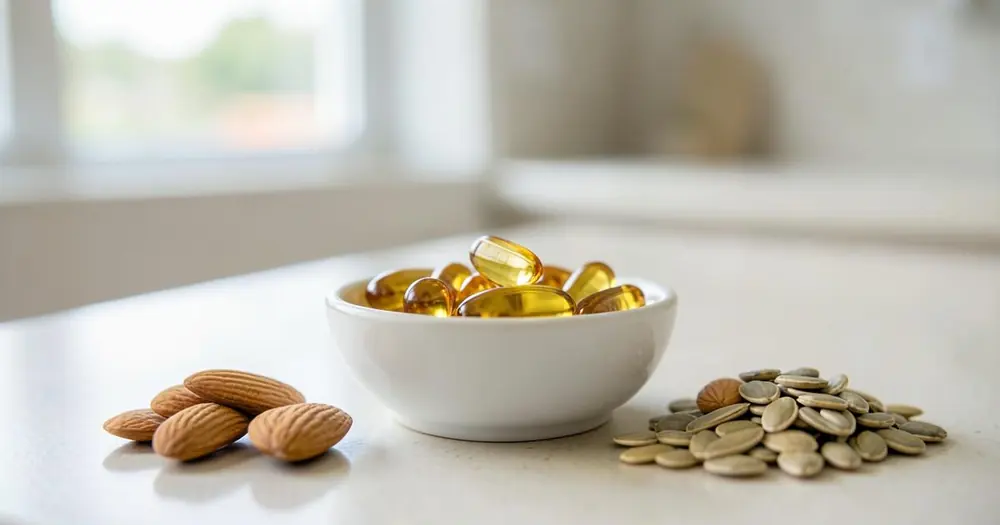
The NIH Office of Dietary Supplements sets the recommended dietary allowance for adults at 15 mg of alpha-tocopherol a day (22.4 IU of the natural form, or 33 IU of the synthetic form), rising to 19 mg while breastfeeding. The tolerable upper intake level for adults is 1,000 mg a day from supplements. Common capsules supply 180–1,000 mg (400–1,500 IU), so a single softgel can sit near or above the ceiling. Large trials of high-dose supplementation — including SELECT at 400 IU a day — did not show the benefits that motivated them, and a pooled analysis of high-dose trials reported higher all-cause mortality.
Vitamin E amounts reported in health-authority documents and trials
| Use case | Amount reported in sources | What to know |
|---|---|---|
| Adults, daily requirement (RDA) | 15 mg alpha-tocopherol per day | Equivalent to about 22.4 IU natural (d-alpha) or 33 IU synthetic (dl-alpha). Source |
| Breastfeeding | 19 mg per day | Published by the NIH ODS from Food and Nutrition Board values. Source |
| Upper limit, adults | 1,000 mg per day from supplements | Set on the basis of bleeding risk seen with high supplemental intakes. Source |
| SELECT prostate cancer trial | 400 IU per day of synthetic alpha-tocopheryl acetate | Research protocol in men aged 50+; no benefit, and prostate cancer rose. Source |
| Typical retail softgel | 180–1,000 mg (400–1,500 IU) | Frequently many times the requirement; check the panel unit before totalling. Source |
Figures are amounts reported in the cited sources, not a personal recommendation. Your own amount depends on your health, medicines and blood work.
IU versus milligrams is the whole problem
Vitamin E requirements are defined only for alpha-tocopherol, and only for the forms the body retains. Natural-source vitamin E is labeled d-alpha-tocopherol (RRR-alpha-tocopherol); the synthetic version, dl-alpha-tocopherol, is a mixture of eight stereoisomers, half of which the body does not maintain in plasma. That is why 1 mg of natural alpha-tocopherol counts as 1.49 IU while 1 mg of synthetic counts as 2.22 IU.
In practice this means a 400 IU natural softgel supplies about 268 mg, and a 400 IU synthetic softgel supplies about 180 mg. Both are well above the 15 mg daily requirement and neither is close to the units printed on most forum advice. When you log vitamin E, record the milligram figure from the Supplement Facts panel rather than the IU number on the front of the bottle.
Mixed tocopherol products add another wrinkle: gamma-, delta- and beta-tocopherol appear on the panel but do not count toward the requirement, because the liver's alpha-tocopherol transfer protein preferentially returns alpha-tocopherol to circulation.
- Natural (d-alpha, RRR): 1 mg = 1.49 IU.
- Synthetic (dl-alpha, all-rac): 1 mg = 2.22 IU.
- Only alpha-tocopherol counts toward the RDA and the upper limit.
What the large high-dose trials found
The case for high-dose vitamin E came from observational data linking higher intakes with lower cardiovascular disease and cancer rates. Randomised trials did not reproduce it. SELECT, a trial of more than 35,000 men, tested 400 IU a day of synthetic alpha-tocopheryl acetate and reported a statistically significant increase in prostate cancer diagnoses in the vitamin E arm rather than the prevention the trial was designed to find.
A 2005 meta-analysis pooling nineteen trials reported a dose-dependent relationship between supplemental vitamin E above roughly 400 IU a day and all-cause mortality. That analysis has been argued over since — many included trials enrolled people who were already ill — but combined with SELECT it is the reason no major health authority now recommends high-dose vitamin E supplementation for prevention.
The clinical exception people cite most often is nonalcoholic steatohepatitis, where 800 IU a day has been used in trial settings in non-diabetic adults with biopsy-confirmed disease. That is a supervised research amount, tracked with liver testing, and not the same activity as taking a bottle off a shelf.
Bleeding, anticoagulants and the upper limit
The upper limit exists because vitamin E interferes with platelet aggregation and vitamin K–dependent clotting factors. The NIH ODS documents haemorrhagic effects at high supplemental intakes, and warns specifically about people taking anticoagulant or antiplatelet medicines.
This is also why surgeons routinely ask about vitamin E before procedures. If you take warfarin, a direct oral anticoagulant, aspirin or clopidogrel, the interaction is a real clinical question rather than a formality, and the prescriber needs to know the milligram amount.
Deficiency, by contrast, is rare and is almost always the result of a fat malabsorption condition — cystic fibrosis, cholestatic liver disease, abetalipoproteinaemia — rather than diet. Those cases are managed with a specific water-miscible preparation under medical supervision.
Getting vitamin E from food
Vegetable oils, nuts and seeds carry most of the vitamin E in a typical diet. A single ounce of sunflower seeds supplies roughly half the adult requirement, and an ounce of almonds supplies about a third. Because absorption depends on dietary fat, vitamin E taken with a fat-containing meal is absorbed better than the same amount taken with water.
Meeting 15 mg a day from food is achievable without unusual eating, which is part of why supplemental vitamin E has such a poor trial record: the population being supplemented was rarely deficient in the first place.
What the published studies found
Each entry below links straight to the paper or the health authority page so you can read the original rather than take our word for it.
- Klein EA, Thompson IM, Tangen CM, et al. Vitamin E and the risk of prostate cancer: the Selenium and Vitamin E Cancer Prevention Trial (SELECT). JAMA. 2011.
Randomised, placebo-controlled trial in over 35,000 men
400 IU a day of synthetic alpha-tocopheryl acetate did not prevent prostate cancer; the vitamin E group had a statistically significant increase in prostate cancer diagnoses compared with placebo.
- Miller ER, Pastor-Barriuso R, Dalal D, et al. Meta-analysis: high-dosage vitamin E supplementation may increase all-cause mortality. Ann Intern Med. 2005.
Dose-response meta-analysis of 19 randomised trials
Pooled trial data showed a dose-dependent relationship, with supplemental doses above roughly 400 IU a day associated with increased all-cause mortality. The authors advised against high-dose supplementation.
- Office of Dietary Supplements, National Institutes of Health. Vitamin E — Fact Sheet for Health Professionals.
Health-authority reference document
Publishes the 15 mg adult RDA, the 1,000 mg tolerable upper intake level, the IU conversion factors for natural and synthetic forms, and the bleeding risk that underpins the upper limit.
Side effects reported in the literature
Commonly reported
- Nausea and stomach upset at high supplemental amounts
- Diarrhea and abdominal cramping
- Fatigue and headache reported in high-dose trials
Serious, seek medical advice
- Increased bleeding tendency, including haemorrhagic stroke in some trial data
- Interference with vitamin K–dependent clotting, relevant before surgery
- Increased prostate cancer diagnoses at 400 IU a day in the SELECT trial
Summarized from NIH Office of Dietary Supplements vitamin E fact sheet. Report anything unexpected to your own doctor or pharmacist.
Interactions to check with a pharmacist
| Medicine or condition | What sources report |
|---|---|
| Warfarin and other anticoagulants | Vitamin E can add to anticoagulant effect and increase bleeding risk; prescribers need the milligram amount. Source |
| Antiplatelet medicines (aspirin, clopidogrel) | Additive effect on platelet aggregation reported at high supplemental intakes. Source |
| Statins and niacin | Antioxidant combinations including vitamin E have been reported to blunt the HDL response to statin–niacin therapy. Source |
| Chemotherapy and radiotherapy | High-dose antioxidants during treatment are contentious; oncology teams generally ask patients to stop them. Source |
This is not a complete interaction list. Check your own medicines with a pharmacist before combining anything.
This page is reference material, not medical advice. Supplements interact with prescription medicines and with each other. Talk to a doctor or pharmacist before starting anything, especially if you are pregnant, breastfeeding, managing a health condition or taking prescription medicine.
Frequently asked questions
How much vitamin E per day is safe?
The adult requirement is 15 mg of alpha-tocopherol a day, and the tolerable upper intake level is 1,000 mg a day from supplements. Most benefit-seeking trials used far more than the requirement and did not find the benefits they were testing for.
Is 400 IU of vitamin E too much?
400 IU is roughly 180 mg synthetic or 268 mg natural — well below the 1,000 mg upper limit but many times the 15 mg requirement. It is also the amount used in SELECT, where prostate cancer diagnoses rose, and around the level where the 2005 mortality meta-analysis found a signal.
What is the difference between d-alpha and dl-alpha tocopherol?
d-alpha is the natural form and is retained better in plasma; dl-alpha is synthetic and only half of its stereoisomers are maintained. That is why 1 mg of natural counts as 1.49 IU and 1 mg of synthetic as 2.22 IU.
Should vitamin E be taken with food?
Yes. It is fat-soluble, so absorption is better with a meal containing fat. Taken on an empty stomach with water, less of the dose is absorbed.
Can vitamin E thin your blood?
High supplemental intakes interfere with platelet function and vitamin K–dependent clotting, which is the basis for the upper limit. Anyone on anticoagulants or facing surgery should raise it with their clinician rather than assume it is inert.
Do I need a vitamin E supplement at all?
Deficiency is rare outside fat malabsorption conditions, and vegetable oils, nuts and seeds cover the requirement easily. That is one reason supplement trials in generally well-nourished populations have been so unrewarding.
Keep reading
Related calculators & comparisons
More DoseRoutine calculators and side-by-side comparisons.
- Peptide calculator
Mix, convert syringe units, build a chart and plan vial supply.
- All calculators
Index of every DoseRoutine calculator and dosing tool.
- Peptide dosage calculator
Convert peptide doses into exact insulin-syringe units.
- Peptide reconstitution
Plan BAC water, concentration and doses per vial.
- Reconstitution calculator
Lightweight standalone reconstitution tool.
- TRT dosage calculator
Weekly testosterone → per-shot volume and syringe units.
Sources
- Office of Dietary Supplements, National Institutes of Health. Vitamin E — Fact Sheet for Health Professionals.
- Klein EA, et al. Vitamin E and the risk of prostate cancer: SELECT. JAMA. 2011;306(14):1549–1556.
- Miller ER, et al. Meta-analysis: high-dosage vitamin E supplementation may increase all-cause mortality. Ann Intern Med. 2005;142(1):37–46.
- MedlinePlus, U.S. National Library of Medicine. Vitamin E.
Track your dose in DoseRoutine
Log what you actually take, get reminders at the right time and check interactions against everything else in your stack.
Sign up free →