Citrulline Dosage: L-Citrulline vs Citrulline Malate
Researched by DoseRoutine Research TeamReviewed for accuracy by Nicholas Alexander, RSE, SO, PMPLast updated Educational reference only — not medical advice. Always confirm dosing and safety decisions with a licensed clinician.
Citrulline is the rare pre-workout ingredient with a mechanism that is easy to state and a label that is easy to misread. The confusion is almost entirely about malate, and it is worth ten minutes to get right.
Human studies of citrulline for exercise have most often used around 6 to 8 g of citrulline malate taken roughly 60 minutes before exercise, or approximately 3 to 6 g of pure L-citrulline daily in blood-flow and vascular research. Citrulline raises plasma arginine more effectively than oral arginine itself, because it bypasses first-pass breakdown in the gut and liver, and arginine is the substrate for nitric oxide production. Citrulline malate is typically supplied at a 2:1 ratio, so an 8 g dose provides roughly 5.3 g of citrulline and the rest as malate.
Citrulline amounts reported in the research literature
| Use case | Amount reported in sources | What to know |
|---|---|---|
| Resistance and high-intensity exercise research | Commonly 6–8 g citrulline malate about 60 minutes pre-exercise | Meta-analytic work on citrulline supplementation and exercise performance summarises this protocol. Source |
| Vascular and blood pressure research | Approximately 3–6 g of L-citrulline per day | Trials measuring endothelial function and blood pressure typically use pure L-citrulline rather than malate. Source |
| Raising plasma arginine | Oral citrulline raises plasma arginine more effectively than oral arginine | Pharmacokinetic work showing citrulline escapes first-pass metabolism that limits oral arginine. Source |
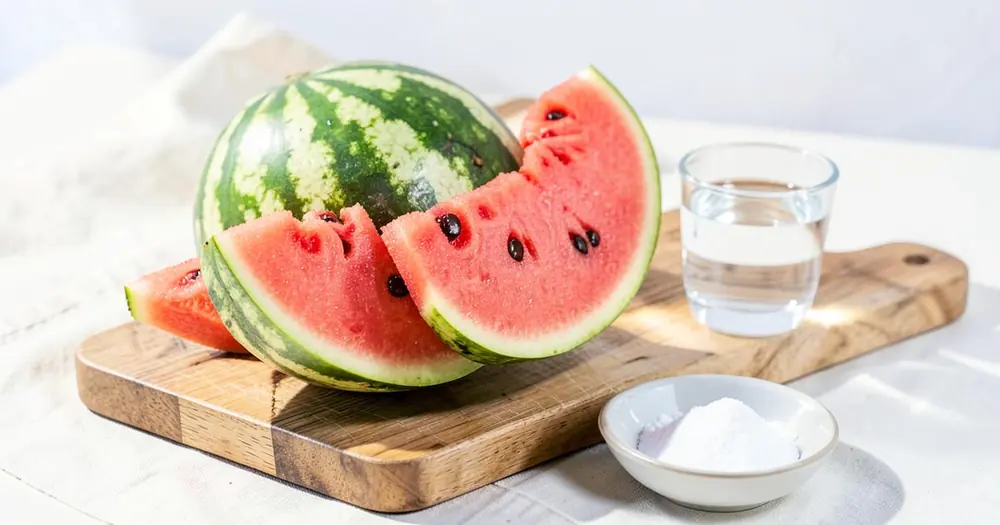
| Watermelon as a dietary source | Present but variable, well below supplement doses | Content varies by variety and ripeness, so watermelon is a food source rather than a dosing strategy. Source |
Figures are amounts reported in the cited sources, not a personal recommendation. Your own amount depends on your health, medicines and blood work.
Why citrulline beat arginine at its own job
Nitric oxide, which relaxes blood vessels and increases blood flow, is made from the amino acid arginine. The obvious move was to supplement arginine directly, and for years that is what products did.
It works poorly. Oral arginine is heavily broken down by arginase in the gut wall and liver before reaching circulation, so plasma arginine rises far less than the dose implies, and large doses cause diarrhea.
Citrulline is converted to arginine in the kidneys, bypassing that first-pass metabolism entirely. Pharmacokinetic studies show oral citrulline raises plasma arginine more effectively than the same oral dose of arginine — which is why the category shifted.
- Nitric oxide is produced from arginine
- Oral arginine is largely destroyed before it reaches the blood
- Citrulline converts to arginine in the kidneys, bypassing that loss
- This is why pre-workouts moved from arginine to citrulline
The malate math most labels obscure
Citrulline malate is citrulline bound to malic acid, usually at a 2:1 ratio. That means 8 g of citrulline malate supplies roughly 5.3 g of citrulline and about 2.7 g of malate.
Some products use a 1:1 ratio without saying so prominently, which halves the citrulline content at the same label weight. If a label says citrulline malate without stating the ratio, the citrulline content is unknown.
Malate is a Krebs cycle intermediate and is sometimes credited with its own role in energy metabolism, but the research separating malate's contribution from citrulline's is thin. Pure L-citrulline at an equivalent citrulline dose is the cleaner comparison and is what vascular studies generally use.
What the performance research shows
Reviews of citrulline supplementation and exercise report modest improvements in high-intensity resistance training volume and in some endurance measures, with effect sizes that are real but small and with heterogeneity between studies.
The most consistent finding is increased repetitions to failure across multiple sets, which fits a blood-flow and metabolite-clearance mechanism rather than a strength mechanism. Maximal strength is not where citrulline shows up.
Perceived muscle soreness in the days after training has also been reported as reduced in some studies. This is a softer endpoint and less consistently replicated.
Timing and the pump
Plasma arginine peaks roughly an hour after oral citrulline, which is why performance protocols dose about 60 minutes before training. This is one of the few supplements where acute timing genuinely matters.
The visible pump that people associate with citrulline is increased blood flow and plasma volume in working muscle. It is a real physiological effect and it is not a measure of training quality or hypertrophy.
For vascular endpoints such as blood pressure, trials generally dose daily rather than around exercise, because the outcome depends on sustained exposure rather than an acute peak.
Safety and interactions
Citrulline is well tolerated in the trial literature, notably better than arginine at equivalent arginine-raising doses because it avoids the osmotic diarrhea that limits arginine.
The meaningful caution is cardiovascular. Because citrulline supports nitric oxide production and can lower blood pressure, combining it with nitrates, PDE5 inhibitors such as sildenafil, or antihypertensive medicines can produce additive drops in blood pressure. That combination should not be self-managed.
People with kidney disease should get clinical input given the kidney's role in converting citrulline to arginine, and it has not been characterised in pregnancy.
What the published studies found
Each entry below links straight to the paper or the health authority page so you can read the original rather than take our word for it.
- Gonzalez AM, Trexler ET. Effects of Citrulline Supplementation on Exercise Performance in Humans: A Review of the Current Literature. J Strength Cond Res. 2020.
Narrative review of human exercise trials
Summarises typical protocols of around 6–8 g citrulline malate roughly 60 minutes pre-exercise and reports modest improvements in high-intensity exercise performance measures.
- Schwedhelm E, Maas R, Freese R, et al. Pharmacokinetic and pharmacodynamic properties of oral L-citrulline and L-arginine: impact on nitric oxide metabolism. Br J Clin Pharmacol. 2008.
Randomised human pharmacokinetic and pharmacodynamic study
Oral L-citrulline raised plasma arginine concentrations more effectively than oral L-arginine and affected markers of nitric oxide metabolism.
Side effects reported in the literature
Commonly reported
- Generally well tolerated, with fewer digestive complaints than arginine
- Occasional stomach discomfort at higher doses
- Headache reported occasionally, consistent with vasodilation
Serious, seek medical advice
- Additive blood pressure lowering with nitrates or PDE5 inhibitors
- Caution in kidney disease, since conversion to arginine occurs in the kidneys
- Not characterised in pregnancy
Summarized from British Journal of Clinical Pharmacology pharmacokinetic study. Report anything unexpected to your own doctor or pharmacist.
Interactions to check with a pharmacist
| Medicine or condition | What sources report |
|---|---|
| Nitrates (including nitroglycerin) | Additive vasodilation and blood pressure drop; a genuine hazard, not a theoretical one. Source |
| PDE5 inhibitors such as sildenafil | Shared nitric oxide pathway; combined use can lower blood pressure sharply. Source |
| Antihypertensive medicines | Possible additive blood pressure lowering; worth a prescriber check. Source |
This is not a complete interaction list. Check your own medicines with a pharmacist before combining anything.
This page is reference material, not medical advice. Supplements interact with prescription medicines and with each other. Talk to a doctor or pharmacist before starting anything, especially if you are pregnant, breastfeeding, managing a health condition or taking prescription medicine.
Frequently asked questions
How much citrulline should I take before training?
Exercise studies most often used around 6–8 g of citrulline malate taken roughly 60 minutes before training. Vascular research typically uses about 3–6 g of pure L-citrulline daily instead.
Is citrulline malate the same as L-citrulline?
No. Citrulline malate is citrulline bound to malic acid, usually 2:1, so 8 g of citrulline malate supplies about 5.3 g of actual citrulline. A 1:1 product at the same label weight supplies far less.
Why is citrulline better than arginine?
Oral arginine is largely broken down before it reaches the bloodstream, while citrulline bypasses that and is converted to arginine in the kidneys. A pharmacokinetic study found oral citrulline raised plasma arginine more effectively than oral arginine.
When should I take citrulline?
About an hour before exercise for performance protocols, because plasma arginine peaks around then. For blood pressure endpoints, trials dosed daily rather than around training.
Does citrulline increase strength?
Not maximal strength. The more consistent finding is additional repetitions across multiple sets, which fits a blood-flow and metabolite-clearance mechanism.
Can I get enough citrulline from watermelon?
No. Watermelon does contain citrulline, but content varies with variety and ripeness and falls well short of the amounts used in studies.
Is citrulline safe with blood pressure medicine?
It needs a prescriber conversation. Citrulline supports nitric oxide production and can lower blood pressure, and combining it with nitrates or PDE5 inhibitors can cause a sharp drop.
Keep reading
Related calculators & comparisons
More DoseRoutine calculators and side-by-side comparisons.
- Peptide calculator
Mix, convert syringe units, build a chart and plan vial supply.
- All calculators
Index of every DoseRoutine calculator and dosing tool.
- Peptide dosage calculator
Convert peptide doses into exact insulin-syringe units.
- Peptide reconstitution
Plan BAC water, concentration and doses per vial.
- Reconstitution calculator
Lightweight standalone reconstitution tool.
- TRT dosage calculator
Weekly testosterone → per-shot volume and syringe units.
Sources
- Gonzalez AM, Trexler ET. Effects of Citrulline Supplementation on Exercise Performance in Humans: A Review of the Current Literature. J Strength Cond Res. 2020;34(5):1480–1495.
- Schwedhelm E, et al. Pharmacokinetic and pharmacodynamic properties of oral L-citrulline and L-arginine: impact on nitric oxide metabolism. Br J Clin Pharmacol. 2008;65(1):51–59.
Track your dose in DoseRoutine
Log what you actually take, get reminders at the right time and check interactions against everything else in your stack.
Sign up free →