5-HTP: Amounts Used in Studies and the Serotonin Risk
Researched by DoseRoutine Research TeamReviewed for accuracy by Nicholas Alexander, RSE, SO, PMPLast updated Educational reference only — not medical advice. Always confirm dosing and safety decisions with a licensed clinician.
5-HTP is the step between tryptophan and serotonin, sold over the counter in most countries as a mood and sleep supplement. The interesting part is not the mechanism — it plainly raises serotonin synthesis — but how thin the clinical trial evidence is, and how serious the drug interaction is.
Published trials of 5-HTP for depressive symptoms have used roughly 150–300 mg a day, usually split into two or three doses, and sleep-focused studies have used smaller evening amounts. A Cochrane review of tryptophan and 5-HTP for depression found only two small trials of adequate quality out of 108 examined and concluded the evidence was insufficient to support routine use. Because 5-HTP raises serotonin, combining it with SSRIs, SNRIs, MAOIs, triptans or tramadol carries a risk of serotonin syndrome, and that interaction is the single most important thing on this page.
5-HTP amounts reported in the published literature
| Use case | Amount reported in sources | What to know |
|---|---|---|
| Depressive symptoms, trial range | About 150–300 mg per day, divided | Amounts used in small published trials; the Cochrane review judged the evidence insufficient. Source |
| Sleep-focused study use | Roughly 100–300 mg in the evening | Small studies, often combined with other ingredients, so attribution is unclear. Source |
| Typical retail capsule | 50–200 mg | Often sold with vitamin B6, which is a cofactor for the conversion to serotonin. Source |
| With serotonergic medicines | Not appropriate without medical supervision | Combination risk is serotonin syndrome, which can be life-threatening. Source |
Figures are amounts reported in the cited sources, not a personal recommendation. Your own amount depends on your health, medicines and blood work.
What 5-HTP is and why it bypasses tryptophan
Serotonin is made from tryptophan in two steps: tryptophan to 5-hydroxytryptophan, then 5-HTP to serotonin. The first step is the rate-limiting one and is regulated; the second is not. Supplying 5-HTP therefore raises serotonin synthesis more directly than supplying tryptophan, and unlike tryptophan it does not compete with other large neutral amino acids for transport into the brain.
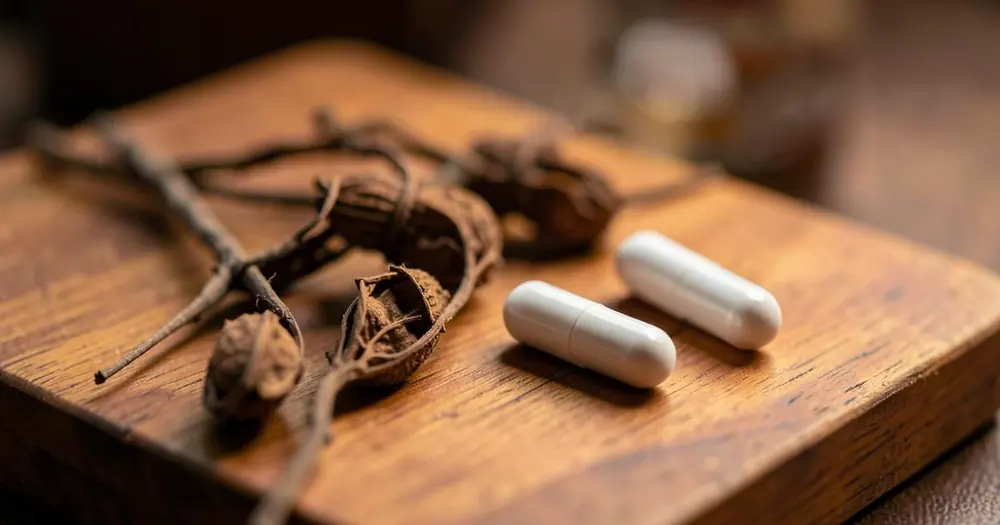
Commercial 5-HTP is extracted from the seeds of the West African plant Griffonia simplicifolia rather than synthesised. Products commonly add vitamin B6, because pyridoxal-5-phosphate is the cofactor for the decarboxylase enzyme that completes the conversion.
The same directness is the problem. Peripheral conversion to serotonin outside the brain is what produces the nausea most users report, and the unregulated nature of the second step is why the interaction with serotonergic drugs is taken seriously.
What the evidence actually shows
The most-cited assessment is a Cochrane review of tryptophan and 5-HTP for depression, which screened 108 trials and found only two — with 64 participants between them — that met basic quality criteria. Those two suggested benefit over placebo, but the reviewers concluded the evidence was insufficient to recommend the supplements over established treatments, particularly given safety questions.
Later narrative reviews of 5-HTP supplementation have made the same point from a pharmacological angle: short half-life, wide inter-individual variation in peripheral conversion, and almost no long-term controlled data. Where trials exist for fibromyalgia, headache or appetite, they are small, old, and rarely replicated.
This is not the same as saying 5-HTP does nothing. It means the honest description is 'plausible mechanism, weak human evidence, meaningful interaction risk' — not 'natural antidepressant'.
- Cochrane: only 2 of 108 screened trials were of adequate quality.
- No long-term controlled safety data in healthy adults.
- Most retail claims outrun the trial base considerably.
Serotonin syndrome and the drugs that matter
Serotonin syndrome is a spectrum, from agitation, sweating, tremor and diarrhea through to hyperthermia, rigidity and cardiovascular instability. It arises from excess serotonergic activity, and it is far more likely when two serotonergic agents are combined than with either alone.
The relevant list is longer than most people expect: SSRIs and SNRIs, tricyclic antidepressants, MAOIs, triptans for migraine, tramadol, linezolid, lithium, dextromethorphan, and St John's wort. Anyone taking any of these should treat 5-HTP as a prescriber's decision rather than a self-care choice.
Carbidopa is a specific case in the other direction: in people taking it for Parkinson's disease, combining it with 5-HTP has been associated with scleroderma-like skin changes in case reports.
The eosinophilia-myalgia history
In 1989 an outbreak of eosinophilia-myalgia syndrome — a serious and sometimes fatal condition — was traced to contaminated L-tryptophan from a single manufacturer. Because 5-HTP is chemically related and shares the serotonin pathway, subsequent testing looked for the same class of contaminant in 5-HTP products, and a peak known as 'peak X' was detected in some samples.
No comparable outbreak has been attributed to 5-HTP, but the episode is the reason supplier quality is a real consideration here rather than a marketing talking point. Products with third-party purity testing are the sensible default, and any new muscle pain with 5-HTP use warrants stopping and getting medical advice.
What the published studies found
Each entry below links straight to the paper or the health authority page so you can read the original rather than take our word for it.
- Shaw K, Turner J, Del Mar C. Tryptophan and 5-hydroxytryptophan for depression. Cochrane Database Syst Rev. 2002.
Systematic review of randomised controlled trials
Of 108 trials identified, only two (64 participants) met quality criteria. Both suggested benefit over placebo, but the reviewers concluded the evidence was insufficient to support routine clinical use.
- Turner EH, Loftis JM, Blackwell AD. Serotonin a la carte: supplementation with the serotonin precursor 5-hydroxytryptophan. Pharmacol Ther. 2006.
Pharmacological review
Reviews 5-HTP pharmacokinetics and clinical use, noting rapid peripheral metabolism, variable response, the short half-life behind divided dosing, and the safety questions that limit recommendations.
Side effects reported in the literature
Commonly reported
- Nausea, the most frequently reported effect, often dose-related
- Diarrhea and abdominal discomfort
- Drowsiness and vivid dreams with evening doses
- Headache
Serious, seek medical advice
- Serotonin syndrome when combined with serotonergic medicines
- Reported scleroderma-like skin changes when combined with carbidopa
- Historical contaminant concerns linked to eosinophilia-myalgia syndrome
Summarized from MedlinePlus herbs and supplements monograph. Report anything unexpected to your own doctor or pharmacist.
Interactions to check with a pharmacist
| Medicine or condition | What sources report |
|---|---|
| SSRIs and SNRIs | Additive serotonergic effect with a risk of serotonin syndrome. Source |
| MAO inhibitors | Considered a high-risk combination for severe serotonin toxicity. Source |
| Triptans and tramadol | Both raise serotonergic activity; combination increases syndrome risk. Source |
| Carbidopa | Case reports describe scleroderma-like skin reactions with the combination. Source |
| Sedatives and alcohol | Additive drowsiness reported with evening use. Source |
This is not a complete interaction list. Check your own medicines with a pharmacist before combining anything.
This page is reference material, not medical advice. Supplements interact with prescription medicines and with each other. Talk to a doctor or pharmacist before starting anything, especially if you are pregnant, breastfeeding, managing a health condition or taking prescription medicine.
Frequently asked questions
How much 5-HTP did studies use?
Published depression trials generally used around 150–300 mg a day in divided doses, and sleep-oriented studies used smaller evening amounts. The Cochrane review that examined this literature found the trial quality too low to support routine use.
Can you take 5-HTP with antidepressants?
Not without medical supervision. Combining 5-HTP with SSRIs, SNRIs, MAOIs, tricyclics, triptans or tramadol raises the risk of serotonin syndrome, which can be life-threatening.
Why does 5-HTP cause nausea?
Much of a dose is converted to serotonin outside the brain, and peripheral serotonin acts on the gut. Splitting the dose and taking it with food are the usual ways people reduce it in practice.
Should 5-HTP be taken at night?
Evening dosing is common because drowsiness is a frequent effect and sleep is a common reason people try it. The short half-life is also why divided dosing appears in the trial literature.
Is 5-HTP safe long term?
There is very little controlled long-term data. The combination of weak efficacy evidence, a real interaction risk and the historical contaminant episode is why most authorities stop short of endorsing ongoing use.
Does 5-HTP need vitamin B6?
B6 is the cofactor for the enzyme that converts 5-HTP to serotonin, which is why many products include it. If yours does, count that B6 toward your daily total — the adult upper limit is 100 mg a day.
Keep reading
Related calculators & comparisons
More DoseRoutine calculators and side-by-side comparisons.
- Peptide calculator
Mix, convert syringe units, build a chart and plan vial supply.
- All calculators
Index of every DoseRoutine calculator and dosing tool.
- Peptide dosage calculator
Convert peptide doses into exact insulin-syringe units.
- Peptide reconstitution
Plan BAC water, concentration and doses per vial.
- Reconstitution calculator
Lightweight standalone reconstitution tool.
- TRT dosage calculator
Weekly testosterone → per-shot volume and syringe units.
Sources
- Shaw K, Turner J, Del Mar C. Tryptophan and 5-hydroxytryptophan for depression. Cochrane Database Syst Rev. 2002;(1):CD003198.
- Turner EH, et al. Serotonin a la carte: supplementation with the serotonin precursor 5-hydroxytryptophan. Pharmacol Ther. 2006;109(3):325–338.
- MedlinePlus, U.S. National Library of Medicine. Herbs and Supplements monograph.
Track your dose in DoseRoutine
Log what you actually take, get reminders at the right time and check interactions against everything else in your stack.
Sign up free →