Hexarelin: What the Research Shows
Researched by DoseRoutine Research TeamReviewed for accuracy by Nicholas Alexander, RSE, SO, PMPLast updated Educational reference only — not medical advice. Always confirm dosing and safety decisions with a licensed clinician.
Hexarelin is a synthetic hexapeptide growth hormone secretagogue that appears constantly in peptide forums and almost never in clinical practice. It is not an approved medicine anywhere, and the most interesting thing the human literature says about it is that it stops working.
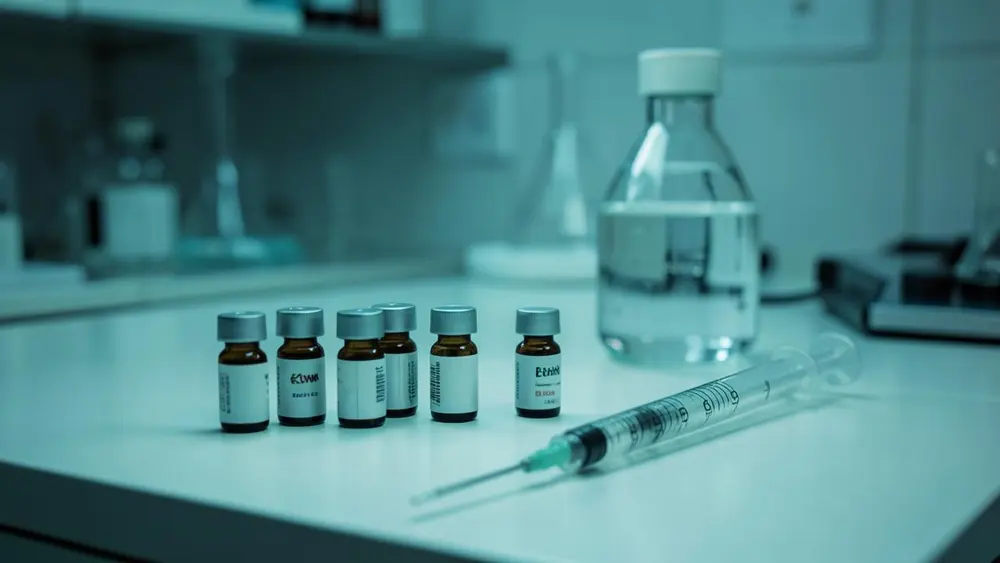
Hexarelin is a ghrelin-receptor (GHS-R1a) agonist that triggers pituitary growth hormone release. Dose-response work in humans showed a clear, rapid GH rise after subcutaneous administration, with responses plateauing at around 1–2 micrograms per kilogram. The critical finding came from longer administration: in a study of continuous hexarelin therapy, the GH response was substantially attenuated within weeks, which is why reported protocols are short and cycled. Hexarelin also stimulates ACTH, cortisol and prolactin release, unlike selective secretagogues such as ipamorelin. It is unapproved for human use, banned in sport under WADA class S2, and no amount described here is a recommendation.
Amounts reported in the published human literature (not recommendations)
| Use case | Amount reported in sources | What to know |
|---|---|---|
| Single-dose GH response studies | Subcutaneous doses around 1–2 µg/kg produced near-maximal GH release | A dose-response study in humans characterised the GH-releasing activity of hexarelin across escalating doses. Source |
| Longer administration | Response attenuated during continued therapy | Growth hormone status during long-term hexarelin therapy showed a markedly reduced GH response over weeks of continuous administration. Source |
| Endocrine side effects | ACTH and cortisol release alongside GH | Comparative work on GHRP-2 and hexarelin documented stimulation of ACTH and cortisol secretion in humans. Source |
| Regulatory status | Not approved for human use; prohibited in sport | Growth hormone secretagogues fall under WADA's prohibited list section S2, in and out of competition. Source |
Figures are amounts reported in the cited sources, not a personal recommendation. Your own amount depends on your health, medicines and blood work.
How a growth hormone secretagogue differs from growth hormone
Injected growth hormone replaces the hormone directly and overrides the body's feedback control. A secretagogue instead asks the pituitary to release its own GH in a pulse, which preserves the negative feedback loop and, in principle, the pulsatile pattern the body normally uses.
Hexarelin acts on GHS-R1a, the ghrelin receptor, the same target used by ipamorelin and GHRP-2. GHRH analogues such as sermorelin, CJC-1295 and tesamorelin act on a different receptor, which is why the two classes are frequently combined in reported protocols to produce a larger combined pulse.
The trade-off with the ghrelin-receptor class is selectivity. Ipamorelin was designed to release GH with minimal effect on other pituitary hormones; hexarelin is potent but promiscuous, raising ACTH, cortisol and prolactin along the way.
Desensitisation is the defining problem
The GH response to hexarelin does not hold. In work on growth hormone status during long-term hexarelin therapy, continued administration produced a substantially blunted GH response compared with the first dose, consistent with receptor downregulation.
That single finding explains most of the folklore around this compound — the short cycles, the washout periods, the escalating doses that people report chasing a fading effect. Increasing the dose after desensitisation mostly increases the cortisol and prolactin exposure rather than restoring the GH pulse.
It also limits any realistic clinical use. A compound whose main effect fades within weeks is difficult to position against approved therapies that maintain their effect.
- Receptor downregulation blunts the GH pulse over weeks
- Dose escalation compounds side effects rather than restoring the response
- Reported protocols are short and cycled specifically because of this
Cortisol, prolactin and the body-composition contradiction
Comparative endocrine studies found that hexarelin and GHRP-2 stimulate ACTH and cortisol secretion in humans, unlike more selective agents. Chronically raised cortisol works directly against the body-composition goals most people are chasing when they take a GH secretagogue.
Prolactin elevation is the other reported effect. Sustained hyperprolactinaemia can suppress libido, disturb mood and, in men, contribute to breast tissue changes.
A safety and efficacy review of growth hormone secretagogues in Sexual Medicine Reviews concluded that this class remains investigational, with limited long-term human safety data, which is a fair summary of where hexarelin sits.
Glucose, IGF-1 and the monitoring clinicians care about
Growth hormone is diabetogenic. It antagonises insulin action, and raising GH pulses can worsen insulin resistance or unmask impaired glucose tolerance. Fasting glucose and HbA1c are therefore the first monitoring anyone should have, with a baseline before anything starts.
IGF-1 is the downstream marker of GH exposure and the reason people with active or previous malignancy are excluded from GH-directed therapy: GH and IGF-1 are growth signals, and raising them with an undiagnosed tumour present is a serious risk.
Prolactin and a morning cortisol complete a sensible panel, given the endocrine profile of this particular peptide.
- Baseline and follow-up fasting glucose and HbA1c
- IGF-1 as the downstream GH exposure marker
- Prolactin and morning cortisol given hexarelin's non-selectivity
Legal status, sport and product quality
Hexarelin is not approved by the FDA, EMA, MHRA or TGA. It is sold as a research chemical, which means no pharmacopoeial standard for identity, purity or endotoxin content applies to what arrives in the post.
In sport, growth hormone secretagogues are prohibited at all times under WADA section S2. This is not a grey area, and detection windows for peptides continue to improve.
Anyone who is pregnant or breastfeeding, has diabetes or impaired glucose tolerance, active or prior cancer, or untreated pituitary disease falls squarely outside anything the literature would support. This page documents what has been published; it is not a protocol to follow, and nothing here replaces an endocrinologist.
What the published studies found
Each entry below links straight to the paper or the health authority page so you can read the original rather than take our word for it.
- Imbimbo BP, Mant T, Edwards M, et al. Growth hormone-releasing activity of hexarelin in humans: a dose-response study. Eur J Clin Pharmacol. 1994;46(5):421–425.
Human dose-response study of subcutaneous hexarelin
Hexarelin produced a rapid, dose-related growth hormone rise, with the response approaching a plateau at the higher doses tested.
- Rahim A, O'Neill PA, Shalet SM. Growth hormone status during long-term hexarelin therapy. J Clin Endocrinol Metab. 1998;83(5):1644–1649.
Longitudinal human study of continued hexarelin administration
The growth hormone response was substantially attenuated during continued therapy, consistent with receptor desensitisation.
- Arvat E, Di Vito L, Maccagno B, et al. Effects of GHRP-2 and hexarelin on ACTH, cortisol and GH secretion in humans. J Endocrinol Invest. 1997;20(7):387–393.
Controlled endocrine challenge study in healthy volunteers
Both peptides stimulated ACTH and cortisol secretion in addition to growth hormone, unlike more selective secretagogues.
- Sigalos JT, Pastuszak AW. The Safety and Efficacy of Growth Hormone Secretagogues. Sex Med Rev. 2018;6(1):45–53.
Narrative review of the secretagogue class
The class remains investigational, with limited long-term human safety data and concerns including insulin resistance and unregulated sourcing.
Side effects reported in the literature
Commonly reported
- Injection-site redness, itching or swelling
- Flushing, transient headache or lightheadedness after dosing
- Increased hunger via ghrelin-receptor activity
- Water retention, joint aches and carpal-tunnel-type symptoms with GH elevation
Serious, seek medical advice
- Raised ACTH, cortisol and prolactin, unlike selective secretagogues
- Worsening insulin resistance or unmasking of impaired glucose tolerance
- Growth signalling risk in anyone with active or previous malignancy
- Unregulated research-chemical sourcing with no purity or sterility guarantee
Summarized from Sigalos & Pastuszak, Sexual Medicine Reviews (2018). Report anything unexpected to your own doctor or pharmacist.
Interactions to check with a pharmacist
| Medicine or condition | What sources report |
|---|---|
| Insulin and diabetes medicines | Growth hormone opposes insulin action; glycaemic control can deteriorate and require review. Source |
| Glucocorticoids | Hexarelin already stimulates ACTH and cortisol; adding exogenous steroid compounds the exposure. Source |
| GHRH analogues (CJC-1295, sermorelin, tesamorelin) | Act on a separate receptor and amplify the combined GH pulse, along with the side-effect profile. Source |
| Anti-doping testing | Prohibited at all times under WADA section S2 for tested athletes. Source |
This is not a complete interaction list. Check your own medicines with a pharmacist before combining anything.
This page is reference material, not medical advice. Supplements interact with prescription medicines and with each other. Talk to a doctor or pharmacist before starting anything, especially if you are pregnant, breastfeeding, managing a health condition or taking prescription medicine.
Frequently asked questions
What is hexarelin?
A synthetic hexapeptide growth hormone secretagogue that activates the ghrelin receptor GHS-R1a and triggers a pituitary GH pulse. It is a research peptide, not an approved medicine in the US, UK, EU, Canada or Australia.
How does hexarelin differ from ipamorelin?
Both act on the same receptor, but hexarelin also stimulates ACTH, cortisol and prolactin, while ipamorelin was designed to be selective for GH release. That selectivity is why ipamorelin is generally preferred for longer use.
Why does hexarelin stop working?
The ghrelin receptor downregulates with repeated stimulation. A study of long-term hexarelin therapy found the GH response was substantially blunted during continued administration, which is the compound's defining practical limitation.
Does hexarelin raise cortisol and prolactin?
Yes. Controlled human work found hexarelin stimulates ACTH and cortisol alongside GH, and prolactin elevation is also reported. Chronically raised cortisol works against the body-composition goals people take it for.
What monitoring makes sense?
Baseline and follow-up fasting glucose and HbA1c, IGF-1, prolactin and a morning cortisol. GH secretagogues can worsen insulin resistance, which is the most likely thing to go wrong quietly.
Is hexarelin legal?
It is not approved for human use by the FDA, EMA, MHRA or TGA and is sold as a research chemical. It is prohibited at all times in sport under WADA section S2, and possession rules vary by country.
Is hexarelin stacked with CJC-1295?
That pairing is commonly reported because the two act on different receptors and produce a larger combined pulse. It also compounds the side-effect profile and stacks the unknowns of two unapproved compounds.
Who should avoid it entirely?
Anyone with active or previous cancer, diabetes or impaired glucose tolerance, untreated pituitary disease, or who is pregnant or breastfeeding. GH and IGF-1 are growth signals.
Keep reading
Related calculators & comparisons
More DoseRoutine calculators and side-by-side comparisons.
- Peptide calculator
Mix, convert syringe units, build a chart and plan vial supply.
- All calculators
Index of every DoseRoutine calculator and dosing tool.
- Peptide dosage calculator
Convert peptide doses into exact insulin-syringe units.
- Peptide reconstitution
Plan BAC water, concentration and doses per vial.
- Reconstitution calculator
Lightweight standalone reconstitution tool.
- TRT dosage calculator
Weekly testosterone → per-shot volume and syringe units.
Sources
- Ghigo E, Arvat E, Muccioli G, Camanni F. Growth hormone-releasing peptides. Eur J Endocrinol. 1997;136(5):445–460.
- Imbimbo BP, et al. Growth hormone-releasing activity of hexarelin in humans: a dose-response study. Eur J Clin Pharmacol. 1994;46(5):421–425.
- Rahim A, O'Neill PA, Shalet SM. Growth hormone status during long-term hexarelin therapy. J Clin Endocrinol Metab. 1998;83(5):1644–1649.
- Arvat E, et al. Effects of GHRP-2 and hexarelin on ACTH, cortisol and GH secretion in humans. J Endocrinol Invest. 1997;20(7):387–393.
- Sigalos JT, Pastuszak AW. The Safety and Efficacy of Growth Hormone Secretagogues. Sex Med Rev. 2018;6(1):45–53.
- World Anti-Doping Agency. The Prohibited List — S2: Peptide Hormones, Growth Factors, Related Substances and Mimetics.
Track your dose in DoseRoutine
Log what you actually take, get reminders at the right time and check interactions against everything else in your stack.
Sign up free →