Vitamin K2 Dosage: How Much MK-7 Per Day?
Researched by DoseRoutine Research TeamReviewed for accuracy by Nicholas Alexander, RSE, SO, PMPLast updated Educational reference only — not medical advice. Always confirm dosing and safety decisions with a licensed clinician.
Vitamin K2 sits in an unusual place: health authorities set intake targets for vitamin K as a whole, while almost all the supplement marketing and most of the trial data concern one specific form, menaquinone-7.
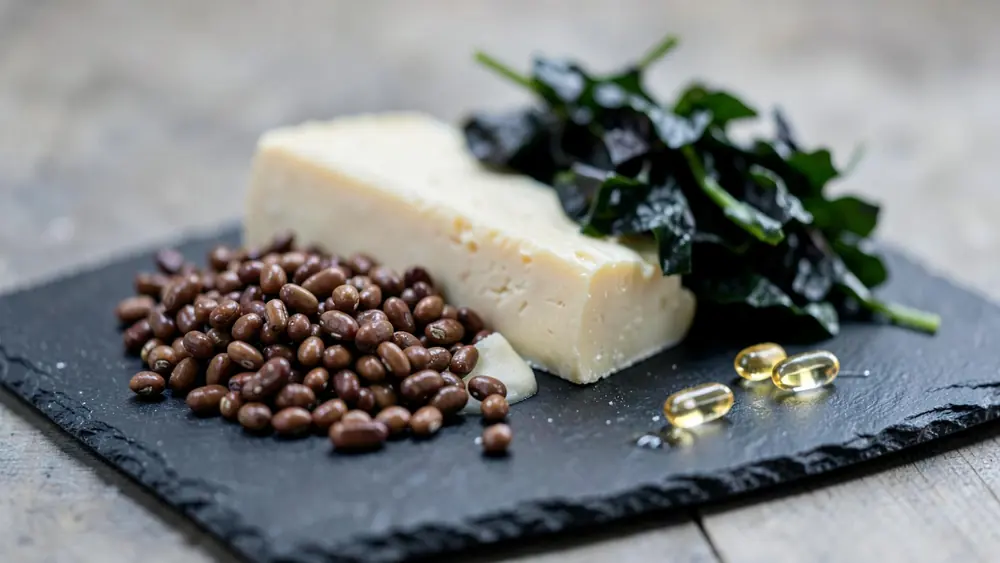
The NIH Office of Dietary Supplements publishes an adequate intake for total vitamin K of 120 micrograms a day for adult men and 90 micrograms a day for adult women. There is no separate requirement for K2 and no tolerable upper intake level, because the Food and Nutrition Board found insufficient evidence to set one. The three-year randomised trial most often cited for bone outcomes used 180 micrograms a day of MK-7 in postmenopausal women. Typical K2 supplements supply 45–200 micrograms of MK-7, or 1,500 micrograms and upwards of MK-4 in Japanese osteoporosis research.
Vitamin K amounts reported in health-authority documents and trials
| Use case | Amount reported in sources | What to know |
|---|---|---|
| Adult men, adequate intake (total vitamin K) | 120 mcg per day | An adequate intake, not an RDA — evidence was insufficient to set one. Source |
| Adult women, adequate intake (total vitamin K) | 90 mcg per day | Applies to K1 and K2 combined; most dietary intake is K1 from greens. Source |
| Upper limit | None established | No tolerable upper intake level has been set for vitamin K. Source |
| MK-7 bone trial (Knapen 2013) | 180 mcg per day for 3 years | Randomised placebo-controlled trial in healthy postmenopausal women. Source |
| Typical supplement label | 45–200 mcg MK-7 per capsule | Often combined with vitamin D3 in the same softgel. Source |
Figures are amounts reported in the cited sources, not a personal recommendation. Your own amount depends on your health, medicines and blood work.
K1, MK-4 and MK-7 are not interchangeable
Vitamin K1 (phylloquinone) comes from leafy greens and dominates dietary intake. Vitamin K2 is a family of menaquinones named by side-chain length: MK-4 is found in animal foods and is what Japanese osteoporosis research used at pharmacological doses, while MK-7 comes from fermented foods such as natto and is the form in most Western supplements.
The practical difference is half-life. MK-4 clears from circulation within hours, which is why the studies using it dosed 45 mg a day in three divided doses. MK-7 has a much longer circulating half-life, so microgram amounts once a day maintain measurable levels. Comparing a 180 mcg MK-7 capsule with a 45 mg MK-4 protocol as if they were the same intervention is a category error.
When you log K2, record the form and the microgram figure. A product listing '100 mcg K2' without saying MK-7 or MK-4 has told you very little.
- K1: leafy greens, main dietary source, short half-life.
- MK-4: animal foods; research doses were milligrams, taken several times a day.
- MK-7: natto and supplements; long half-life, microgram once-daily dosing.
- 'Vitamin K2' on a label without the menaquinone number is incomplete information.
What the bone research actually found
The most cited MK-7 trial is Knapen and colleagues' three-year randomised placebo-controlled study in healthy postmenopausal women, published in Osteoporosis International in 2013. Participants took 180 micrograms of MK-7 a day. The authors reported that MK-7 improved vitamin K status and reduced the age-related decline in bone mineral density at the lumbar spine and femoral neck, alongside changes in vertebral height measures.
That is a single trial in a specific population over a defined period, not a general claim that K2 prevents fractures in everyone. Fracture reduction was not the outcome it was powered to demonstrate, and evidence in men, in younger women and in people already on osteoporosis medication is far thinner.
The NIH ODS is measured on this point: it notes that the relationship between vitamin K and bone health remains an area of ongoing research rather than settled fact.
The arterial calcification claim
The mechanistic argument for K2 is real: matrix Gla protein, which inhibits calcification of soft tissue, requires vitamin K to be carboxylated and functional. Undercarboxylated matrix Gla protein is measurable and rises when vitamin K status is poor.
Where the argument outruns the evidence is the leap from that biomarker to clinical outcomes. Trials measuring arterial stiffness and calcification scores have produced mixed results, and the ODS does not conclude that supplementation prevents cardiovascular events. Marketing that pairs vitamin D with K2 on the premise that K2 'directs calcium away from arteries' is describing a plausible mechanism, not a demonstrated outcome.
None of that makes K2 a bad idea for someone with low intake. It does mean the honest position is 'promising and unresolved' rather than 'proven'.
Warfarin: the one interaction that genuinely matters
Warfarin works by blocking vitamin K recycling. Any change in vitamin K intake — from greens, from K1 supplements, or from K2 — shifts the INR and therefore the anticoagulant effect. The ODS is explicit that people taking warfarin should keep vitamin K intake consistent and discuss supplements with their clinician.
This is not a reason to avoid greens; it is a reason to avoid sudden changes and unannounced supplements. Adding a 180 mcg K2 capsule to a stable warfarin regimen without telling the anticoagulation clinic is the specific behavior to avoid.
Direct oral anticoagulants such as apixaban and rivaroxaban do not act through vitamin K, so this interaction does not apply to them in the same way. Confirm which anticoagulant you are on before assuming either way.
Food sources and who is likely to be low
Natto is by far the richest MK-7 source and supplies more in one serving than most supplements. Hard and soft cheeses, egg yolk, liver and other animal foods supply MK-4 and shorter menaquinones. Gut bacteria produce menaquinones too, though how much of that is absorbed is unclear.
Overt vitamin K deficiency is rare in adults and shows up as bleeding problems. Poorer vitamin K status concentrates in people with fat malabsorption — coeliac disease, cystic fibrosis, cholestatic liver disease, extensive bowel surgery — and in people on long courses of broad-spectrum antibiotics.
Because K2 is fat-soluble, taking it with a meal that contains fat is the sensible default. Taking it with water on an empty stomach reduces what you absorb.
What the published studies found
Each entry below links straight to the paper or the health authority page so you can read the original rather than take our word for it.
- Knapen MHJ, Drummen NE, Smit E, Vermeer C, Theuwissen E. Three-year low-dose menaquinone-7 supplementation helps decrease bone loss in healthy postmenopausal women. Osteoporosis International. 2013.
Three-year randomised, double-blind, placebo-controlled trial
180 micrograms a day of MK-7 improved vitamin K status and reduced the age-related decline in bone mineral density at the lumbar spine and femoral neck compared with placebo in healthy postmenopausal women.
- Office of Dietary Supplements, National Institutes of Health. Vitamin K — Fact Sheet for Health Professionals.
Health-authority reference document
Publishes adequate intakes of 120 mcg (men) and 90 mcg (women), states that no tolerable upper intake level has been established, and documents the warfarin interaction and the unresolved state of bone and cardiovascular evidence.
Side effects reported in the literature
Commonly reported
- Generally well tolerated at supplement amounts in reported trials
- Occasional gastrointestinal upset
- No tolerable upper intake level established, so high-dose safety data are limited
Serious, seek medical advice
- Loss of anticoagulant control in people taking warfarin
- Allergic reaction to a supplement ingredient (rare)
Summarized from NIH Office of Dietary Supplements vitamin K fact sheet. Report anything unexpected to your own doctor or pharmacist.
Interactions to check with a pharmacist
| Medicine or condition | What sources report |
|---|---|
| Warfarin and other vitamin K antagonists | Vitamin K directly opposes the drug's mechanism; intake should stay consistent and changes should be discussed with the anticoagulation clinic. Source |
| Bile acid sequestrants (cholestyramine, colestipol) | Reduce absorption of fat-soluble vitamins including vitamin K. Source |
| Orlistat | Reduces fat absorption and can lower fat-soluble vitamin status. Source |
| Long courses of broad-spectrum antibiotics | Can reduce bacterial menaquinone production in the gut. Source |
This is not a complete interaction list. Check your own medicines with a pharmacist before combining anything.
This page is reference material, not medical advice. Supplements interact with prescription medicines and with each other. Talk to a doctor or pharmacist before starting anything, especially if you are pregnant, breastfeeding, managing a health condition or taking prescription medicine.
Frequently asked questions
How much vitamin K2 should I take per day?
There is no separate requirement for K2. The NIH ODS sets an adequate intake for total vitamin K of 120 micrograms a day for men and 90 micrograms for women. The three-year bone trial most often cited used 180 micrograms a day of MK-7, and typical supplements supply 45–200 micrograms.
Is MK-7 better than MK-4?
They behave differently rather than one simply being better. MK-7 has a long half-life, so microgram amounts once a day maintain levels. MK-4 clears within hours, which is why the research using it gave milligram amounts several times a day. Most Western supplements use MK-7.
Should I take vitamin K2 with vitamin D?
The combination is widely sold and both are fat-soluble, so taking them with the same fat-containing meal is convenient. The claim that K2 redirects calcium away from arteries is based on a plausible mechanism involving matrix Gla protein, not on demonstrated reductions in cardiovascular events.
Can I take vitamin K2 with warfarin?
Not without telling your anticoagulation clinic. Vitamin K opposes how warfarin works, so adding a supplement changes your INR. Direct oral anticoagulants such as apixaban work differently and are not affected in the same way.
Is there an upper limit for vitamin K2?
No tolerable upper intake level has been set, because the Food and Nutrition Board judged the evidence insufficient. That is not the same as proof that any dose is safe — it means high-dose long-term data are limited.
What foods contain vitamin K2?
Natto is the richest source of MK-7 by a wide margin. Hard and soft cheeses, egg yolk and liver supply MK-4 and shorter menaquinones. Leafy greens supply K1 rather than K2.
Does vitamin K2 build bone?
One three-year randomised trial in healthy postmenopausal women reported that 180 micrograms a day of MK-7 slowed the age-related decline in bone mineral density. That is one trial in one population, and the NIH ODS still describes vitamin K and bone health as an area of ongoing research.
Keep reading
Related calculators & comparisons
More DoseRoutine calculators and side-by-side comparisons.
- Peptide calculator
Mix, convert syringe units, build a chart and plan vial supply.
- All calculators
Index of every DoseRoutine calculator and dosing tool.
- Peptide dosage calculator
Convert peptide doses into exact insulin-syringe units.
- Peptide reconstitution
Plan BAC water, concentration and doses per vial.
- Reconstitution calculator
Lightweight standalone reconstitution tool.
- TRT dosage calculator
Weekly testosterone → per-shot volume and syringe units.
Sources
- Office of Dietary Supplements, National Institutes of Health. Vitamin K — Fact Sheet for Health Professionals.
- Knapen MHJ, Drummen NE, Smit E, Vermeer C, Theuwissen E. Three-year low-dose menaquinone-7 supplementation helps decrease bone loss in healthy postmenopausal women. Osteoporos Int. 2013;24(9):2499–2507.
Track your dose in DoseRoutine
Log what you actually take, get reminders at the right time and check interactions against everything else in your stack.
Sign up free →